


























Views
Downloads

Grasshopper Life Cycle Printable Worksheet | Grade 3
Paste this activity's link or code into your existing LMS (Google Classroom, Canvas, Teams, Schoology, Moodle, etc.).
Students can open and work on the activity right away, with no student login required.
You'll still be able to track student progress and results from your teacher account.
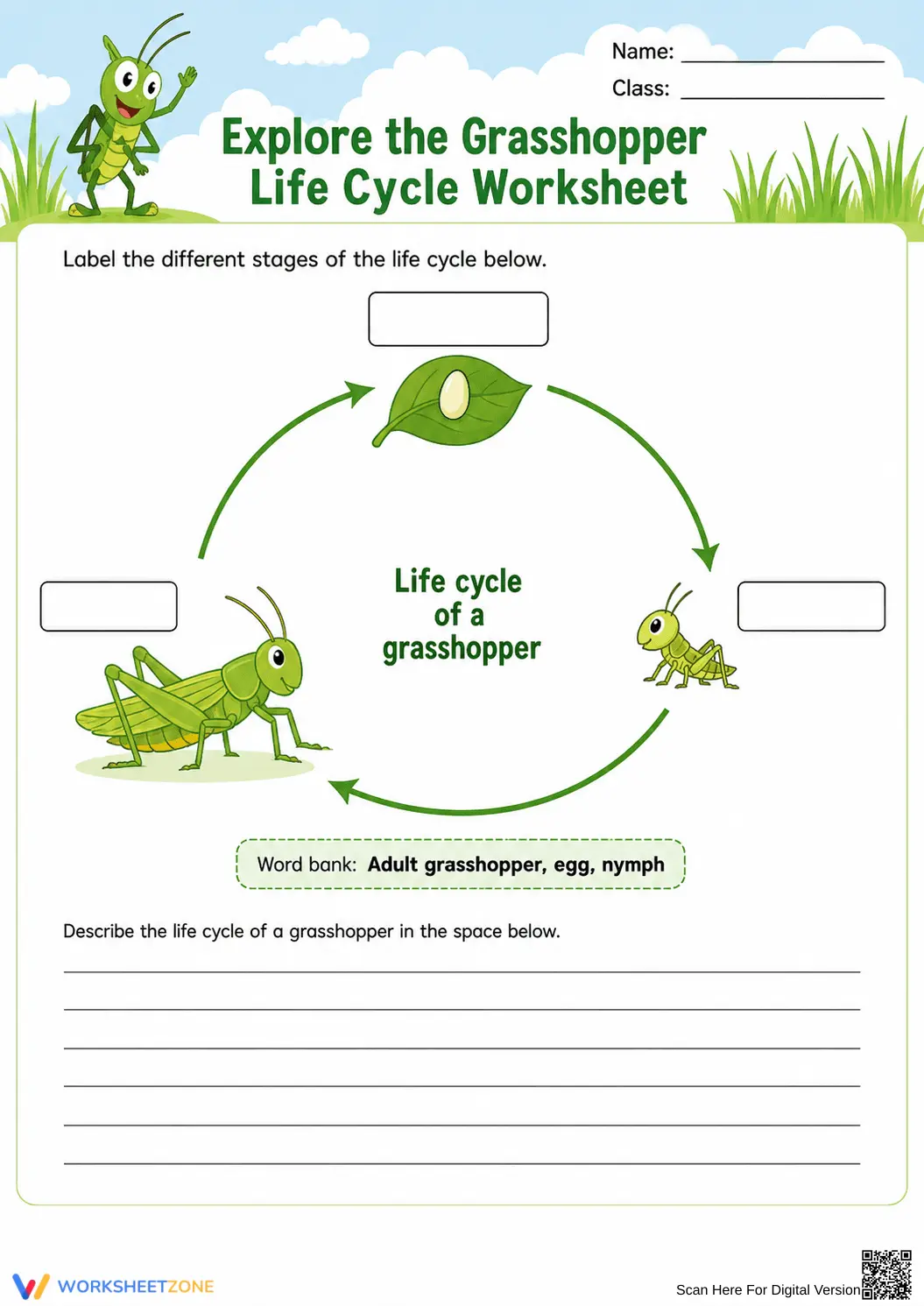
This Grade 3 science worksheet helps students master the stages of incomplete metamorphosis by exploring the grasshopper life cycle. Students will label a clear biological diagram and synthesize their understanding in a short written response, solidifying key vocabulary and scientific observation skills in one focused activity.
At a Glance
- Grade: 3 · Subject: Science
- Standard:
3-LS1-1— Develop models to describe diverse life cycles- Skill Focus: Insect Life Cycles
- Format: 1 page · 4 problems · Answer key included · PDF
- Best For: Independent practice or science centers
- Time: 10–15 minutes
This single-page resource features a clear diagram of a grasshopper's life cycle with three blank labeling boxes. A word bank with "Adult grasshopper," "egg," and "nymph" supports accurate vocabulary usage. Below the diagram, five blank lines prompt students to describe the life cycle, bridging visual identification with scientific writing. An answer key is included.
- Print (1 min): Download the PDF and print a class set. The design ensures crisp copies.
- Distribute (1 min): Hand out during your science block. The word bank lets students begin immediately.
- Review (2 mins): Use the answer key to check labels and assess written summaries.
With under two minutes of prep, this is perfect for sub plans.
This activity aligns to the Next Generation Science Standards, specifically 3-LS1-1: Develop models to describe that organisms have unique and diverse life cycles but all have in common birth, growth, reproduction, and death. By labeling and writing, students model incomplete metamorphosis. Both standard codes can be copied directly into lesson plans, IEP goals, or district curriculum mapping tools.
Deploy this worksheet as independent practice following direct instruction on insect life cycles. It serves as an excellent formative assessment; while students write their paragraphs, observe whether they correctly sequence the egg, nymph, and adult stages. Students should complete both tasks within 10 to 15 minutes.
Designed for third-grade students, this resource is adaptable for second or fourth graders. The word bank provides scaffolding for English Language Learners. Pair this worksheet with a nonfiction reading passage about grasshoppers or an anchor chart comparing complete and incomplete metamorphosis.
Effectively teaching foundational scientific concepts like 3-LS1-1 requires instructional tools that allow students to develop models to describe diverse life cycles. Combining visual diagrams with written explanations significantly enhances vocabulary retention and conceptual understanding in elementary science classrooms. According to Fisher & Frey (2014), providing structured opportunities for students to interact with domain-specific vocabulary through both visual labeling and expressive writing solidifies their grasp of complex biological processes. This specific worksheet facilitates that essential dual-modality learning by requiring students to first identify the distinct stages—egg, nymph, and adult grasshopper—and then articulate the continuous transition between these phases in their own words. By integrating clear visual models with descriptive writing tasks, educators can more accurately assess student comprehension, identify misconceptions early, and ensure that critical science standards are met effectively and efficiently.


