


























Views
Downloads
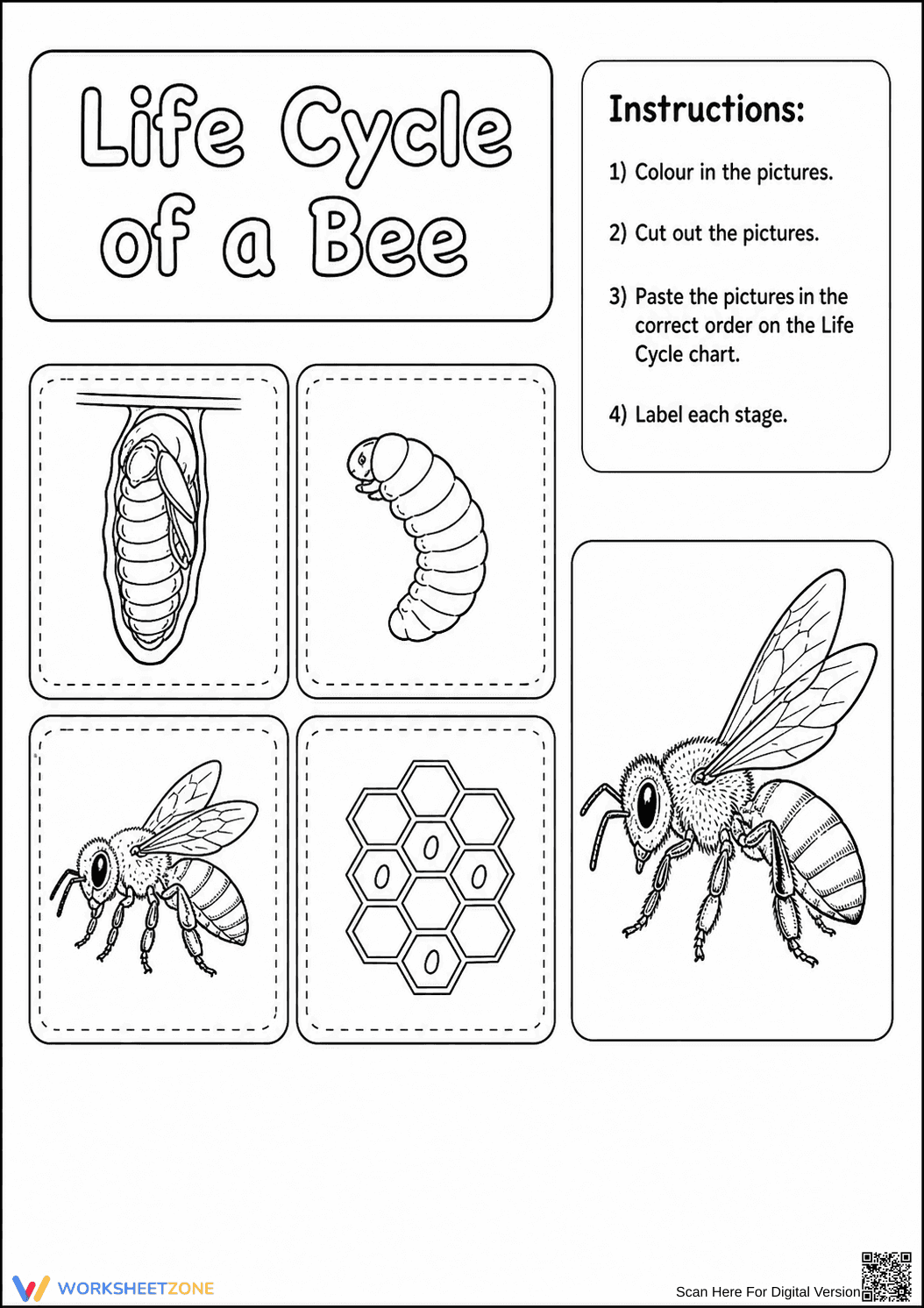

Bee Life Cycle Worksheet | Grade 3 Essential
Paste this activity's link or code into your existing LMS (Google Classroom, Canvas, Teams, Schoology, Moodle, etc.).
Students can open and work on the activity right away, with no student login required.
You'll still be able to track student progress and results from your teacher account.
This Grade 3 bee life cycle worksheet provides a hands-on modeling activity where students sequence biological stages from egg to adult. By engaging in a tactile cut-and-paste exercise, learners internalize the chronological progression of insect development while building scientific vocabulary. It transforms abstract biological concepts into a concrete, visual representation of growth and metamorphosis.
At a Glance
- Grade: 3 · Subject: Science
- Standard:
3-LS1-1— Develop models to describe that organisms have unique and diverse life cycles- Skill Focus: Biological sequencing and labeling
- Format: 1 page · 4 tasks · Answer key included · PDF
- Best For: Independent practice or science centers
- Time: 15–20 minutes
This single-page PDF features four distinct illustrations representing the life cycle of a honeybee: the honeycomb (containing eggs), larva, pupa, and adult bee. The worksheet is designed in high-contrast black and white to facilitate student coloring, which aids in visual identification of anatomical changes. It includes a dedicated instruction panel and four dashed-line cutouts, ensuring students have clear visual cues for the interactive components of the lesson.
Zero-Prep Workflow
- Print: Generate the required number of copies for your class in under 30 seconds.
- Distribute: Provide students with scissors, glue, and crayons for a self-contained activity (1 minute setup).
- Review: Use the completed sequences as a whole-class check or formative assessment to verify mastery (5 minutes).
This streamlined process makes the worksheet an ideal candidate for emergency sub plans or transition periods between core science modules.
The primary focus is 3-LS1-1, which requires students to develop models to describe that organisms have unique and diverse life cycles but all have in common birth, growth, reproduction, and death. This worksheet serves as the "model" component of the standard. Both standard codes can be copied directly into lesson plans, IEP goals, or district curriculum mapping tools.
Use this worksheet as a formative assessment after a direct instruction lesson on pollinators or insect anatomy. As students work, circulate to observe if they correctly identify the pupa stage versus the larva stage, which is a common point of confusion in early biology. It also functions well as a quiet-time activity for early finishers during a broader unit on ecosystems or environmental science.
This resource is tailored for elementary students in grades 2 through 5 who are exploring life sciences. It is particularly effective for kinesthetic learners who benefit from moving physical objects to demonstrate understanding. Pair this with a live "bee cam" video or a non-fiction text about hive roles to provide a comprehensive learning experience for diverse learners.
According to the RAND AIRS 2024 report on elementary science instruction, hands-on modeling activities significantly improve the retention of chronological biological processes compared to passive reading alone. This worksheet aligns with the 3-LS1-1 standard by requiring students to construct a physical representation of the bee life cycle, moving from the egg stage within the honeycomb to the fully developed adult. By integrating fine motor tasks like cutting and pasting with scientific labeling, the resource supports dual-coding theory, where visual and tactile inputs reinforce cognitive schemas. Research from Fisher & Frey (2014) suggests that such scaffolded, interactive tasks are essential for transitioning students from guided instruction to independent mastery of complex scientific systems. This printable provides a structured environment for students to demonstrate their understanding of birth, growth, and development within the animal kingdom, making it a reliable tool for classroom assessment.


