


























Views
Downloads
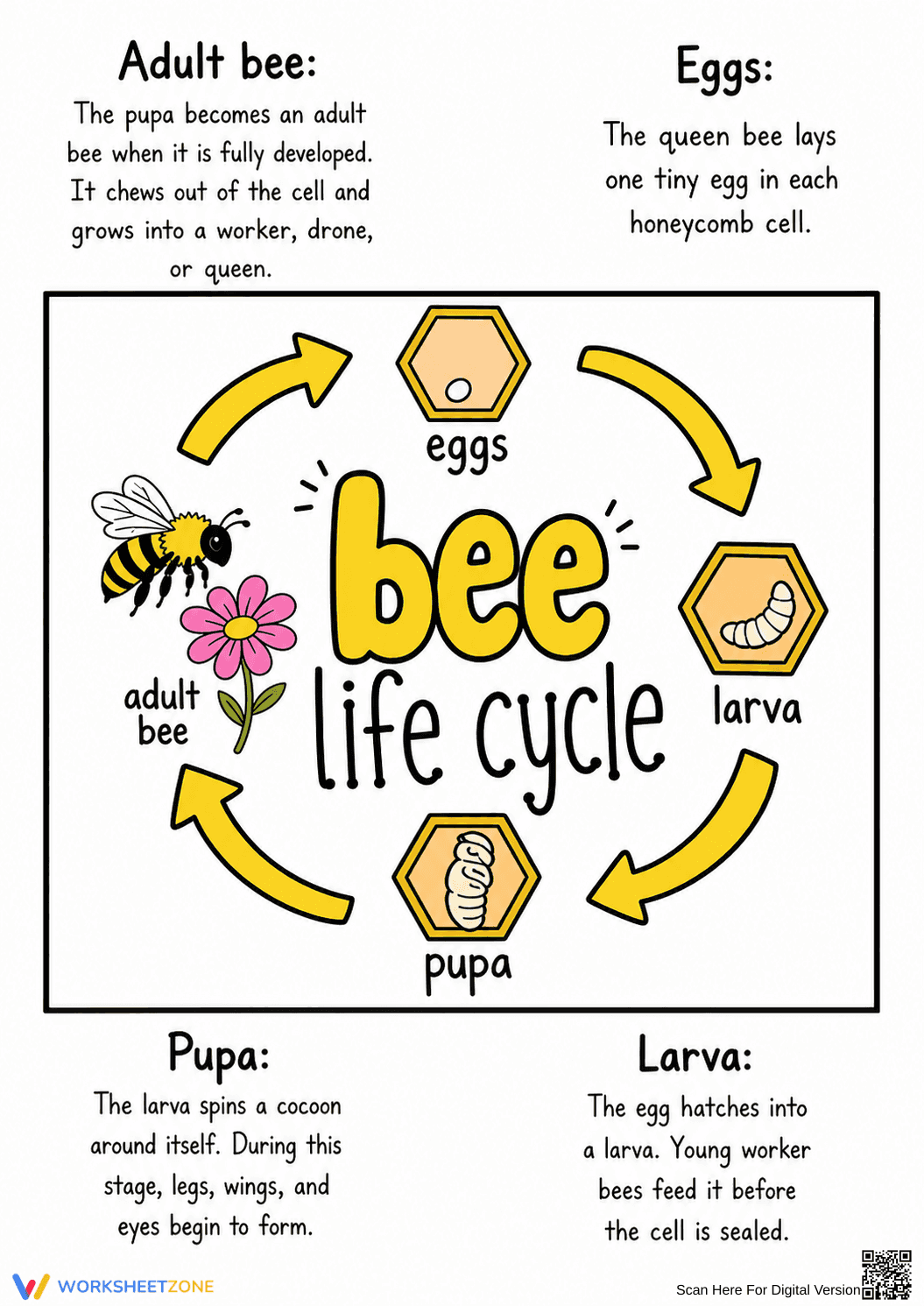

Grade 3 Bee Life Cycle — Printable No-Prep Guide
Paste this activity's link or code into your existing LMS (Google Classroom, Canvas, Teams, Schoology, Moodle, etc.).
Students can open and work on the activity right away, with no student login required.
You'll still be able to track student progress and results from your teacher account.
This Grade 3 science poster provides a clear visual representation of the bee life cycle, helping students master the four distinct stages of development. By studying the transition from egg to adult, young learners gain a foundational understanding of biological growth and metamorphosis through an accessible, highly visual format.
At a Glance
- Grade: 3 · Subject: Science
- Standard:
3-LS1-1— Identify and describe diverse life cycle stages- Skill Focus: Life cycle stage identification
- Format: 1 page · 4 stages · No answer key · PDF
- Best For: Science centers and anchor charts
- Time: 10–15 minutes
This single-page printable features a central diagram illustrating the circular nature of the honeybee life cycle. Surrounding the diagram are four detailed text blocks explaining the specific biological changes occurring at each phase. The layout includes clear labels and descriptions for eggs, larva, pupa, and adult bees, making it an ideal reference tool for student notebooks or classroom displays.
The zero-prep workflow for this resource is designed for maximum efficiency. First, print the high-resolution PDF (30 seconds). Next, distribute copies to students or display the poster on a digital whiteboard (1 minute). Finally, review the four stages as a whole-class activity or use it as a silent reference during independent writing (1 minute). Total teacher preparation time is under three minutes, making it an excellent addition to any sub plan.
This resource is aligned with 3-LS1-1, which requires students to develop models to describe that organisms have unique and diverse life cycles but all have in common birth, growth, reproduction, and death. It also supports RI.3.7 by using information gained from illustrations to demonstrate understanding. Both standard codes can be copied directly into lesson plans, IEP goals, or district curriculum mapping tools.
Use this poster during the direct instruction phase of a science lesson to provide concrete definitions of metamorphosis. Alternatively, place it in a science center as a reference guide for independent research projects. As a formative assessment observation tip, ask students to point to the stage where the bee spins a cocoon to check for reading comprehension. Expect students to spend 10 to 15 minutes engaging with the text and diagram.
This guide is designed for third-grade students but is also highly appropriate for Grade 1 and 2 learners exploring animal traits. It is particularly helpful for English Language Learners who benefit from the strong visual-text pairing. Pair this poster with a live hive observation or a non-fiction reading passage about pollinators for a comprehensive unit.
According to the RAND AIRS 2024 report on elementary science instruction, visual models are critical for helping young learners internalize the cyclical nature of biological processes. This resource focuses on the 3-LS1-1 standard, providing a clear model of the bee life cycle from egg to adult to help students identify and describe diverse life cycle stages. By breaking down the metamorphosis process into four distinct, labeled stages, the poster reduces cognitive load and allows students to focus on the specific characteristics of each phase. High-quality informational graphics serve as essential scaffolds for developing scientific literacy in the primary grades. This printable ensures that students can accurately describe how a pupa develops into a worker, drone, or queen, which is a key component of understanding diverse life cycles. It is a reliable tool for any standards-based science curriculum.


