


























Views
Downloads
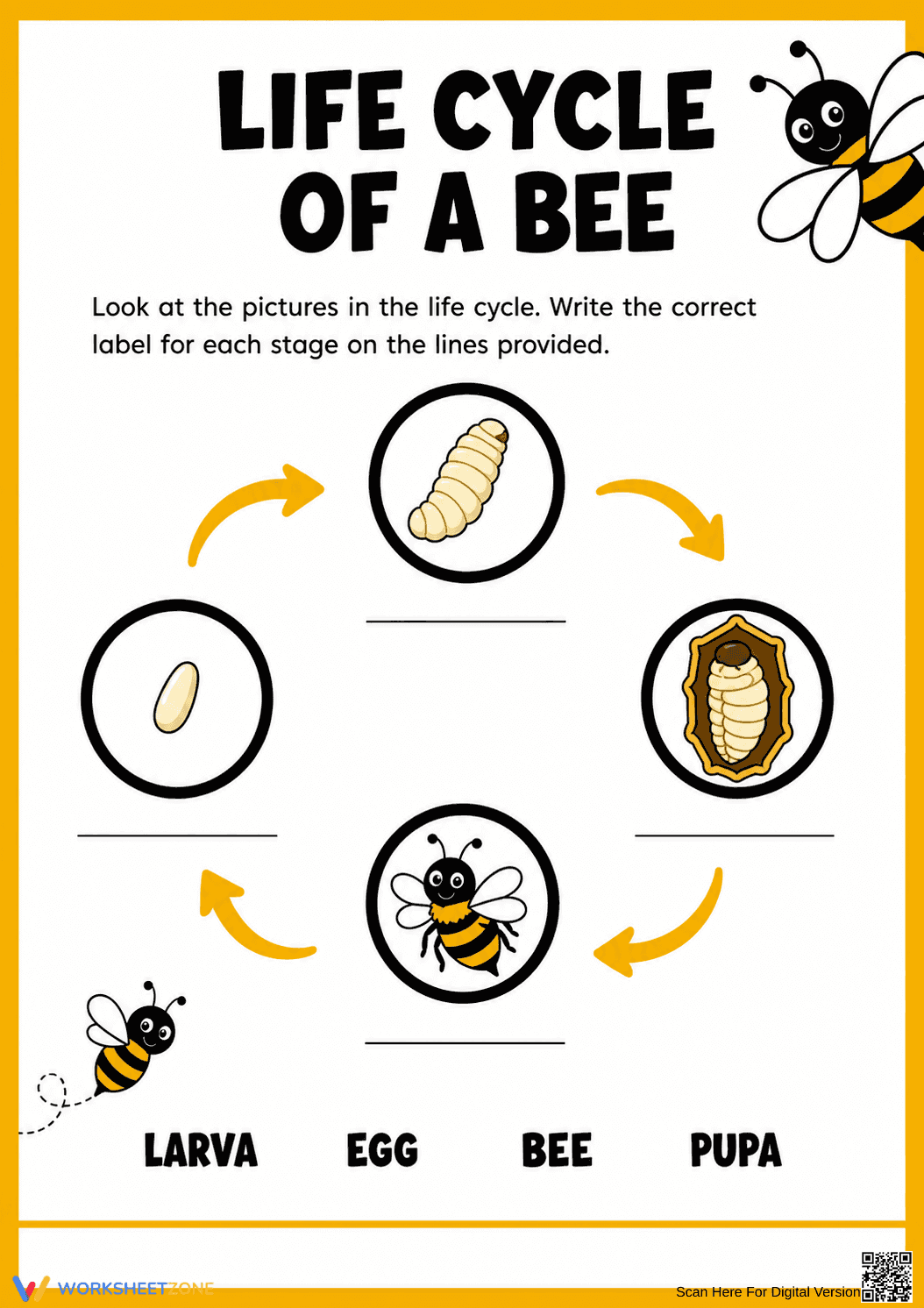

Printable Bee Life Cycle Worksheet | Grade 3 Science
Paste this activity's link or code into your existing LMS (Google Classroom, Canvas, Teams, Schoology, Moodle, etc.).
Students can open and work on the activity right away, with no student login required.
You'll still be able to track student progress and results from your teacher account.
This Grade 3 science worksheet provides students with a clear, visual model to identify and label the four stages of a bee's development. By matching vocabulary words to the correct illustrations, learners build foundational knowledge of insect life cycles and biological sequencing.
At a Glance
- Grade: 3 · Subject: Science
- Standard:
3-LS1-1— Describe that organisms have unique and diverse life cycles- Skill Focus: Labeling life cycle stages
- Format: 1 page · 4 problems · Answer key included · PDF
- Best For: Independent practice or science centers
- Time: 10–15 minutes
This single-page labeling activity features illustrations of a bee's developmental stages. It includes four fill-in-the-blank tasks guided by directional arrows to reinforce the cycle. A word bank provides the terms larva, egg, bee, and pupa, ensuring students have vocabulary support to complete the assignment. An answer key is provided for quick grading.
This resource offers a streamlined workflow:
- Print (1 minute): The design prints beautifully without special formatting.
- Distribute (1 minute): The word bank lets students begin immediately without extensive pre-teaching.
- Review (3 minutes): Use the answer key to quickly check work.
With under two minutes of teacher prep time, this activity is an excellent addition to emergency sub plans.
This worksheet is directly aligned to the Next Generation Science Standard 3-LS1-1, which requires students to develop models to describe that organisms have unique and diverse life cycles but all have in common birth, growth, reproduction, and death. By labeling the cyclical model of a bee, students visually demonstrate their understanding of these biological phases. Both standard codes can be copied directly into lesson plans, IEP goals, or district curriculum mapping tools.
This activity fits perfectly after direct instruction on insect development. Use it as a formative assessment to check if students can accurately sequence the stages. Alternatively, place it in a science center for independent reinforcement. As a formative assessment observation tip, watch if students correctly identify the pupa stage, which is often confused with the larva stage. Expect completion within 10 to 15 minutes.
This resource is primarily designed for third-grade general education students, though it serves as an excellent review for older students or an extension for advanced second graders. The visual supports and word bank make it highly accessible for English Language Learners and students requiring vocabulary accommodations. For a comprehensive lesson, pair this worksheet with a short documentary video on honeybees or an anchor chart detailing the metamorphosis process.
Understanding biological sequencing through visual models is a critical component of early elementary science education. This worksheet directly supports standard 3-LS1-1 by requiring students to describe that organisms have unique and diverse life cycles using a clearly structured diagram. According to a recent ScienceDirect TpT Analysis, instructional materials that combine clear visual representations with targeted vocabulary practice significantly improve student retention of complex scientific processes like metamorphosis. By utilizing a provided word bank and explicit directional arrows, this activity effectively reduces cognitive overload. This intentional design allows young learners to focus entirely on mastering the biological sequence rather than struggling with spelling or rote recall mechanics. This targeted instructional approach ensures that students can confidently articulate the specific stages of a bee's development, building a strong, evidence-based foundation for future life science curricula and broader environmental awareness.


