




























Views
Downloads

Essential Letter X Tracing Worksheet | Kindergarten ELA

Paste this activity's link or code into your existing LMS (Google Classroom, Canvas, Teams, Schoology, Moodle, etc.).
Students can open and work on the activity right away, with no student login required.
You'll still be able to track student progress and results from your teacher account.
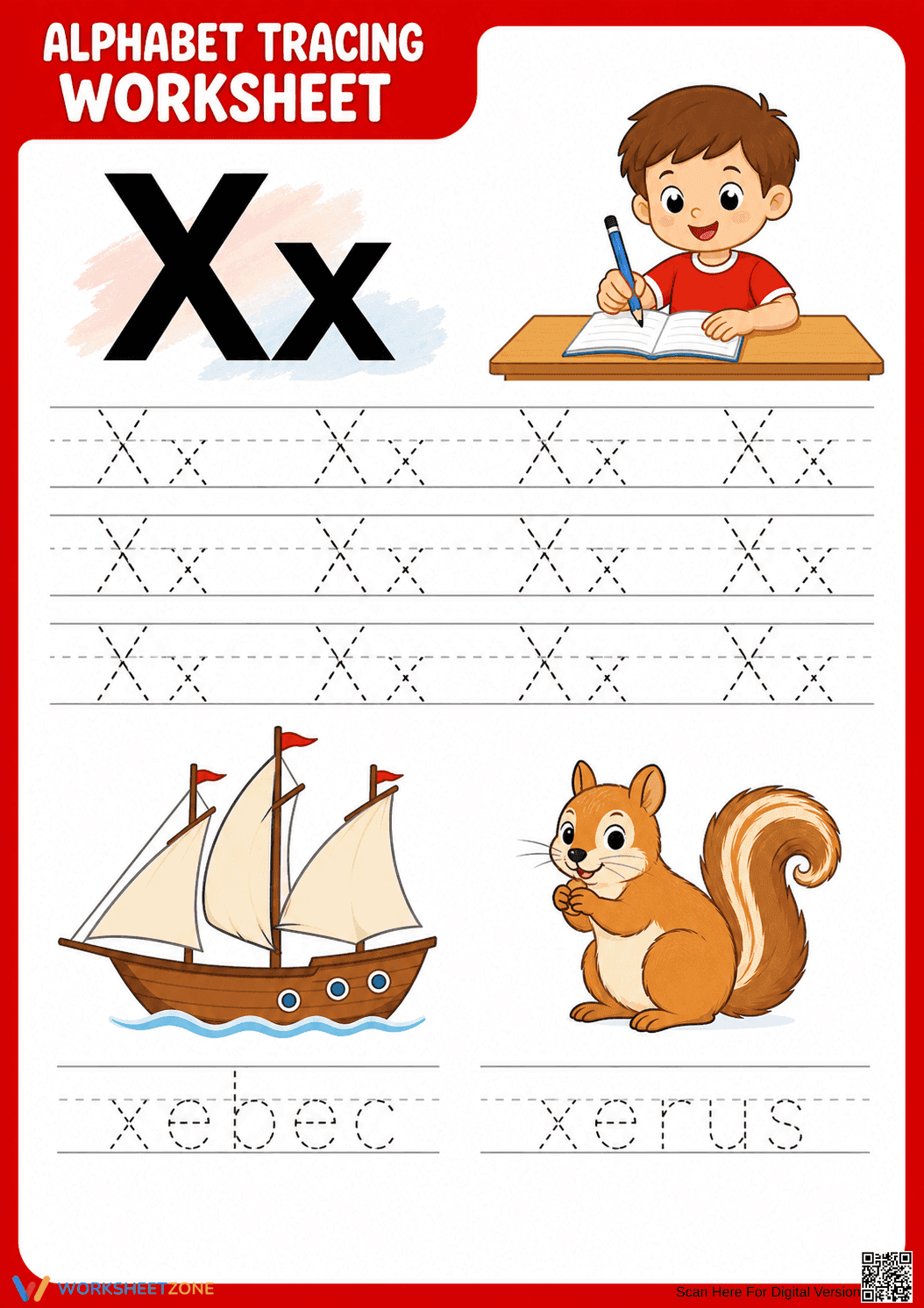
This Kindergarten ELA worksheet provides targeted practice for letter formation and beginning sound recognition for the letter X. Students develop fine motor control through repetitive tracing of uppercase and lowercase letters while connecting the sound to unique vocabulary. This resource ensures students master the specific strokes required for legible handwriting and phonemic awareness.
At a Glance
- Grade: Kindergarten · Subject: ELA
- Standard:
CCSS.ELA-LITERACY.L.K.1.A— Print many upper- and lowercase letters of the alphabet accurately- Skill Focus: Letter X formation and phonics
- Format: 1 page · 14 tasks · Answer key not required · PDF
- Best For: Independent morning work or literacy centers
- Time: 10–15 minutes
The worksheet features three rows for tracing the letter X in uppercase and lowercase forms. Below, students trace "xebec" and "xerus." Each word includes an illustration to provide visual context, helping students associate the letter X with its initial sound. The layout is clean and distraction-free for young learners, ensuring they stay focused on the task at hand.
This resource is designed for a zero-prep workflow. First, print the single-page PDF (30 seconds). Second, distribute the sheets to students during your literacy block (1 minute). Finally, review the letter formation by walking the room to provide immediate feedback on pencil grip and stroke order (5 minutes). Total teacher prep time is under two minutes, making it an ideal sub-plan addition.
This worksheet aligns with `CCSS.ELA-LITERACY.L.K.1.A`, which requires students to print many upper- and lowercase letters. It also supports `CCSS.ELA-LITERACY.RF.K.1.D` by reinforcing the recognition of alphabet letters. Both standard codes can be copied directly into lesson plans, IEP goals, or district curriculum mapping tools to ensure compliance with national requirements.
Use this worksheet as a formative assessment during the "You Do" phase of a lesson. Observe students as they trace the diagonal lines of the letter X to identify those struggling with crossing the midline. It also serves as an excellent quiet activity for early finishers or as a simple homework assignment to reinforce the letter of the week during phonics instruction.
This activity is ideal for Kindergarten students beginning their handwriting journey, as well as Grade 1 and 2 students who require remedial fine motor support. It is particularly useful for English Language Learners (ELLs) who benefit from the visual cues provided by the xebec and xerus illustrations. Pair this with a letter X anchor chart for maximum instructional impact.
Research from Fisher & Frey (2014) emphasizes the importance of guided practice in the acquisition of foundational literacy skills. By providing structured tracing paths, this worksheet reduces the cognitive load on early learners, allowing them to focus on the mechanics of letter formation. Handwriting remains a critical component of literacy development, as the physical act of writing letters by hand is linked to better letter recognition and reading fluency. According to the RAND AIRS 2024 report, consistent exposure to alphabet tracing in early childhood education significantly predicts later spelling and writing proficiency. This worksheet utilizes a research-backed approach by combining visual stimuli with repetitive motor tasks, ensuring that students internalize the shape and sound of the letter X. This systematic practice is essential for building the muscle memory required for fluent, legible writing in subsequent grades.


