


























Views
Downloads
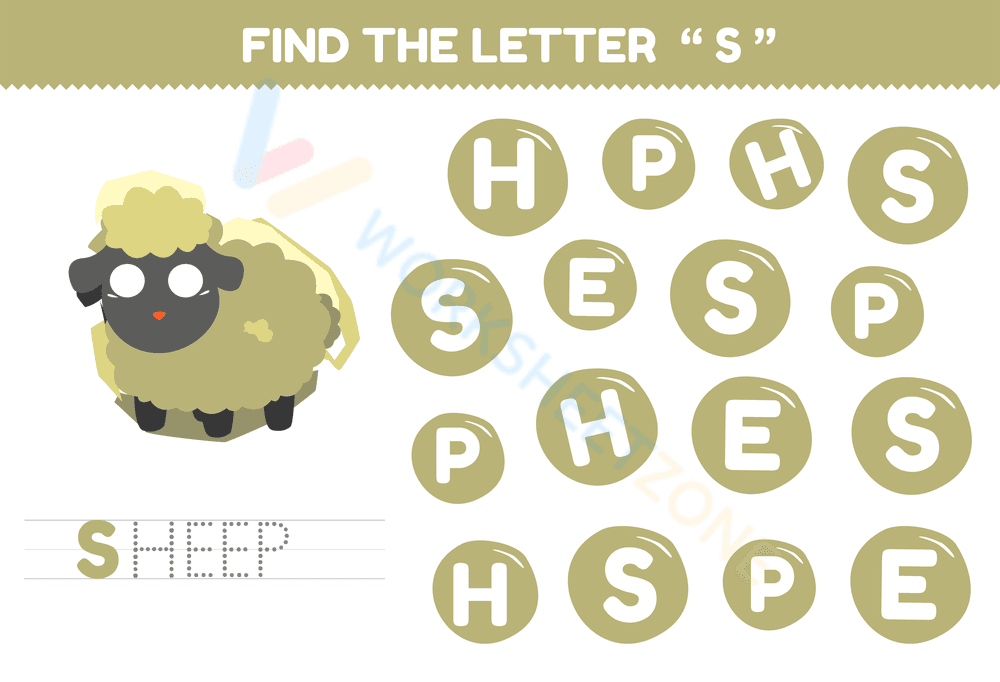

Printable Letter S Tracing Worksheet | Pre-K & K
Paste this activity's link or code into your existing LMS (Google Classroom, Canvas, Teams, Schoology, Moodle, etc.).
Students can open and work on the activity right away, with no student login required.
You'll still be able to track student progress and results from your teacher account.
This foundational letter recognition worksheet helps early learners identify and write the letter S. By combining visual scanning with guided handwriting practice, students strengthen their phonics knowledge and fine motor control. The engaging sheep theme keeps young readers focused while they master essential alphabet skills.
At a Glance
- Grade: K · Subject: ELA
- Standard:
CCSS.ELA-LITERACY.RF.K.1.D— Recognize and name all uppercase and lowercase letters- Skill Focus: Letter Recognition & Tracing
- Format: 1 page · 16 problems · No answer key · PDF
- Best For: Morning work or centers
- Time: 10–15 minutes
What's Inside
This single-page printable features two distinct task types designed for early childhood development. First, students trace the word "SHEEP" using dotted guidelines to practice proper letter formation and pencil grip. Next, they complete a visual discrimination activity by scanning 15 letter bubbles to find and identify every uppercase "S" hidden among distractors like H, P, and E.
Zero-Prep Workflow
This resource is designed for immediate classroom implementation with a simple three-step workflow:
- Print: Generate the PDF in seconds, requiring zero teacher preparation or special materials.
- Distribute: Hand out the pages during morning arrival or literacy centers, taking less than two minutes of instructional time.
- Review: Assess student work quickly by glancing at the circled letters and traced words, making it an ideal, self-explanatory activity for substitute teacher plans.
Standards Alignment
Aligned to primary standard CCSS.ELA-LITERACY.RF.K.1.D, this activity requires students to recognize and name all upper- and lowercase letters of the alphabet. It also supports foundational handwriting expectations by having children print letters. Both standard codes can be copied directly into lesson plans, IEP goals, or district curriculum mapping tools.
How to Use It
Deploy this worksheet during independent literacy centers after introducing the letter S through direct instruction. It serves as an excellent formative assessment tool; teachers can observe students' pencil grip during the tracing portion and note their accuracy in distinguishing the target letter from similar shapes. Expect students to complete the activities within 10 to 15 minutes.
Who It's For
This resource is primarily designed for Kindergarten students and Pre-K learners who are beginning their alphabet journey. It provides necessary repetition for students needing extra support with visual discrimination. Pair this worksheet with a read-aloud book featuring sheep or farm animals to create a cohesive, thematic literacy lesson.
Mastering alphabet knowledge through activities aligned to CCSS.ELA-LITERACY.RF.K.1.D is a critical predictor of later reading success. When students recognize and name all uppercase and lowercase letters, they build the automaticity required for fluent decoding. According to Fisher & Frey (2014), combining visual discrimination tasks with physical handwriting practice significantly improves letter retention in early childhood education. This dual-modality approach ensures that learners not only see the letter S but also commit its shape to muscle memory. By integrating tracing with a targeted search-and-find activity, educators provide the structured repetition necessary for foundational literacy. This evidence-based method supports cognitive development and prepares young readers for more complex phonemic awareness tasks, establishing a strong baseline for future academic achievement.


