


























Views
Downloads
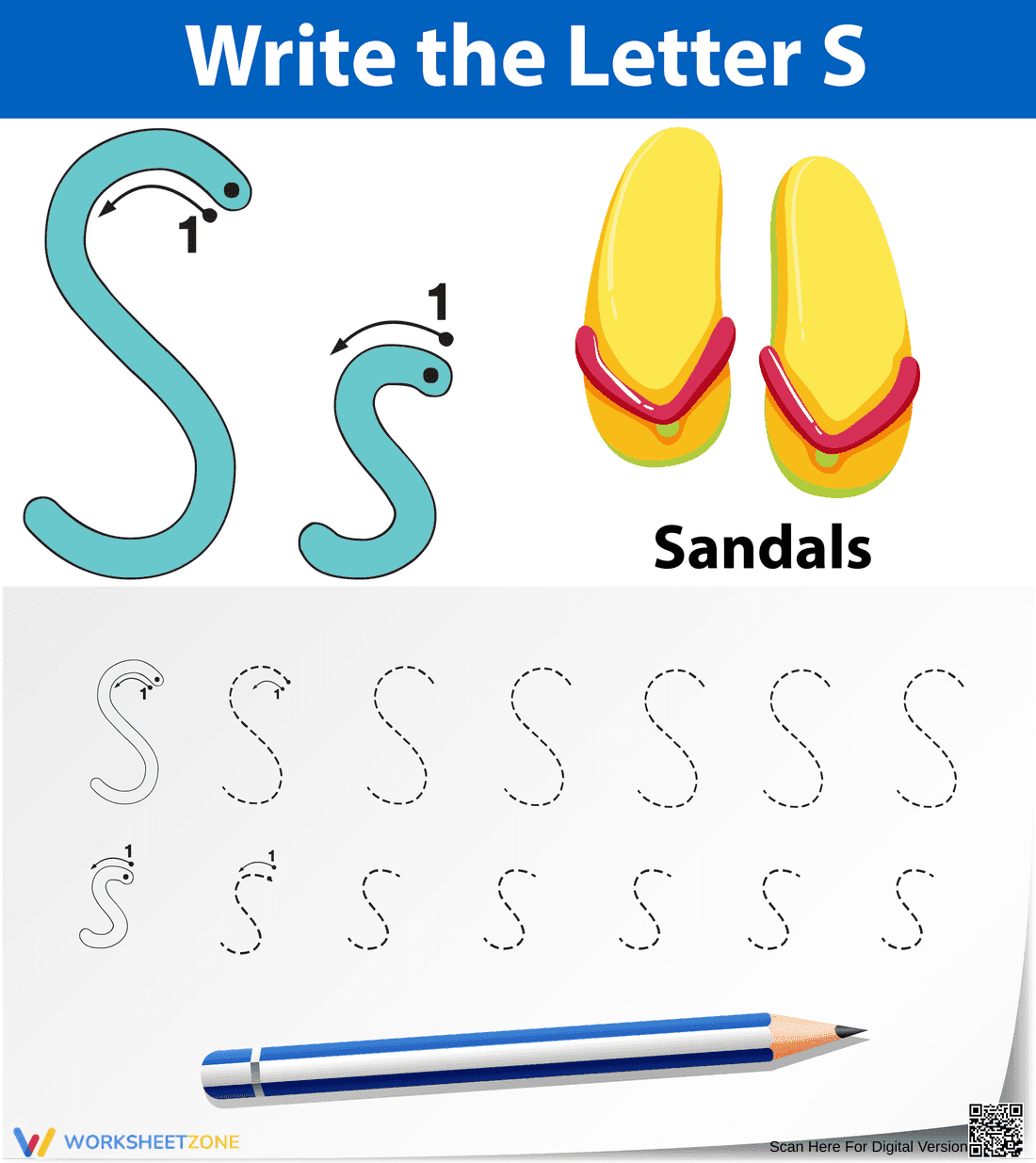

Letter S Tracing Worksheet | Essential Kindergarten Ready
Paste this activity's link or code into your existing LMS (Google Classroom, Canvas, Teams, Schoology, Moodle, etc.).
Students can open and work on the activity right away, with no student login required.
You'll still be able to track student progress and results from your teacher account.
This Kindergarten Letter S handwriting worksheet provides immediate practice for early learners to master uppercase and lowercase letter formation. By combining visual cues with tactile tracing, students develop the muscle memory required for legible writing. This resource ensures students transition from guided tracing to independent strokes effectively.
At a Glance
- Grade: Kindergarten · Subject: Handwriting
- Standard:
CCSS.ELA-LITERACY.L.K.1.A— Print many upper- and lowercase letters accurately- Skill Focus: Letter S Formation
- Format: 1 page · 14 problems · Answer key included · PDF
- Best For: Daily morning work or literacy centers
- Time: 5–10 minutes
This single-page PDF features a clear "S is for Sandals" visual anchor to reinforce phonemic awareness alongside graphomotor skills. The worksheet includes 7 uppercase and 7 lowercase tracing tasks. Each row begins with a directional arrow guide numbered "1" to show students exactly where to start their pencil stroke, preventing common reversal errors and promoting proper D'nealian or standard manuscript habits.
Teachers can implement this resource in under 2 minutes. First, print the single-page PDF for your entire class or small group. Second, distribute the sheets during your phonics block or as a quiet transition activity. Finally, review the letter formation by checking for consistent curves and proper alignment within the invisible mid-line, providing immediate verbal feedback to students as they work.
The primary focus is `CCSS.ELA-LITERACY.L.K.1.A`, which requires students to print many upper- and lowercase letters. This worksheet specifically targets the "S" character, ensuring students understand the distinct shapes of both cases. This standard code can be copied directly into lesson plans, IEP goals, or district curriculum mapping tools to ensure compliance with state and national literacy frameworks.
Use this worksheet during the "I Do" phase of a handwriting lesson to demonstrate the "snake-like" curve of the letter S. It also serves as an excellent formative assessment tool; observe students as they trace to identify those struggling with grip or stroke direction. Completion typically takes 5 to 10 minutes, making it a perfect fit for high-frequency rotation schedules.
This resource is designed for Preschool and Kindergarten students who are beginning their literacy journey. It is also highly effective for Grade 1 students requiring remedial handwriting support or Occupational Therapy (OT) students working on fine motor control. Pair this with a letter-sound anchor chart or a tactile sand tray activity for maximum instructional impact.
Research by Fisher & Frey (2014) emphasizes the importance of the gradual release of responsibility, which is mirrored in the structured tracing provided here. By using numbered directional cues, this worksheet reduces the cognitive load on early writers, allowing them to focus on precision. According to the RAND AIRS 2024 report, consistent, short-burst practice in letter formation is a significant predictor of later reading fluency and written expression. This worksheet provides 14 specific opportunities for students to engage in this high-leverage practice. The inclusion of the CCSS.ELA-LITERACY.L.K.1.A standard ensures that the activity is not merely busy work but a foundational step toward meeting national literacy benchmarks. Educators can confidently integrate this into a comprehensive ELA curriculum, knowing it supports the mechanical requirements of early writing as identified by NAEP frameworks for primary grade success.


