


























Views
Downloads

Grade 1 Cursive M — Printable No-Prep Worksheet
Paste this activity's link or code into your existing LMS (Google Classroom, Canvas, Teams, Schoology, Moodle, etc.).
Students can open and work on the activity right away, with no student login required.
You'll still be able to track student progress and results from your teacher account.
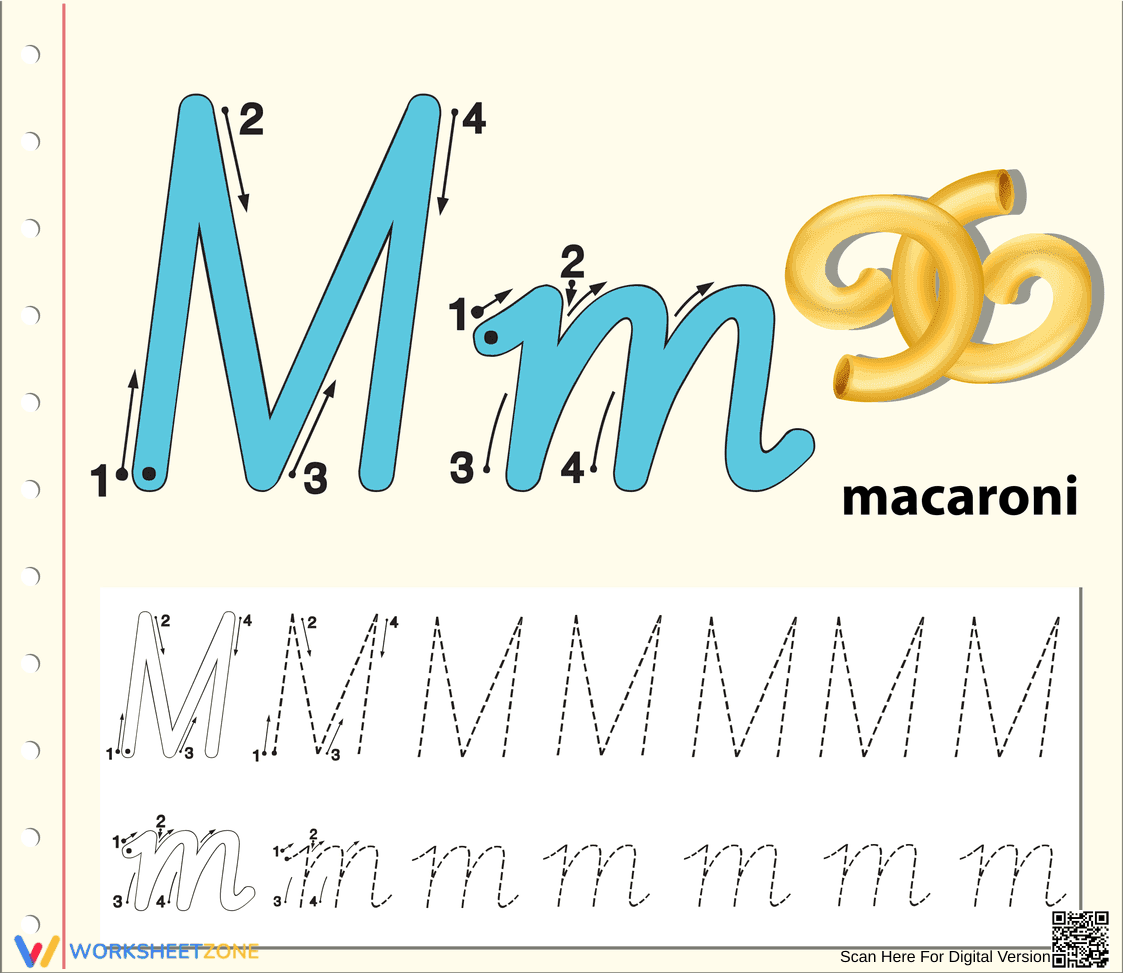
Master the art of cursive handwriting with this focused letter M practice sheet. This resource helps first-grade students develop the fine motor control necessary for fluid script writing. By following the numbered stroke guides, learners build muscle memory for both uppercase and lowercase cursive forms, ensuring a solid foundation for future writing speed and legibility.
At a Glance
- Grade: 1 · Subject: English
- Standard:
CCSS.ELA-LITERACY.L.1.1.A— Print all upper- and lowercase letters with proper formation and spacing- Skill Focus: Cursive letter M formation
- Format: 1 page · 16 problems · Answer key included · PDF
- Best For: Morning work or handwriting centers
- Time: 10–15 minutes
This single-page PDF features a macaroni theme to provide a memorable mnemonic for the letter M. The top section displays large-scale models of uppercase and lowercase cursive M with numbered arrows indicating stroke direction. Below, students find two rows of dotted-line tracing tasks: 8 uppercase and 8 lowercase letters. The clear, uncluttered layout prevents visual overwhelm for young learners while providing sufficient repetition for mastery.
This worksheet is designed for immediate classroom implementation. First, print the single-page PDF (30 seconds). Second, distribute the sheets to students during a handwriting block or as a transition activity (1 minute). Third, provide a quick visual review of the stroke order shown at the top of the page (1 minute). Total teacher preparation time is under 3 minutes, making it an ideal choice for busy mornings or unexpected sub plans.
This resource aligns with `CCSS.ELA-LITERACY.L.1.1.A`, which requires students to demonstrate command of the conventions of standard English grammar and usage when writing, specifically focusing on letter formation. While many districts introduce cursive as an extension of this standard, the focus on stroke order and letter consistency supports general fine motor development. Both standard codes can be copied directly into lesson plans, IEP goals, or district curriculum mapping tools.
Use this worksheet during the independent practice phase of a handwriting lesson after demonstrating the letter M on a whiteboard. It serves as an excellent formative assessment tool; observe students as they trace to ensure they are following the correct stroke sequence rather than drawing the letters. Completion typically takes 10 to 15 minutes, depending on the student's fine motor proficiency and focus.
This practice page is perfect for first-grade students beginning their cursive journey or older students needing remedial handwriting support. It pairs naturally with an alphabet anchor chart or a short reading passage featuring M words like macaroni, moon, or mountain. The visual cues make it accessible for English Language Learners who are familiarizing themselves with the English alphabet.
Handwriting instruction remains a critical component of early literacy, as research from Fisher & Frey (2014) emphasizes the link between manual letter production and word recognition. This worksheet targets CCSS.ELA-LITERACY.L.1.1.A by providing 16 structured tracing opportunities for the cursive letter M. By utilizing numbered stroke guides, the resource scaffolds the learning process, allowing students to internalize the complex movements required for cursive fluency. Systematic practice of this nature is shown to improve writing endurance and cognitive load management during later composition tasks. According to recent NAEP data, students who develop early handwriting automaticity often perform better in overall writing assessments. This resource provides the necessary repetition to move students toward that mastery while requiring zero teacher preparation time, making it a highly efficient tool for the modern primary classroom.


