


























Views
Downloads

Letter M Beginning Sound Printable | Grade K ELA
Paste this activity's link or code into your existing LMS (Google Classroom, Canvas, Teams, Schoology, Moodle, etc.).
Students can open and work on the activity right away, with no student login required.
You'll still be able to track student progress and results from your teacher account.
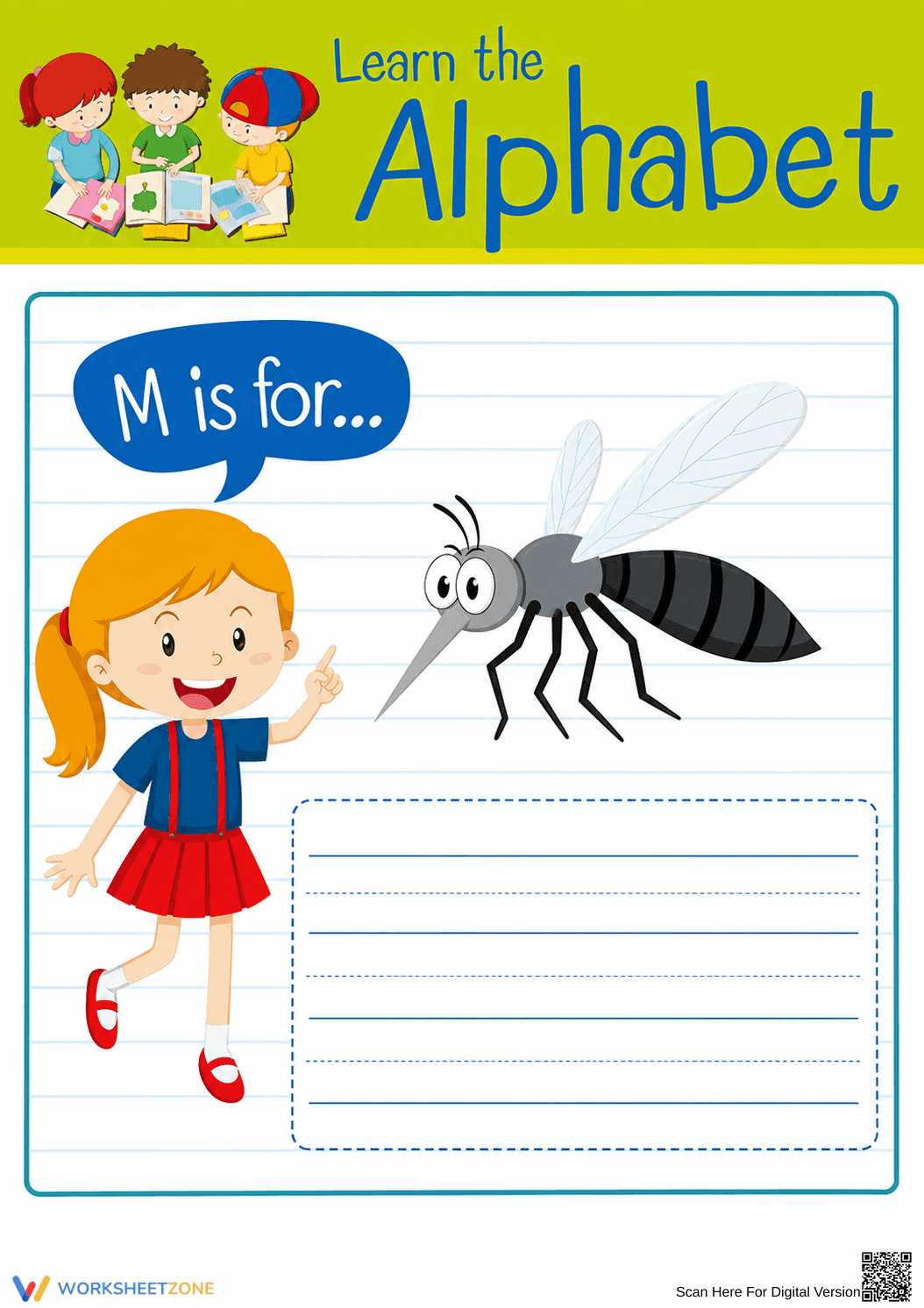
This printable Grade K phonics worksheet helps early readers master the letter M beginning sound while practicing their handwriting skills. Students connect the visual cue of a mosquito to the target consonant, reinforcing letter-sound correspondence and building foundational literacy skills in a highly accessible format.
At a Glance
- Grade: K · Subject: ELA
- Standard:
CCSS.ELA-LITERACY.RF.K.3.A— Produce primary sounds for consonants- Skill Focus: Letter M Beginning Sound
- Format: 1 page · 1 task · No answer key needed · PDF
- Best For: Independent phonics practice
- Time: 5–10 minutes
Inside this single-page resource, educators will find a clear phonics activity centered on the letter M. The page features a colorful illustration of a mosquito alongside a speech bubble prompting "M is for...". Below the visual cue, four sets of primary handwriting lines provide space for students to practice writing the letter M or simple words. The layout is distraction-free, ensuring young learners stay focused on the target phonics skill.
Zero-Prep Workflow
This worksheet is designed for immediate classroom implementation.
- Print (1 minute): Download the PDF and print.
- Distribute (1 minute): Hand out the worksheets. The intuitive layout means students immediately understand the task.
- Review (3 minutes): Quickly check student handwriting and phonetic understanding.
With a total prep time of under two minutes, this resource is an excellent addition to emergency sub plans or morning work routines.
Standards Alignment
This resource is directly aligned to CCSS.ELA-LITERACY.RF.K.3.A, requiring students to demonstrate basic knowledge of one-to-one letter-sound correspondences by producing the primary sound or many of the most frequent sounds for each consonant. It also supports early handwriting development by providing structured writing space. Both standard codes can be copied directly into lesson plans, IEP goals, or district curriculum mapping tools.
How to Use It
Deploy this worksheet during morning work to activate prior knowledge about the alphabet. Alternatively, use it as an independent literacy center activity where students practice writing words starting with M. As a formative assessment tip, observe students to ensure they use proper letter formation and can verbally identify the "mmm" sound. Expected completion time is 5 to 10 minutes.
Who It's For
This worksheet is primarily designed for Kindergarten students developing their initial phonics and handwriting skills. It also serves as a helpful intervention tool for first-grade students who need additional reinforcement with consonant sounds. For differentiation, teachers can challenge advanced learners to write a complete sentence about the mosquito, while students needing support can focus solely on tracing or writing the uppercase and lowercase letter M. Pair this activity with a read-aloud book featuring heavy M-alliteration to maximize phonetic exposure.
Mastering early phonics skills, such as the letter M beginning sound, is a critical milestone in early childhood literacy. According to a comprehensive EdReports 2024 analysis of foundational reading programs, explicit instruction in letter-sound correspondence significantly accelerates decoding proficiency in young learners. By aligning with CCSS.ELA-LITERACY.RF.K.3.A to produce primary sounds for consonants, this worksheet provides the targeted, repetitive practice necessary for phonetic mastery. The integration of visual cues, like the mosquito illustration, alongside structured handwriting lines ensures that cognitive connections between the auditory sound and the physical letter formation are strengthened. This dual-modality approach supports diverse learning profiles and builds the automaticity required for fluent reading. Utilizing targeted, standards-based materials in early education establishes a robust framework for future academic success and reading comprehension.


