


























Views
Downloads
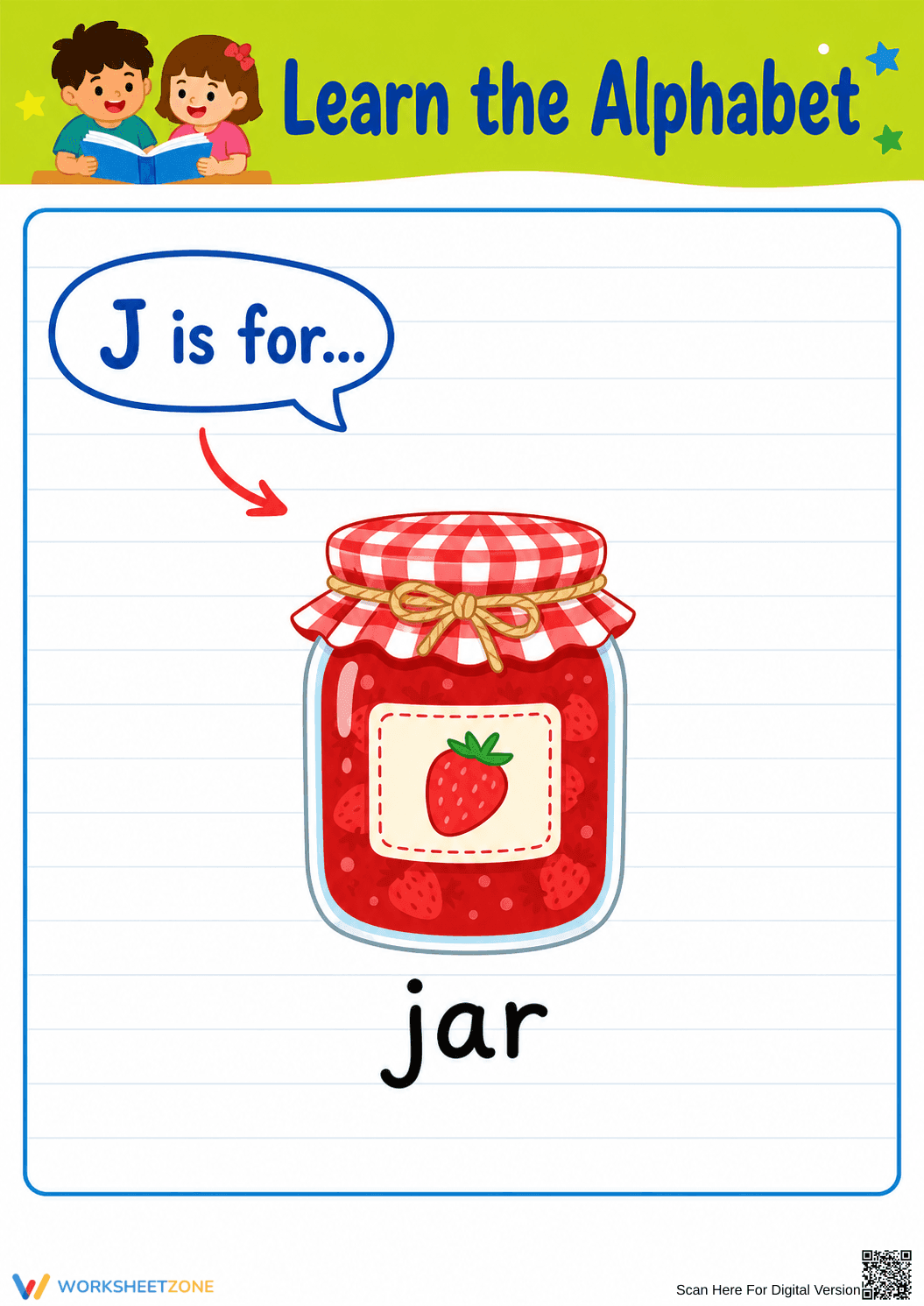

Printable Letter J Beginning Sound Worksheet | Grade K
Paste this activity's link or code into your existing LMS (Google Classroom, Canvas, Teams, Schoology, Moodle, etc.).
Students can open and work on the activity right away, with no student login required.
You'll still be able to track student progress and results from your teacher account.
This foundational phonics resource helps early learners master the beginning sound of the letter J. By connecting the visual representation of the letter to a familiar object, students build essential letter-sound correspondence skills. This single-page printable provides a clear, distraction-free focus on the target consonant to strengthen early reading readiness.
At a Glance
- Grade: K · Subject: ELA
- Standard:
CCSS.ELA-LITERACY.RF.K.3.A— Produce the primary sound for each consonant- Skill Focus: Letter J Beginning Sound
- Format: 1 page · 1 visual task · No answer key needed · PDF
- Best For: Direct instruction and visual reference
- Time: 5–10 minutes
Educators will find a highly focused visual worksheet designed for early childhood phonics instruction. The page features a large illustration of a jar alongside the target letter J and its corresponding word. This layout minimizes cognitive overload, allowing students to concentrate entirely on the relationship between the letter symbol and its initial sound. Bright graphics capture attention while reinforcing the core phonemic concept.
This resource offers a streamlined zero-prep workflow:
- Print (1 minute): Simply download the PDF and print the required number of copies. The high-contrast design ensures clear reproduction in both color and grayscale.
- Distribute (1 minute): Hand out the page during morning work, literacy centers, or small group instruction. No cutting, laminating, or special materials are required.
- Review (3 minutes): Guide students through the visual, practicing the /j/ sound together. Total teacher preparation time is under two minutes, making this an excellent addition to any emergency sub plan.
This worksheet is tightly aligned to CCSS.ELA-LITERACY.RF.K.3.A: Demonstrate basic knowledge of one-to-one letter-sound correspondences by producing the primary sound or many of the most frequent sounds for each consonant. It also supports early vocabulary acquisition by linking the target sound to a concrete noun. Both standard codes can be copied directly into lesson plans, IEP goals, or district curriculum mapping tools.
Teachers can utilize this printable during the introduction phase of a letter-of-the-week curriculum. Distribute individual copies before direct instruction to anchor the lesson. As a formative assessment observation tip, ask students to point to the letter J and produce the /j/ sound independently before transitioning to writing practice. Expected completion time ranges from five to ten minutes.
This material is primarily designed for Kindergarten students, though it serves as an effective intervention tool for Grade 1 and Grade 2 learners requiring foundational phonics reinforcement. The clear, uncluttered design supports students with attention difficulties or visual processing needs. It pairs perfectly with an alphabet anchor chart or a direct instruction lesson on consonant sounds.
Effective phonics instruction relies heavily on clear, unambiguous letter-sound correspondence practice in the early childhood classroom. According to a recent EdReports 2024 analysis of foundational reading materials, explicit instruction linking visual symbols to phonemes is absolutely critical for early literacy development and long-term reading success. This specific resource directly supports CCSS.ELA-LITERACY.RF.K.3.A by requiring students to produce the primary sound for each consonant. By isolating the letter J and pairing it with a highly recognizable image of a jar, educators can significantly reduce cognitive load and facilitate stronger memory retention for young learners. Early mastery of these beginning sounds forms the necessary cognitive architecture for subsequent decoding and encoding skills. Providing students with targeted, distraction-free materials ensures that instructional minutes are maximized, leading to more robust phonemic awareness and overall reading proficiency in the primary grades.


