




























Views
Downloads

Letter J Tracing Worksheet | Essential Grade K-2 Phonics

Paste this activity's link or code into your existing LMS (Google Classroom, Canvas, Teams, Schoology, Moodle, etc.).
Students can open and work on the activity right away, with no student login required.
You'll still be able to track student progress and results from your teacher account.
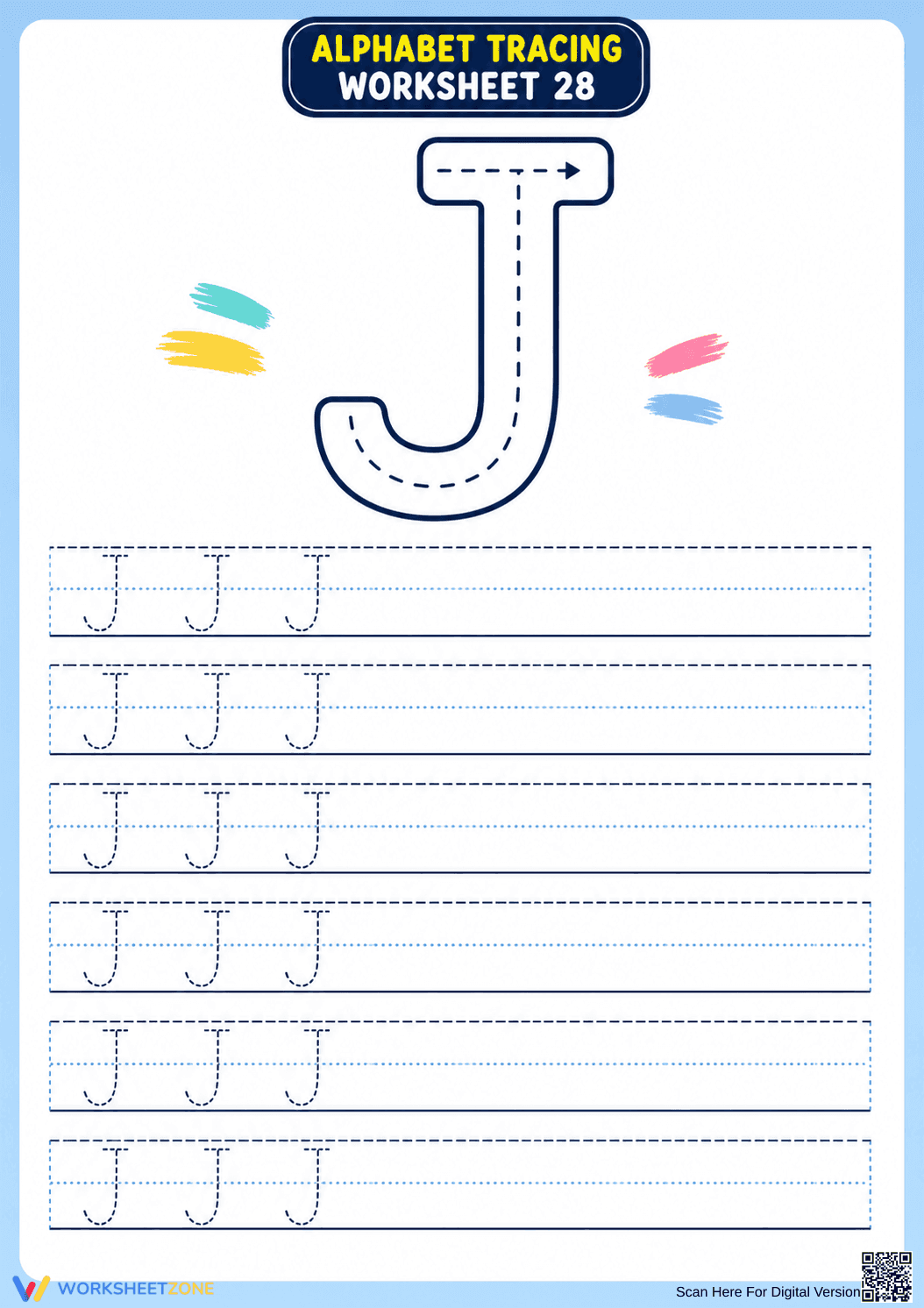
This Grade K-2 Letter J tracing worksheet provides students with structured practice to master uppercase letter formation and reinforce phonemic awareness. By focusing on the specific motor movements required for the letter J, students build the muscle memory necessary for fluent writing. This resource ensures students can identify and produce the letter accurately in various literacy contexts.
At a Glance
- Grade: Kindergarten, Grade 1, Grade 2 · Subject: ELA
- Standard:
CCSS.ELA-LITERACY.RF.K.1.D— Recognize and name all upper- and lowercase letters of the alphabet- Skill Focus: Uppercase Letter J Formation
- Format: 1 page · 19 tasks · Answer key included · PDF
- Best For: Morning work or literacy centers
- Time: 10–15 minutes
What's Inside: This single-page PDF features a large instructional graphic of the uppercase letter J, complete with directional arrows to guide the initial stroke. Below the primary example, students find 18 individual tracing opportunities organized into six neat rows. The clear, dotted-line font provides a high-contrast visual guide, while the inclusion of a simple answer key ensures teachers can quickly verify completion and accuracy.
Skill Progression
- Guided Practice: Students begin with a large-scale tracing task that uses directional arrows to model the correct top-to-bottom and hook motion.
- Supported Practice: Six rows of dotted-line templates provide 18 repetitions, allowing students to refine their fine motor control with consistent visual scaffolding.
- Independent Practice: The final rows encourage students to maintain consistent sizing and spacing as they move toward autonomous letter production.
This gradual-release approach follows the proven I Do, We Do, You Do instructional model to ensure student success.
Standards Alignment
This resource is primarily aligned with `CCSS.ELA-LITERACY.RF.K.1.D`, which requires students to recognize and name all upper- and lowercase letters of the alphabet. It also supports foundational writing standards by developing the fine motor skills needed for legible print. Both standard codes can be copied directly into lesson plans, IEP goals, or district curriculum mapping tools.
How to Use It
This worksheet is ideal for use during the "during instruction" phase of a phonics lesson. Introduce the letter J sound, then distribute the worksheet for immediate tactile reinforcement. As a formative assessment tip, observe the directionality of the student's pencil strokes; ensure they are starting from the top line rather than drawing from the bottom up. Expected completion time is 10 to 15 minutes depending on the student's fine motor development.
Who It's For
This resource is designed for early learners in Kindergarten through Grade 2, including English Language Learners (ELLs) who need explicit practice with the English alphabet. It pairs naturally with a beginning sounds picture sort or a letter J anchor chart. For students struggling with grip, consider using a triangular pencil or a crayon to provide additional tactile feedback during the tracing process.
According to Fisher & Frey (2014), scaffolded literacy instruction that includes explicit modeling of letter formation is critical for early writing development. This worksheet addresses the need for repetitive, high-quality practice in recognizing and producing the letter J, which is a foundational component of the CCSS.ELA-LITERACY.RF.K.1.D standard. Research indicates that students who master letter formation early are better equipped to focus on higher-order writing tasks, such as sentence construction and storytelling. By providing 19 distinct tracing opportunities, this resource ensures that students receive the necessary volume of practice to move from guided recognition to independent production. This alignment with evidence-based practices makes it a reliable tool for any early childhood classroom or intervention setting focused on foundational literacy skills.


