


























Views
Downloads

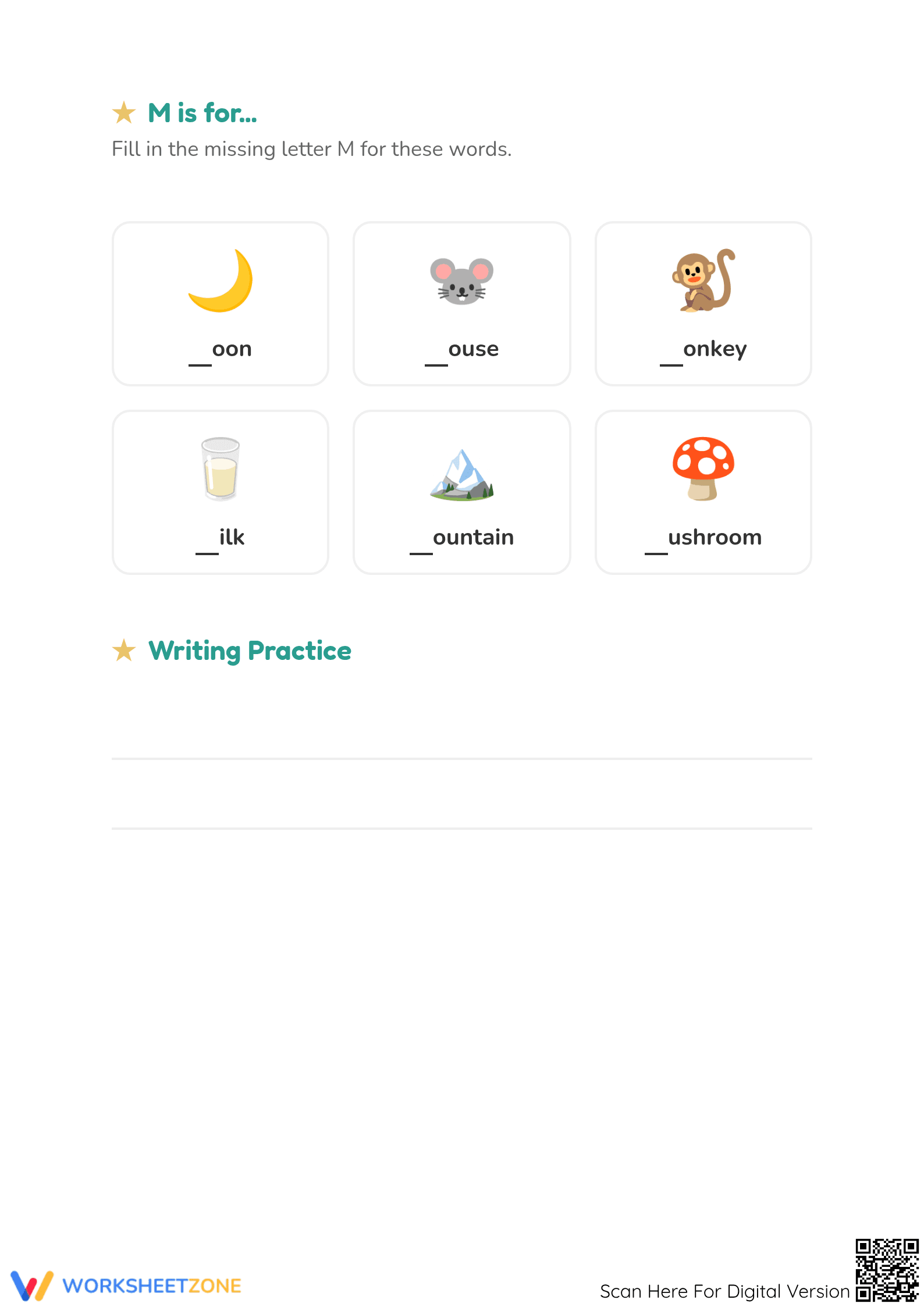

Letter M Beginning Sound Worksheet | Grade K-2 Essential
Paste this activity's link or code into your existing LMS (Google Classroom, Canvas, Teams, Schoology, Moodle, etc.).
Students can open and work on the activity right away, with no student login required.
You'll still be able to track student progress and results from your teacher account.
This comprehensive Grade K-2 phonics worksheet provides students with structured practice to master the letter M. By combining tactile tracing with phonemic awareness tasks, learners build a solid foundation for reading and writing. Students will identify the initial /m/ sound in common vocabulary words and practice precise letter formation for both uppercase and lowercase versions.
At a Glance
- Grade: Kindergarten–2 · Subject: ELA Phonics
- Standard:
CCSS.ELA-LITERACY.RF.K.1.D— Recognize and name all upper- and lowercase letters of the alphabet- Skill Focus: Letter M formation and initial sound identification
- Format: 2 pages · 19 problems · Answer key included · PDF
- Best For: Daily phonics warm-ups or literacy centers
- Time: 15–20 minutes
What's Inside: This two-page PDF resource features a clean, distraction-free layout designed for early learners. The first page focuses on handwriting with 12 dedicated tracing tasks for uppercase and lowercase M. The second page transitions to phonemic application, requiring students to fill in the missing initial letter for six illustrated words, including moon, mouse, and monkey. A final section provides open lines for independent writing practice.
Zero-Prep Workflow
- Print: Select the two-page PDF and print enough copies for your group in under 30 seconds.
- Distribute: Hand out the sheets during your phonics block; the intuitive icons allow students to start with minimal verbal instruction.
- Review: Use the included answer key to check for correct letter orientation and initial sound placement in less than one minute per student.
This resource is an ideal sub plan component because it requires no teacher setup or specialized materials beyond a pencil.
Standards Alignment
The primary focus is CCSS.ELA-LITERACY.RF.K.1.D, which requires students to recognize and name all upper- and lowercase letters. Additionally, the vocabulary section supports CCSS.ELA-LITERACY.RF.K.3.A by demonstrating knowledge of one-to-one letter-sound correspondences. Both standard codes can be copied directly into lesson plans, IEP goals, or district curriculum mapping tools.
How to Use It
Use this worksheet during the "You Do" phase of a gradual release lesson on the letter M. It serves as an excellent formative assessment tool; as students work, circulate to observe pencil grip and the directionality of their strokes. Expect most Kindergarten students to complete both pages within 15 to 20 minutes, while older students may use it as a 5-minute fluency review.
Who It's For
This resource is designed for Kindergarten students first encountering the alphabet, as well as Grade 1 and 2 students requiring RTI intervention or handwriting remediation. It is particularly effective for English Language Learners (ELLs) due to the clear visual cues for each vocabulary word. Pair this with a letter M anchor chart or a physical alphabet tub for a multi-sensory experience.
Research by Fisher & Frey (2014) emphasizes that the integration of motor skills with phonemic identification significantly improves long-term retention of letter-sound relationships. This worksheet applies those findings by requiring students to physically trace the letter M immediately before applying its sound to visual representations like a mermaid or a mountain. By addressing CCSS.ELA-LITERACY.RF.K.1.D through multiple modalities, the resource ensures that students move beyond simple recognition toward active production. The inclusion of 19 distinct tasks provides the necessary repetition for cognitive mapping without overwhelming the learner. Educators can rely on this structured approach to provide evidence of student progress in foundational literacy skills, making it a reliable addition to any early childhood curriculum. The clear formatting and high-contrast visuals are designed to support focus and reduce cognitive load during the critical early stages of reading development.


