


























Views
Downloads
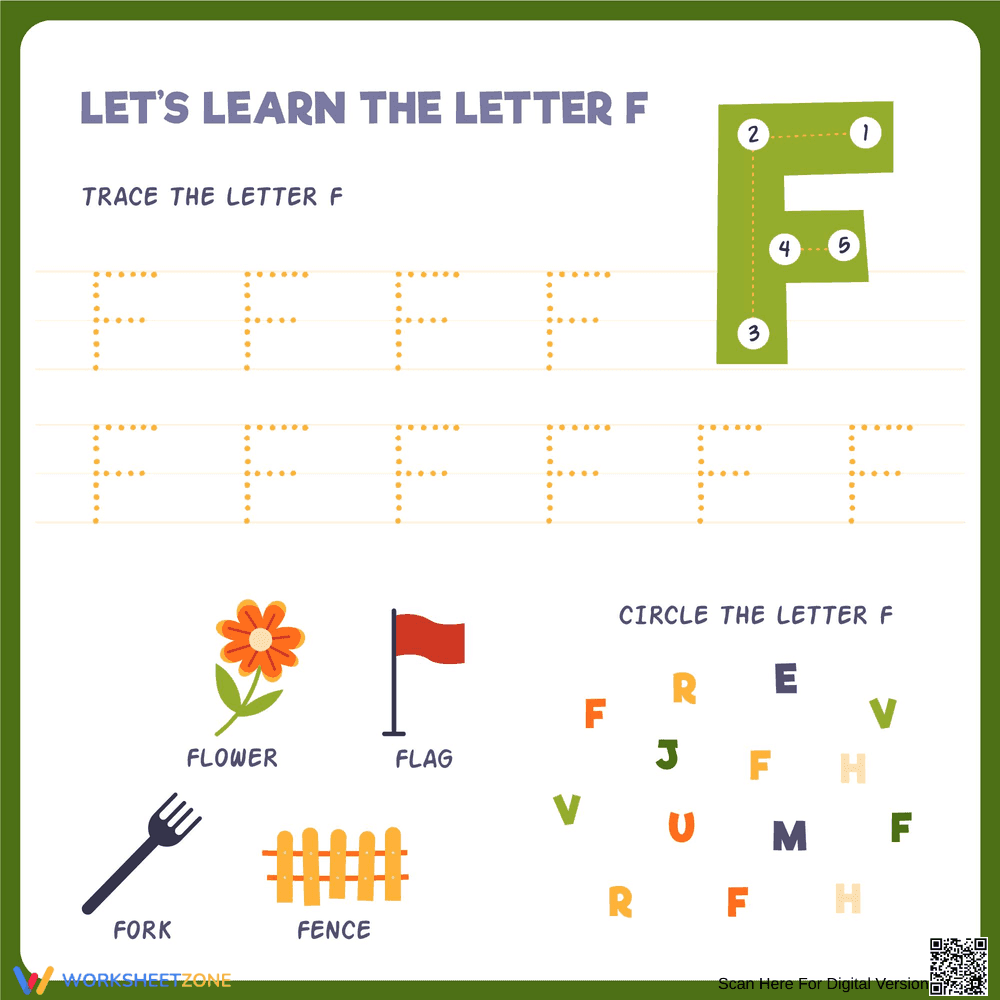

Printable Letter F Tracing Worksheet | Grade K
Paste this activity's link or code into your existing LMS (Google Classroom, Canvas, Teams, Schoology, Moodle, etc.).
Students can open and work on the activity right away, with no student login required.
You'll still be able to track student progress and results from your teacher account.
This foundational handwriting worksheet helps early learners master the uppercase Letter F through targeted tracing and recognition activities. By combining stroke-order guidance with visual vocabulary, students develop fine motor control and letter-sound association simultaneously, building essential literacy skills for kindergarten reading readiness.
At a Glance
- Grade: Kindergarten · Subject: ELA
- Standard:
CCSS.ELA-LITERACY.L.K.1.A— Print many upper- and lowercase letters- Skill Focus: Letter F tracing and recognition
- Format: 1 page · 3 activities · No answer key · PDF
- Best For: Morning work or literacy centers
- Time: 10–15 minutes
This single-page resource features three distinct activity zones designed for early childhood development. It begins with a numbered stroke-order guide for the uppercase Letter F, followed by ten dotted letters for guided tracing practice. The bottom half includes a visual vocabulary section with four illustrated words (flower, flag, fork, fence) to reinforce phonics, alongside a letter-hunt activity where students must identify and circle the target letter among a scattered group of distractors.
Designed for immediate classroom implementation, this resource requires zero teacher preparation:
- Print (1 minute): The high-contrast design ensures clear copies without draining printer ink.
- Distribute (1 minute): Hand out directly to students with pencils or crayons. The visual instructions make the tasks self-evident.
- Review (3 minutes): Quickly scan student pages to check for proper stroke direction and accurate letter identification.
With a total prep time of under two minutes, this page is an ideal addition to emergency sub plans or spontaneous morning work routines.
This worksheet is directly aligned to CCSS.ELA-LITERACY.L.K.1.A, requiring students to print many upper- and lowercase letters. It also supports foundational reading skills by reinforcing letter recognition and initial sounds. Both standard codes can be copied directly into lesson plans, IEP goals, or district curriculum mapping tools.
Teachers can deploy this worksheet during morning arrival as a quiet, independent task that settles the classroom. Alternatively, it serves as a focused station activity during literacy centers after direct instruction on the Letter F. As students work, observe their pencil grip and stroke sequence; ensure they are starting from the top and moving down, rather than drawing from the bottom up. Most kindergarteners will complete these tasks within 10 to 15 minutes.
This material is designed for kindergarten students, pre-K learners preparing for elementary school, and first graders needing handwriting intervention. To differentiate for students struggling with fine motor skills, provide a highlighter for them to trace over before using a pencil. Pair this worksheet with a tactile activity, such as forming the Letter F with playdough or tracing it in a sand tray, to solidify muscle memory.
Developing automaticity in letter formation is a critical stepping stone for early literacy. This resource targets CCSS.ELA-LITERACY.L.K.1.A, helping students print many upper- and lowercase letters accurately. By integrating explicit stroke-order instruction with independent tracing and visual identification, the worksheet builds both fine motor stamina and orthographic mapping skills. According to Fisher & Frey (2014), providing structured, gradual-release practice opportunities is essential for moving students from guided learning to independent mastery. When young learners do not have to expend cognitive energy on how to form a letter, they can dedicate more working memory to phonics and eventual word composition. This targeted practice ensures that foundational handwriting mechanics are solidified early, preventing bad habits and supporting broader reading and writing development across the primary grades.


