


























0
Views
0
Downloads

0.0
0
Save
0 Likes
Let's Have Pun Worksheet
0 Views
0 Downloads
Paste this activity's link or code into your existing LMS (Google Classroom, Canvas, Teams, Schoology, Moodle, etc.).
Students can open and work on the activity right away, with no student login required.
You'll still be able to track student progress and results from your teacher account.
Information
Description
What It Is:
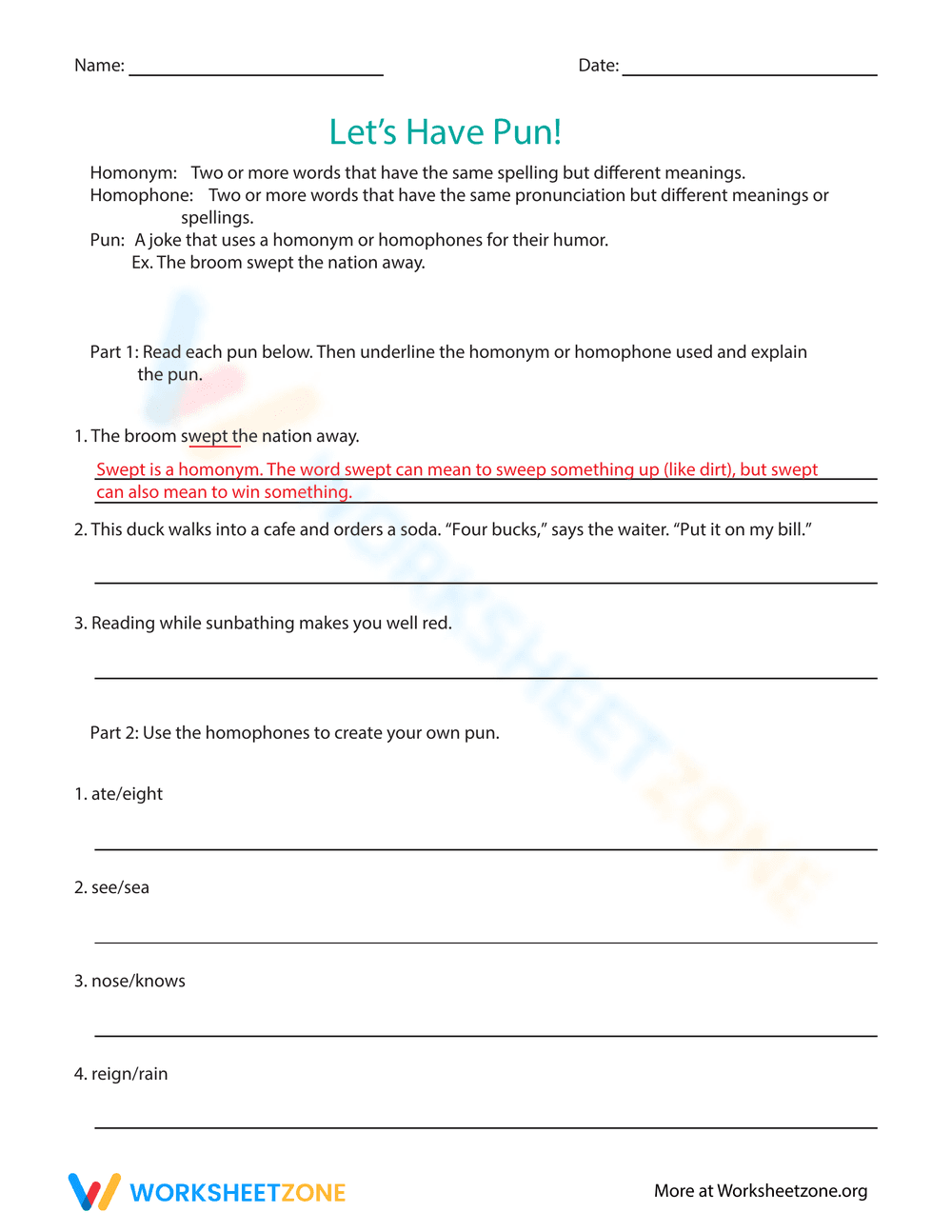
This is an educational worksheet titled 'Let's Have Pun!' It focuses on homonyms, homophones, and puns. The worksheet provides definitions of homonyms, homophones, and puns, and includes an example pun. Part 1 requires students to read puns, underline the homonym or homophone used, and explain the pun. Part 2 asks students to use given homophones (ate/eight, see/sea, nose/knows, reign/rain) to create their own puns.
Grade Level Suitability:
This worksheet is suitable for grades 4-6. The concepts of homonyms, homophones, and puns are typically introduced in these grades. The worksheet requires reading comprehension, critical thinking, and creative writing skills appropriate for this age range.
Why Use It:
This worksheet helps students understand and differentiate between homonyms and homophones. It enhances their vocabulary, reading comprehension, and creative writing skills. It also encourages them to think critically about language and humor.
How to Use It:
First, review the definitions of homonym, homophone, and pun with the student. For Part 1, read each pun aloud and have the student identify and underline the homonym or homophone. Then, guide them to explain the pun, focusing on the different meanings of the word. For Part 2, encourage the student to brainstorm puns using the given homophones, and write them down.
Target Users:
This worksheet is ideal for elementary and middle school students learning about language, wordplay, and humor. It can be used by teachers in the classroom or by parents for home learning activities. It is also beneficial for students who need extra practice with vocabulary and reading comprehension.
This is an educational worksheet titled 'Let's Have Pun!' It focuses on homonyms, homophones, and puns. The worksheet provides definitions of homonyms, homophones, and puns, and includes an example pun. Part 1 requires students to read puns, underline the homonym or homophone used, and explain the pun. Part 2 asks students to use given homophones (ate/eight, see/sea, nose/knows, reign/rain) to create their own puns.
Grade Level Suitability:
This worksheet is suitable for grades 4-6. The concepts of homonyms, homophones, and puns are typically introduced in these grades. The worksheet requires reading comprehension, critical thinking, and creative writing skills appropriate for this age range.
Why Use It:
This worksheet helps students understand and differentiate between homonyms and homophones. It enhances their vocabulary, reading comprehension, and creative writing skills. It also encourages them to think critically about language and humor.
How to Use It:
First, review the definitions of homonym, homophone, and pun with the student. For Part 1, read each pun aloud and have the student identify and underline the homonym or homophone. Then, guide them to explain the pun, focusing on the different meanings of the word. For Part 2, encourage the student to brainstorm puns using the given homophones, and write them down.
Target Users:
This worksheet is ideal for elementary and middle school students learning about language, wordplay, and humor. It can be used by teachers in the classroom or by parents for home learning activities. It is also beneficial for students who need extra practice with vocabulary and reading comprehension.


