


























Views
Downloads
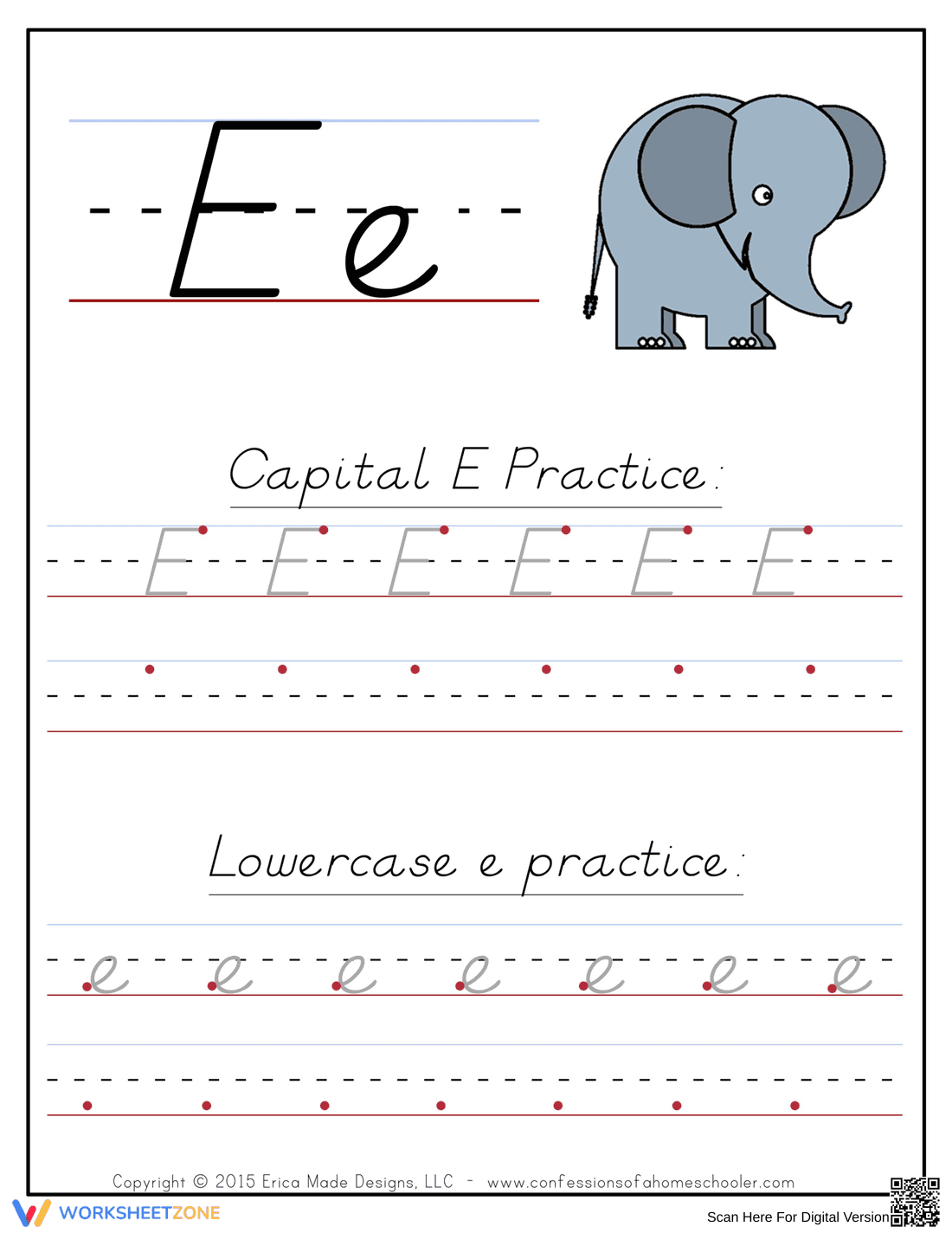

Printable Letter E Tracing Worksheet | Grade K
Paste this activity's link or code into your existing LMS (Google Classroom, Canvas, Teams, Schoology, Moodle, etc.).
Students can open and work on the activity right away, with no student login required.
You'll still be able to track student progress and results from your teacher account.
This single-page handwriting worksheet helps early learners master the D'Nealian letter E through guided tracing and independent practice. By focusing on proper stroke order and spatial awareness, students develop the fine motor skills necessary for fluent writing and confident letter recognition in their daily literacy activities.
At a Glance
- Grade: Kindergarten · Subject: ELA
- Standard:
CCSS.ELA-LITERACY.L.K.1.A— Print many upper- and lowercase letters- Skill Focus: D'Nealian Letter E Tracing
- Format: 1 page · 26 problems · No answer key needed · PDF
- Best For: Morning work or literacy centers
- Time: 10–15 minutes
This resource provides a structured practice page for the capital and lowercase letter E, featuring an elephant illustration to reinforce phonics. Students trace dashed letters on primary lines, then write independently using starting dots. The page includes 12 capital and 14 lowercase tasks, ensuring ample repetition for muscle memory.
This resource offers a streamlined zero-prep workflow.
- Print (1 minute): Simply download the PDF and print the required number of copies. The black-and-white design is ink-friendly.
- Distribute (1 minute): Hand out the worksheets during morning routines or transition periods. The clear layout means students can begin immediately.
- Review (1 minute): Quickly scan student work to check for proper stroke direction and line adherence.
Total teacher preparation time is under two minutes, making this an excellent addition to emergency sub plans or last-minute center activities.
This handwriting practice is directly aligned to CCSS.ELA-LITERACY.L.K.1.A, requiring students to print many upper- and lowercase letters. It also supports foundational reading skills by pairing the target letter with a corresponding phonetic image. Both standard codes can be copied directly into lesson plans, IEP goals, or district curriculum mapping tools.
This worksheet serves as an ideal independent activity during morning work or literacy centers. Before direct instruction, teachers can use it as a warm-up to activate prior knowledge of the alphabet. During the activity, teachers should observe students' pencil grip and stroke sequence, providing immediate corrective feedback if a child starts the letter from the bottom instead of the top. Expected completion time ranges from 10 to 15 minutes, depending on the student's fine motor proficiency.
This resource is primarily designed for Kindergarten and Preschool students developing their foundational writing skills. It is particularly beneficial for learners who require explicit visual boundaries, as the primary writing lines clearly define the top, middle, and bottom spaces. For differentiation, teachers can pair this worksheet with a tactile activity, such as tracing the letter E in sand, or use it alongside a direct instruction lesson on short vowel sounds.
Developing automaticity in letter formation is a critical component of early literacy that directly impacts future reading and writing success. This resource targets CCSS.ELA-LITERACY.L.K.1.A, which requires students to print many upper- and lowercase letters. According to Fisher & Frey (2014), providing students with structured, repetitive practice in a low-stakes environment significantly enhances their cognitive retention and fine motor coordination. When children do not have to expend working memory on how to form a letter, they can dedicate more cognitive resources to higher-order tasks like spelling and sentence composition. By utilizing guided tracing lines and starting dots, this worksheet scaffolds the physical act of writing, ensuring that early learners build correct muscle memory. Consistent practice with targeted resources is essential for establishing the foundational skills necessary for long-term academic achievement.


