


























Views
Downloads
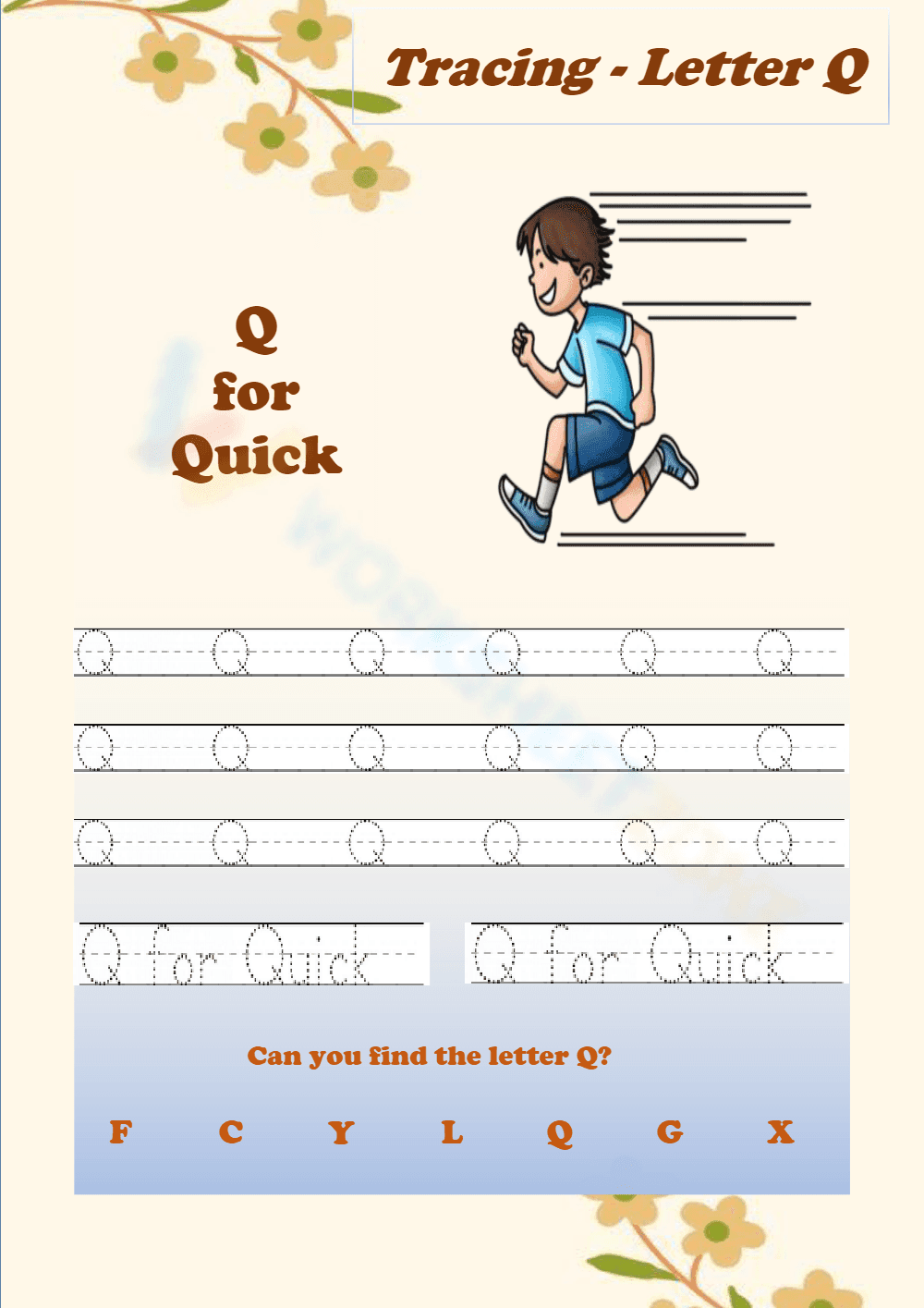

Letter Q Tracing Worksheet | Grade K-1 Printable
Paste this activity's link or code into your existing LMS (Google Classroom, Canvas, Teams, Schoology, Moodle, etc.).
Students can open and work on the activity right away, with no student login required.
You'll still be able to track student progress and results from your teacher account.
This Grade K-1 Letter Q tracing worksheet provides young learners with structured practice to master uppercase letter formation and phonemic awareness. By combining repetitive tracing with a visual identification task, students build the muscle memory and letter recognition necessary for early literacy success. It is a complete, ready-to-use resource for foundational handwriting.
At a Glance
- Grade: K-1 · Subject: English
- Standard:
CCSS.ELA-LITERACY.L.K.1.A— Print many upper- and lowercase letters accurately- Skill Focus: Letter Q formation and identification
- Format: 1 page · 21 tasks · Answer key included · PDF
- Best For: Independent morning work or literacy centers
- Time: 10–15 minutes
This single-page PDF features 18 individual uppercase "Q" tracing opportunities across three primary-lined rows. Below the letter practice, students trace the phrase "Q for Quick" twice to see the letter in a word context. The page concludes with a "Can you find the letter Q?" activity, where students must distinguish the target letter from a field of seven different uppercase characters.
The zero-prep workflow for this resource is designed for maximum efficiency in busy classrooms. First, print the single-page PDF (30 seconds). Second, distribute the sheets to students during your phonics block or as a transition activity (1 minute). Third, review the letter identification section as a whole group to check for understanding (30 seconds).
The primary focus is CCSS.ELA-LITERACY.L.K.1.A, which requires students to print many upper- and lowercase letters. This worksheet specifically targets the uppercase "Q" and the concept of letter-sound correspondence through the "Quick" keyword. The standard code can be copied directly into lesson plans or IEP goals.
Use this worksheet during the "You Do" phase of a gradual release lesson on the letter Q. It serves as an excellent formative assessment tool; as students work, walk around to observe pencil grip and stroke order. Alternatively, place it in a dry-erase sleeve in a literacy center for repeated practice during small-group rotations. Completion typically takes 10 to 15 minutes.
This resource is designed for Kindergarten students beginning their handwriting journey and Grade 1 students who require additional fine motor intervention. It pairs naturally with an alphabet anchor chart or a read-aloud featuring words that start with the letter Q. The clear, uncluttered layout supports students with visual processing needs.
According to Fisher & Frey (2014), the gradual release of responsibility model is most effective when students are provided with clear, scaffolded opportunities for independent practice. This worksheet adheres to that principle by providing dotted-line guides that slowly fade as the student progresses through the 21 tasks. Research from the NAEP highlights that early mastery of letter formation is a significant predictor of later writing fluency and reading comprehension. By focusing on the specific mechanics of the letter Q, this resource helps bridge the gap between letter recognition and active production. The inclusion of a letter-search task at the bottom of the page reinforces visual discrimination, a key component of the CCSS.ELA-LITERACY.L.K.1.A standard. Educators can confidently integrate this tool into a comprehensive literacy framework, knowing it provides the repetitive, high-quality practice required for foundational mastery.


