


























Views
Downloads

Essential Landforms and Water Bodies Worksheet | Grade 2-3
Paste this activity's link or code into your existing LMS (Google Classroom, Canvas, Teams, Schoology, Moodle, etc.).
Students can open and work on the activity right away, with no student login required.
You'll still be able to track student progress and results from your teacher account.
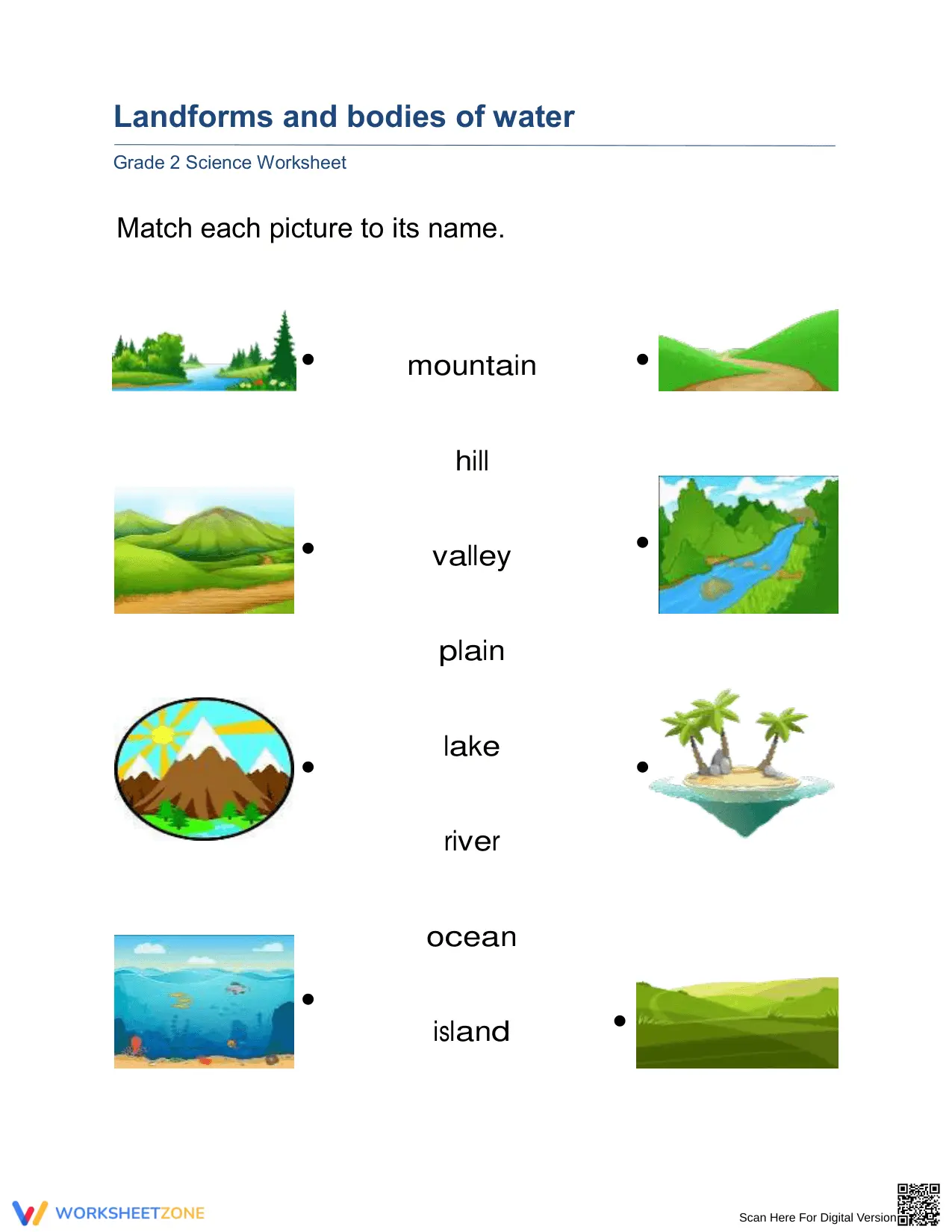
This essential Grade 2-3 science worksheet helps students identify major geographical features by matching vivid illustrations to their correct terms. Students will distinguish between various landforms and bodies of water, building foundational vocabulary needed for earth science and geography mastery. It provides an immediate, visual way to assess student understanding of physical characteristics.
At a Glance
- Grade: 2 · Subject: Science
- Standard:
2-ESS2-2— Identify and represent the shapes and kinds of land and bodies of water- Skill Focus: Geographic Vocabulary Identification
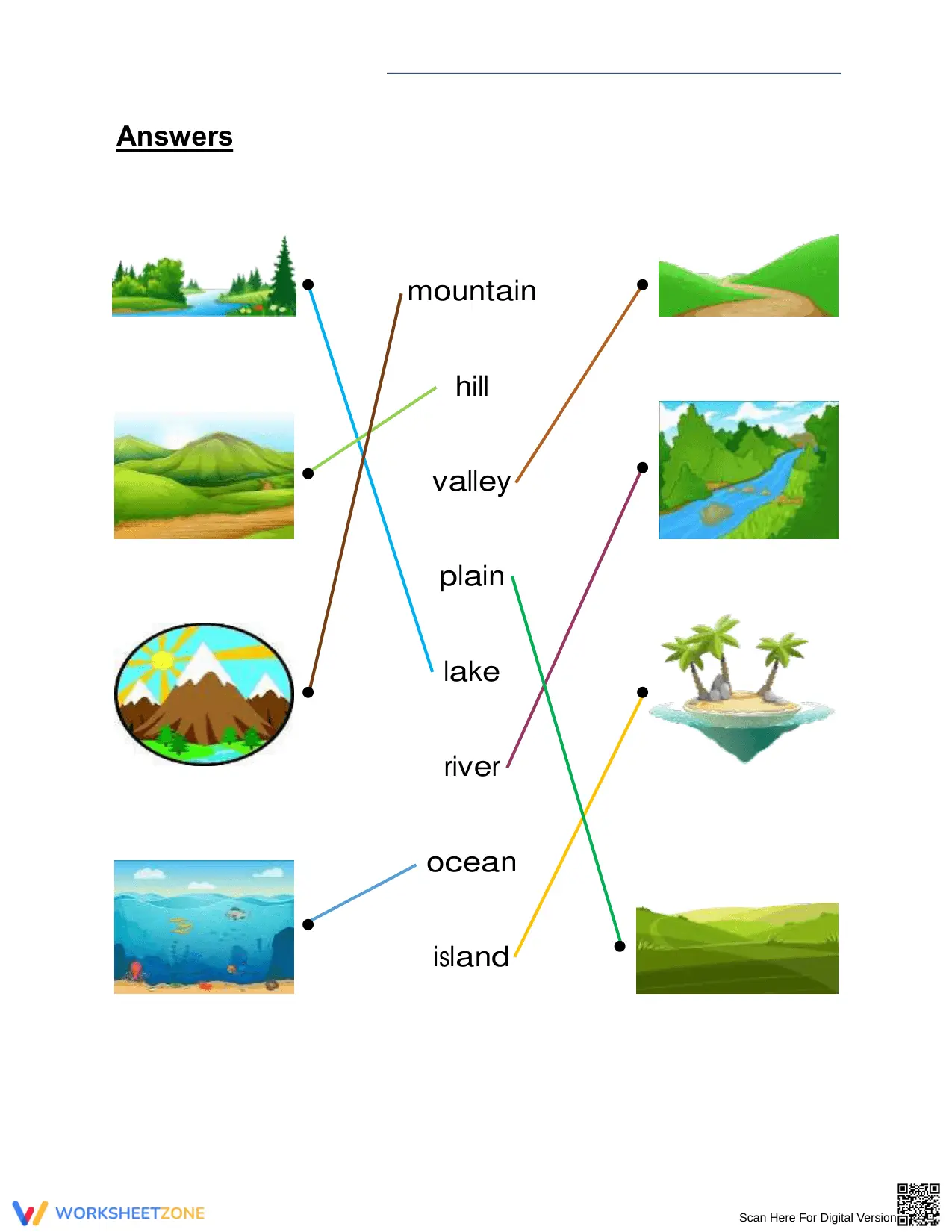
- Format: 1 page · 8 problems · Answer key included · PDF
- Best For: Independent practice or quick formative assessment
- Time: 10–15 minutes
What's Inside
This single-page PDF features eight clear, colorful illustrations representing common landforms and water bodies, including mountains, hills, valleys, plains, lakes, rivers, oceans, and islands. Students are tasked with drawing lines to match each picture to its corresponding name. The layout is clean and distraction-free, making it ideal for younger learners. A comprehensive answer key is included for rapid grading.
Zero-Prep Workflow
This resource is designed for maximum efficiency in the classroom. Step 1: Print the single-page PDF for your class (30 seconds). Step 2: Distribute the worksheets and provide a brief overview of the matching task (1 minute). Step 3: Review the answers together using the provided key or have students self-check their work (3 minutes). Total teacher preparation time is under two minutes, making this an ideal sub plan.
Standards Alignment
The primary alignment is to `2-ESS2-2`: "Develop a model to represent the shapes and kinds of land and bodies of water in an area." This matching activity serves as a foundational step toward modeling by ensuring students can accurately identify and name the physical components of Earth's surface. This standard code can be copied directly into lesson plans, IEP goals, or district curriculum mapping tools.
How to Use It
Use this worksheet as a "ticket-out-the-door" formative assessment after an introductory lesson on Earth's features. Alternatively, it works well as a center activity where students work in pairs to discuss the visual characteristics of each landform before matching. Observe if students can distinguish between the flowing water of a river and the vast expanse of an ocean. Expected completion time is 10 to 15 minutes.
Who It's For
This resource is tailored for second and third-grade students beginning their earth science unit. It is particularly effective for English Language Learners (ELL) or students with IEPs who benefit from high-quality visual supports when learning new academic vocabulary. It pairs naturally with a classroom anchor chart or a short introductory video about landforms.
Research from EdReports 2024 emphasizes that high-quality instructional materials in early science must provide explicit vocabulary support through multi-modal representations. This worksheet aligns with those findings by connecting concrete visual models of landforms and bodies of water directly to their scientific nomenclature. By mastering the core vocabulary associated with standard `2-ESS2-2`, students develop the necessary schema to engage in more complex earth systems modeling later in their academic careers. According to Fisher & Frey (2014), the use of visual matching tasks is a proven strategy for accelerating the acquisition of academic language, especially in content areas like science where abstract concepts are often tied to physical geography. This resource ensures that students have a stable mental model of what constitutes a valley versus a plain or a lake versus an ocean, reducing cognitive load during subsequent higher-order analysis of geological processes and environmental interactions.


