


























Views
Downloads

Kingdom Classification Essential Worksheet | Grade 10-12
Paste this activity's link or code into your existing LMS (Google Classroom, Canvas, Teams, Schoology, Moodle, etc.).
Students can open and work on the activity right away, with no student login required.
You'll still be able to track student progress and results from your teacher account.
This comprehensive biology worksheet guides students through the fundamental principles of biological taxonomy. By identifying and categorizing diverse organisms, learners develop a concrete understanding of the six-kingdom system. It bridges the gap between visual recognition and scientific classification, ensuring students can distinguish between complex life forms based on observable traits and cellular characteristics.
At a Glance
- Grade: 10-12 · Subject: Biology
- Standard:
HS-LS4-1— Communicate scientific information that common ancestry and biological evolution are supported by evidence.- Skill Focus: Six-Kingdom Taxonomy
- Format: 2 pages · 24 problems · Answer key included · PDF
- Best For: High school biology classification units
- Time: 30–45 minutes
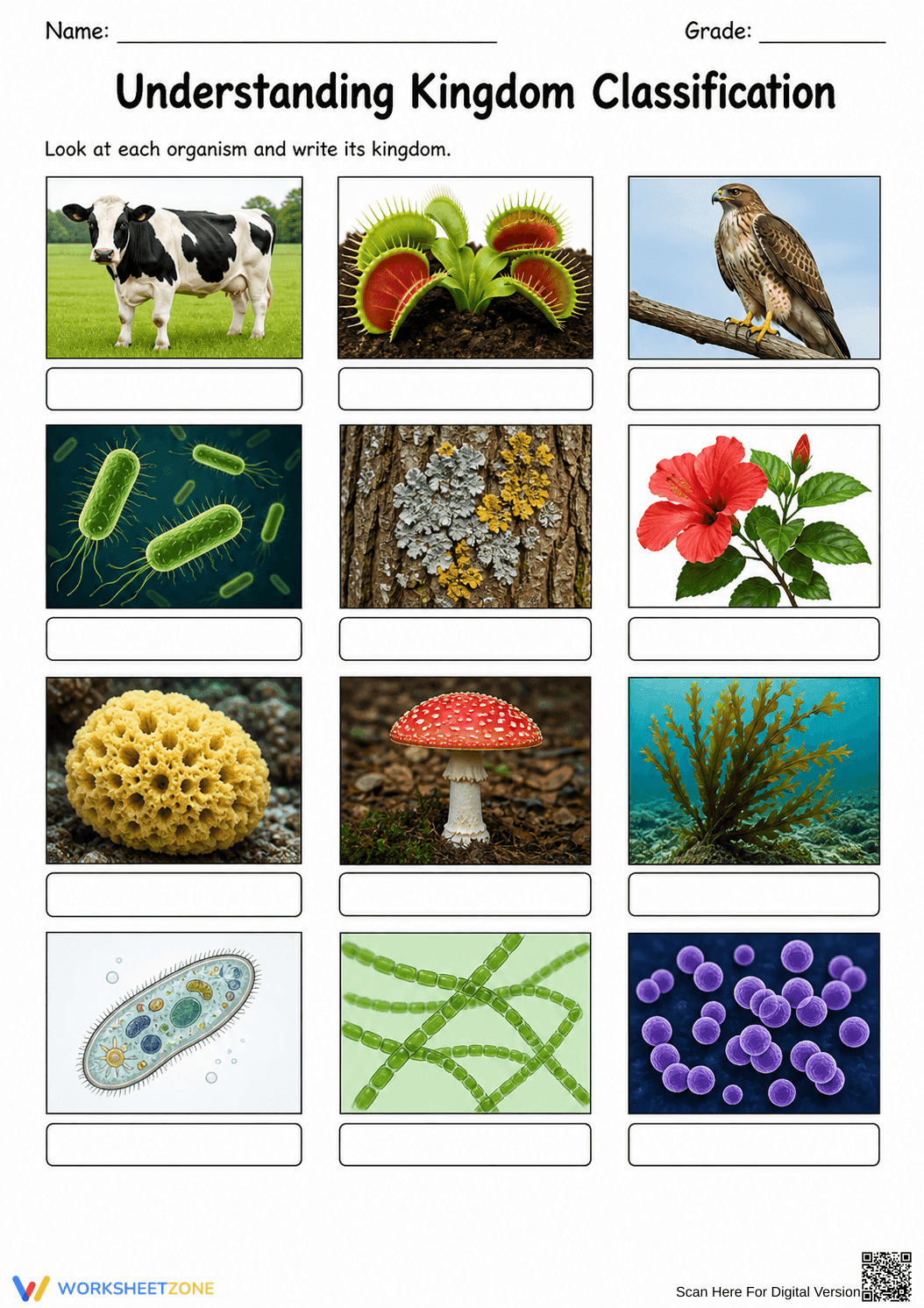
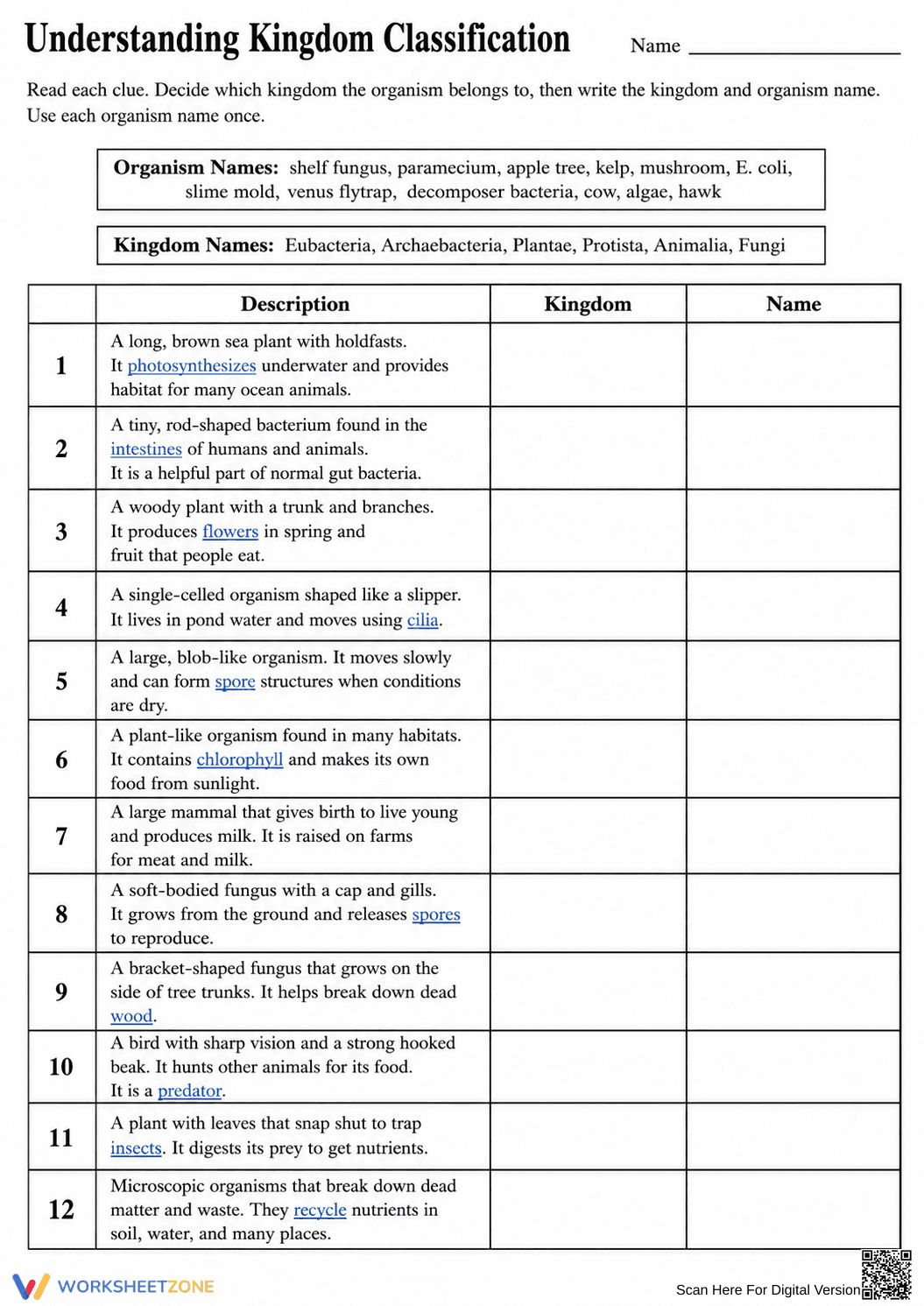
The resource consists of two distinct activity pages. The first page features 12 high-quality images of organisms ranging from microscopic bacteria to complex mammals, requiring students to assign each to its correct biological kingdom. The second page provides a structured table with 12 detailed descriptions, challenging students to match specific traits—such as photosynthesis, spore production, or predatory behavior—to the correct kingdom and organism name.
Skill Progression
- Guided practice: Students begin by observing 12 vivid images and applying prior knowledge to categorize them into broad groups.
- Supported practice: The second page provides a word bank of organism and kingdom names, offering a scaffold for the descriptive matching task.
- Independent practice: Learners synthesize technical clues to justify their classifications without direct teacher intervention, completing 24 total data points.
This approach follows a gradual-release model, moving from concrete visual identification to abstract conceptual matching.
Standards Alignment
This resource is aligned with `HS-LS4-1`, which requires students to communicate scientific information regarding the diversity of life. By classifying organisms into Eubacteria, Archaebacteria, Protista, Fungi, Plantae, and Animalia, students demonstrate an understanding of the structural and functional evidence used in modern taxonomy. Both standard codes can be copied directly into lesson plans, IEP goals, or district curriculum mapping tools.
How to Use It
Use this worksheet as a formative assessment following a lecture on the characteristics of the six kingdoms. It serves as an excellent mid-unit check to identify misconceptions regarding protists and fungi. Alternatively, assign it as a collaborative lab station activity where students must debate the classification of organisms like seaweed or paramecium. Expected completion time is 35 to 45 minutes.
Who It's For
This activity is designed for high school biology students, including those in Honors tracks who need a refresher on taxonomic hierarchy. It is particularly effective for visual learners and can be paired with a kingdom characteristics anchor chart or a direct instruction lesson on phylogeny to reinforce the underlying biological concepts.
According to the RAND AIRS 2024 report on science literacy, the use of multi-modal classification tasks—combining visual stimuli with descriptive text—significantly improves long-term retention of biological hierarchies. This worksheet leverages that research by requiring students to process information through both image recognition and technical reading. By engaging with the HS-LS4-1 standard through 24 distinct data points, students move beyond rote memorization toward a functional understanding of how scientists organize the natural world. The inclusion of diverse organisms, from E. coli to the Venus flytrap, ensures a broad representative sample of life, which Fisher & Frey (2014) identify as a key component of effective scaffolded instruction in secondary science environments. This resource provides the rigorous practice necessary for mastering high school biology standards while maintaining high student engagement through visual cues.


