


























Views
Downloads
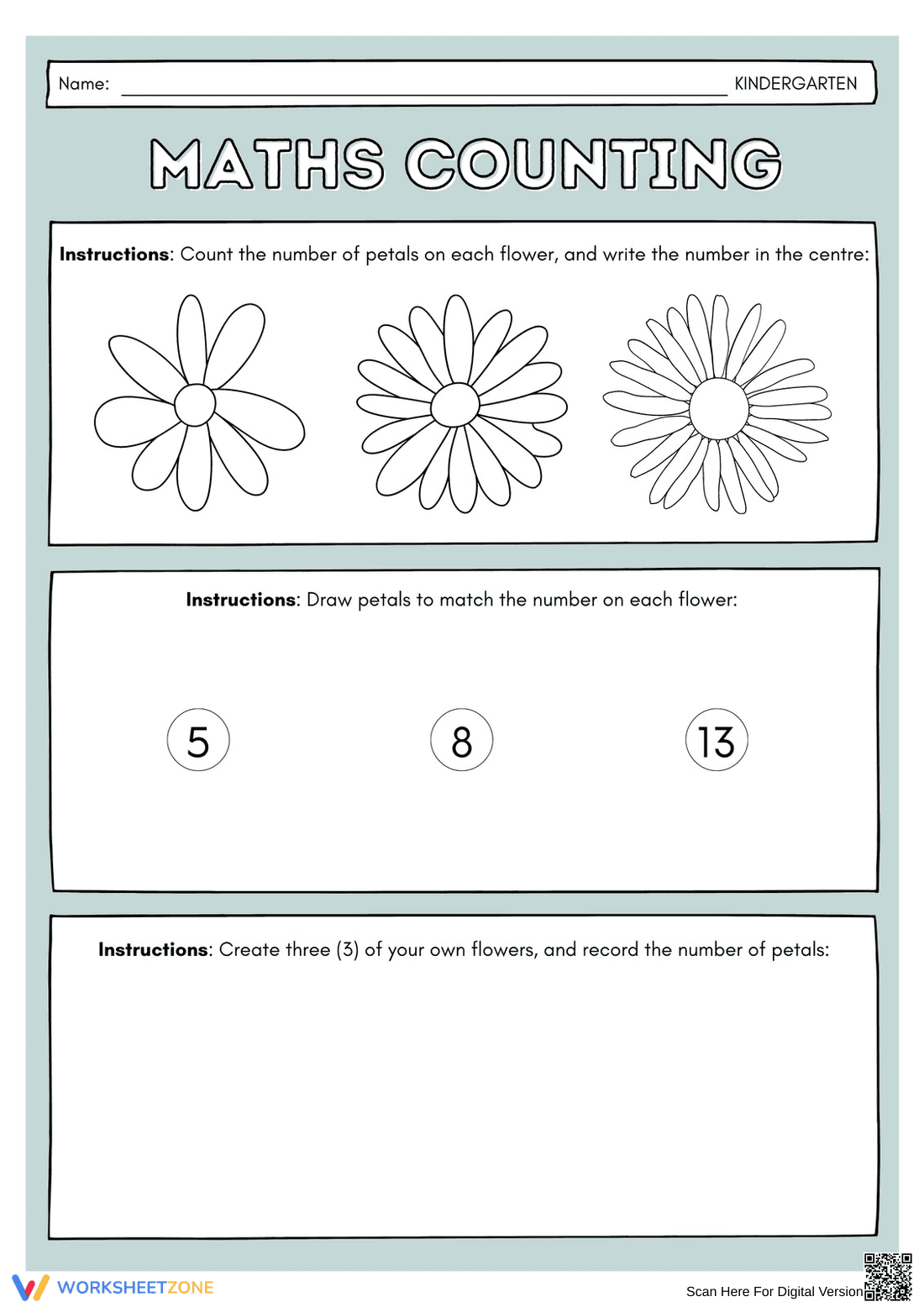

Printable Flower Counting Worksheet for Kindergarten
Paste this activity's link or code into your existing LMS (Google Classroom, Canvas, Teams, Schoology, Moodle, etc.).
Students can open and work on the activity right away, with no student login required.
You'll still be able to track student progress and results from your teacher account.
This printable kindergarten math worksheet provides an engaging way for young learners to practice counting and cardinality. By interacting with friendly flower illustrations, students build essential early math skills. This resource helps children connect numeral recognition with physical quantities through structured counting, drawing, and creative design tasks.
At a Glance
- Grade: Kindergarten · Subject: Math
- Standard:
CCSS.MATH.CONTENT.K.CC.B.5— Count to answer how many questions about up to 20 things- Skill Focus: Flower petal counting
- Format: 1 page · 9 problems · PDF
- Best For: Independent math centers
- Time: 15–20 minutes
This single-page PDF features three scaffolded math activities centered around a floral theme. The top section presents three unique flowers for students to count and record. The middle section challenges learners to read a given numeral and draw the corresponding number of petals. The final section offers an open-ended creative space where children draw three custom flowers and record their petals.
This worksheet is engineered for an efficient, zero-prep classroom workflow. First, print the single-page PDF in under 1 minute. Next, distribute the sheets during morning arrival, requiring less than 30 seconds of setup. Finally, review the completed drawings in under 2 minutes. The total teacher preparation time is under 2 minutes, making this an ideal resource for emergency substitute plans.
Standards Alignment
This activity aligns directly with CCSS.MATH.CONTENT.K.CC.B.5, which requires students to count to answer "how many?" questions about as many as 20 things. By counting petals in a circular pattern and drawing specific quantities, students demonstrate a deep understanding of numbers and quantities. Both standard codes can be copied directly into lesson plans, IEP goals, or district curriculum mapping tools.
How to Use It
Incorporate this worksheet during or after direct instruction on counting objects up to 20. It serves beautifully as an independent math center activity. For a powerful formative assessment observation, watch students as they complete the middle section; note whether they use one-to-one correspondence while drawing petals. Expect completion within 15 to 20 minutes.
Who It's For
This resource is designed for kindergarten students developing foundational number sense, but it also serves as an excellent intervention tool for first-grade students. It accommodates diverse learning styles by combining visual and artistic modalities. Pair this worksheet naturally with concrete manipulatives like plastic math counters to scaffold the counting process for struggling learners.
Early childhood mathematics research emphasizes that developing robust counting skills requires multi-modal engagement where children connect abstract numerals to concrete visual representations. According to the NAEP framework for early childhood mathematics assessment, activities that require students to both decode a numeral and generate a corresponding set of objects—such as drawing petals to match a number—strengthen the neural pathways responsible for long-term mathematical fluency. This worksheet directly targets these critical milestones by guiding students through a progression from passive counting to active generation and creative application. Utilizing targeted exercises aligned with CCSS.MATH.CONTENT.K.CC.B.5 ensures that kindergarteners master one-to-one correspondence and cardinality before advancing to complex operations. Integrating this structured practice into daily routines fosters confidence and precision in early learners, establishing a reliable foundation for future STEM success.


