


























Views
Downloads

Printable Light & Materials Worksheet | Grade 1 Science
Paste this activity's link or code into your existing LMS (Google Classroom, Canvas, Teams, Schoology, Moodle, etc.).
Students can open and work on the activity right away, with no student login required.
You'll still be able to track student progress and results from your teacher account.
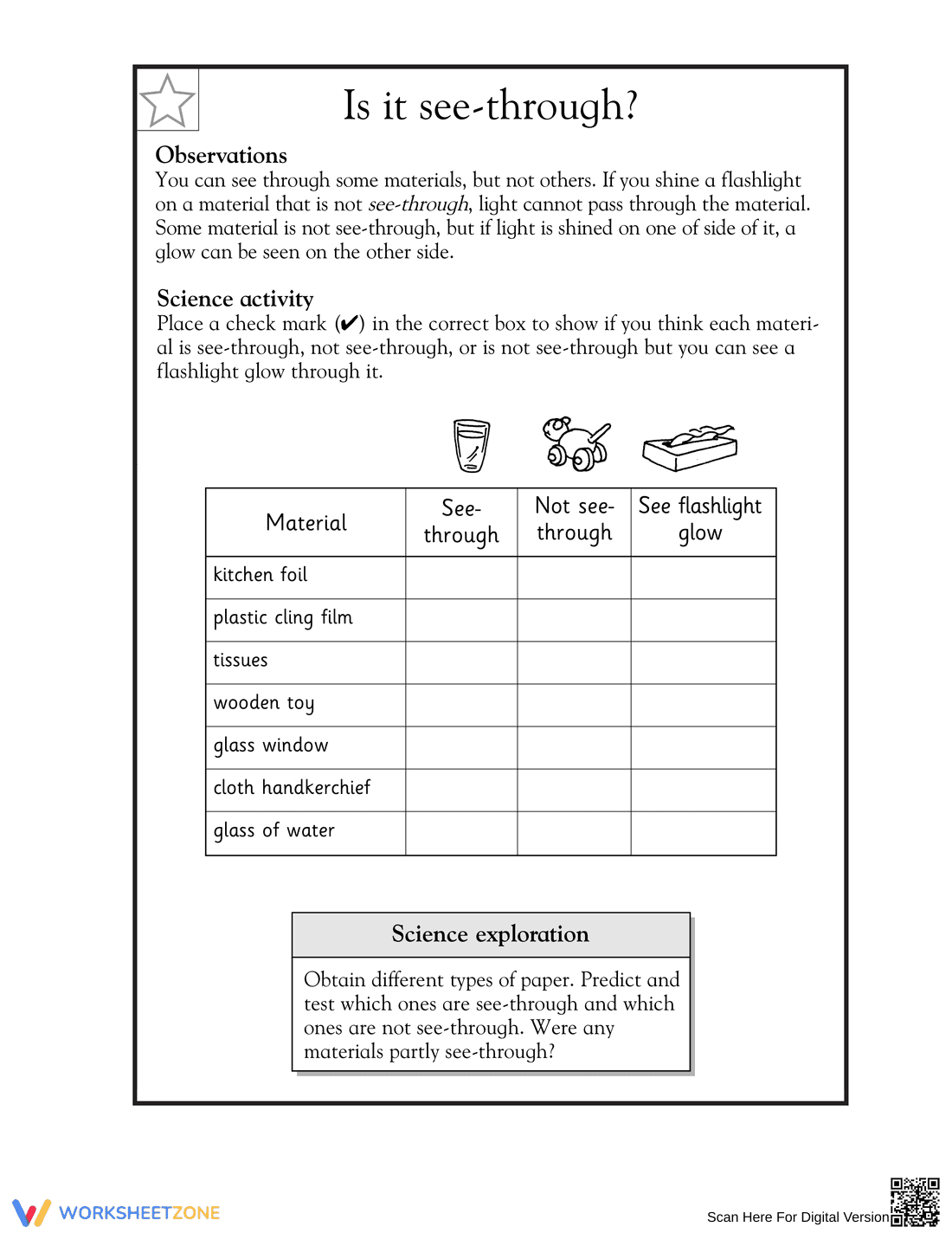
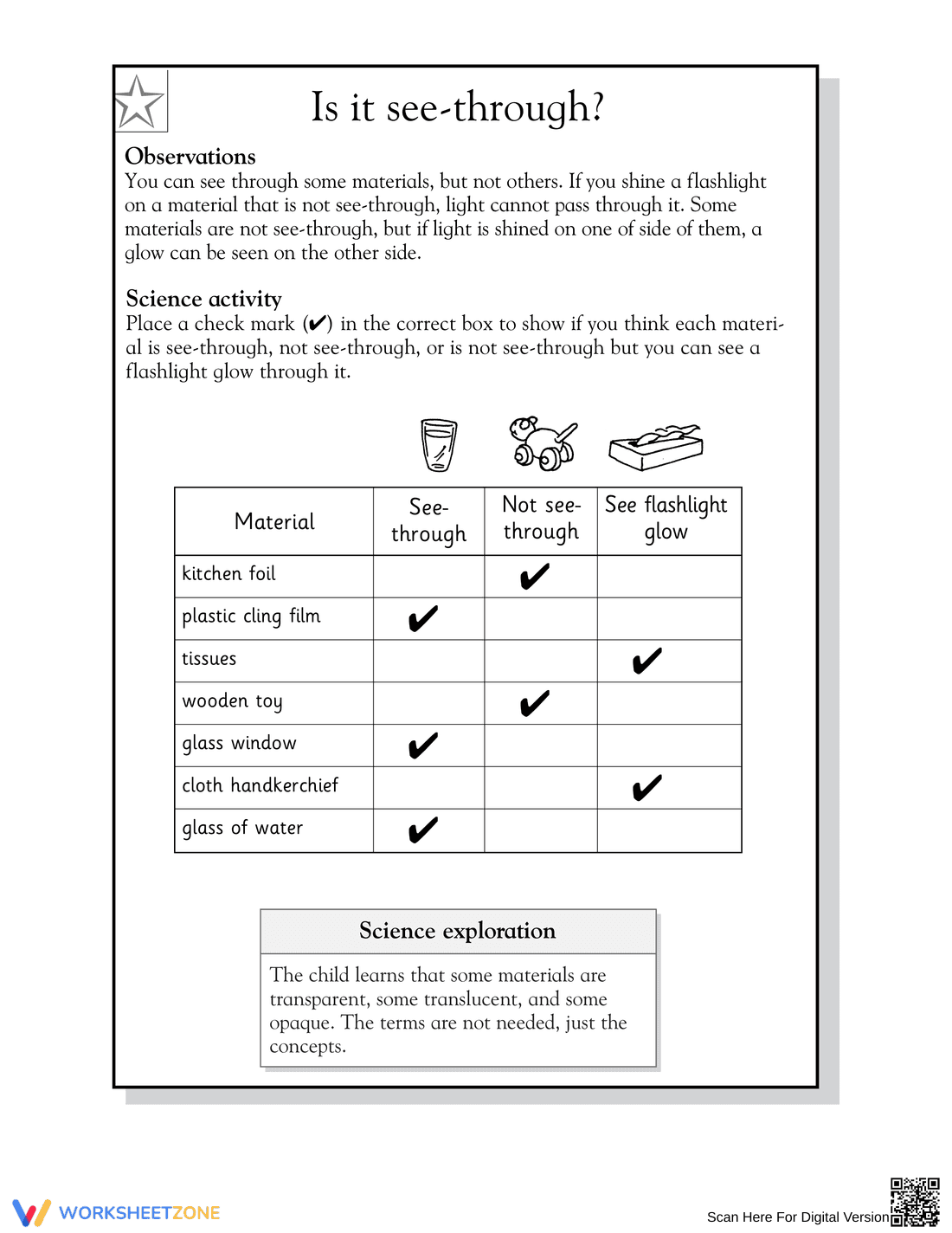
This Grade 1 science worksheet provides a hands-on investigation into the properties of light. Students will explore how light interacts with different materials, classifying them as transparent (see-through), opaque (not see-through), or translucent (letting a glow pass through). It's a foundational, inquiry-based activity to build observation skills.
At a Glance
- Grade: 1 · Subject: Science
- Standard:
1-PS4-3— Investigate the effect of placing different materials in a light beam's path.- Skill Focus: Transparent, Translucent, & Opaque Materials
- Format: 1 page · 2 problems · Answer key included · PDF
- Best For: Hands-on science centers or concept introduction
- Time: 15–20 minutes
What's Inside
This single-page, printable PDF features a clear "Observations" section that explains the core concepts of transparency and opacity. The main activity is a structured chart where students predict and test seven common household items. An additional "Science Exploration" task encourages further inquiry with other materials. A complete answer key is included.
Zero-Prep Workflow
Designed for immediate classroom use, this worksheet minimizes teacher preparation time.
- Print (under 1 minute): The resource is a single, self-contained page. Just print one copy for each student or group.
- Distribute (under 1 minute): Hand out the worksheet along with a simple flashlight and the listed materials, which are common household or classroom items.
- Review (5 minutes): Use the included answer key for a quick and efficient review of student findings, or facilitate a whole-class discussion about their observations.
Total teacher prep time is under two minutes, making this an ideal resource for a substitute teacher plan or a last-minute science activity.
Standards Alignment
This worksheet aligns with Next Generation Science Standard 1-PS4-3, where students "plan and conduct an investigation to determine the effect of placing objects made of different materials in the path of a beam of light." The activities guide students through this exact process. The standard code can be copied directly into lesson plans or curriculum maps.
How to Use It
Use this resource during a unit on light to solidify new concepts. It works well as a 15-20 minute station activity in a science center rotation. For formative assessment, observe if students can correctly predict an object's property before testing; this reveals their grasp of the concepts. The activity can typically be completed in 15 to 20 minutes.
Who It's For
This activity is for first-grade students learning about the physical properties of materials. The clear layout supports early learners. For differentiation, pre-sort the objects for struggling students or challenge advanced learners with the open-ended exploration prompt. It pairs well with an anchor chart defining transparent, translucent, and opaque.
This Grade 1 worksheet provides a practical investigation into how light interacts with different materials, a key inquiry skill outlined in NGSS standard 1-PS4-3. By testing whether common objects are transparent, translucent, or opaque, students engage in the scientific practices of planning and carrying out investigations. Research from RAND AIRS 2024 highlights the importance of such hands-on, phenomenon-based learning in early elementary science for building foundational knowledge and fostering curiosity. The worksheet's structure—predicting, testing, and recording—mirrors authentic scientific inquiry, moving beyond simple vocabulary memorization. This approach helps students develop a tangible understanding of abstract physical science concepts, a critical step for future learning. The activity serves as an accessible entry point for students to explore the properties of light and matter directly, promoting deeper conceptual understanding than passive learning alone.


