


























Views
Downloads
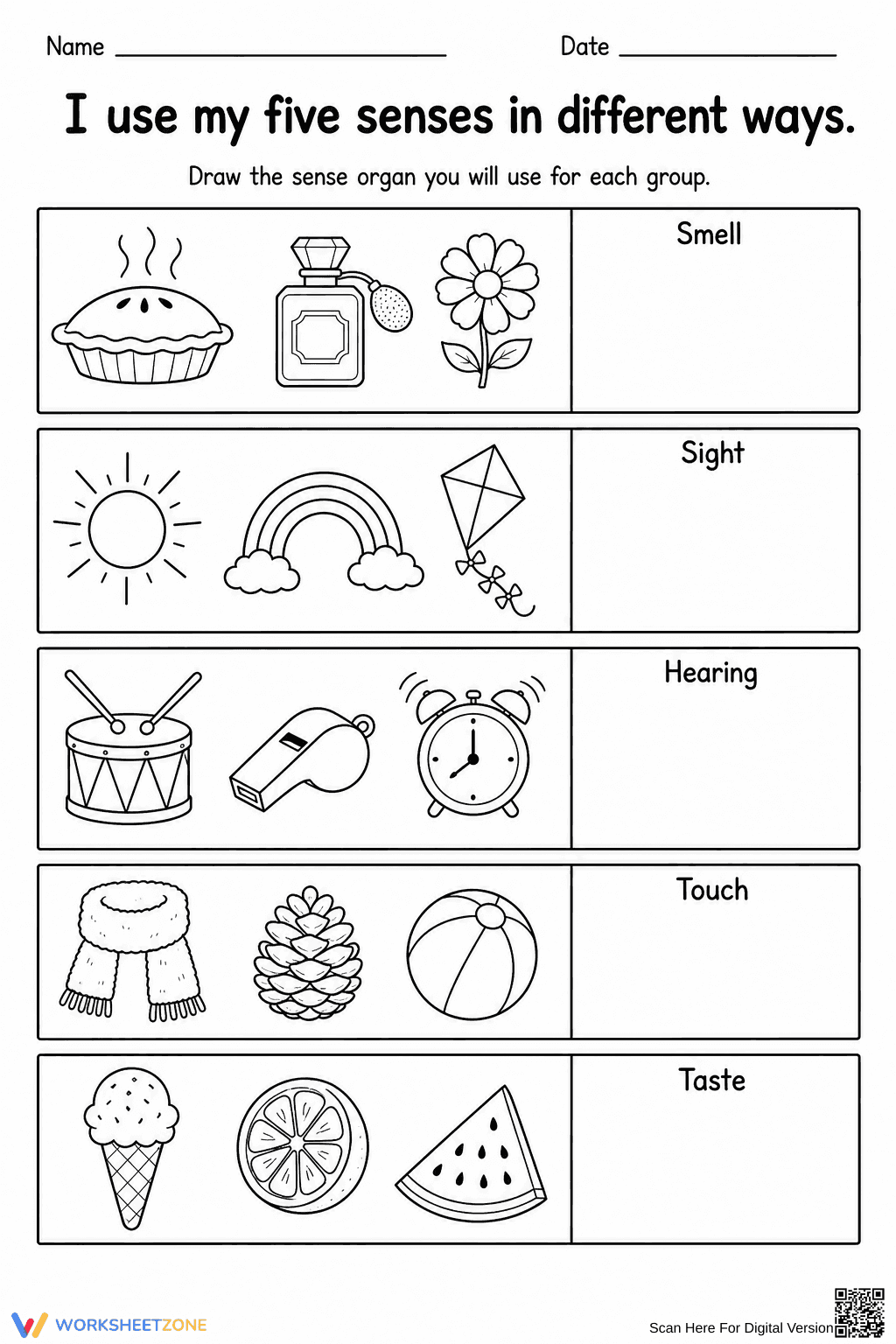

Grade 2 Five Senses — Printable No-Prep Worksheet
Paste this activity's link or code into your existing LMS (Google Classroom, Canvas, Teams, Schoology, Moodle, etc.).
Students can open and work on the activity right away, with no student login required.
You'll still be able to track student progress and results from your teacher account.
This Grade 2 science worksheet helps students connect everyday objects to the human body by identifying which sense organ is used to observe them. Young learners will analyze groups of items and draw the corresponding body part for smell, sight, hearing, touch, and taste to demonstrate their understanding.
At a Glance
- Grade: 2 · Subject: Science
- Standard:
2-PS1-1— Describe materials by their observable properties- Skill Focus: Identifying the five senses
- Format: 1 page · 5 problems · PDF
- Best For: Independent practice or morning work
- Time: 10–15 minutes
Inside this single-page resource, students will find five rows, each dedicated to one specific sense. Every row features three illustrations of common objects, such as a ringing alarm clock or a textured pinecone. A blank box is provided on the right side, prompting students to draw the specific sense organ—nose, eyes, ears, hands, or tongue—associated with observing those items.
Zero-Prep Workflow
Designed for immediate classroom implementation with under two minutes of teacher prep time.
- Print (1 minute): Generate the single-page PDF. The black-and-white art ensures minimal ink usage.
- Distribute (1 minute): Hand out sheets with pencils. Visual instructions make the task self-explanatory.
- Review (3 minutes): Check student drawings as they work, or review as a whole class.
This activity is highly suitable for emergency sub plans.
Standards Alignment
This activity aligns with 2-PS1-1: Plan and conduct an investigation to describe and classify different kinds of materials by their observable properties. By identifying which sense organ is required to observe specific objects, students build the foundational skills needed to gather sensory data. Both standard codes can be copied directly into lesson plans, IEP goals, or district curriculum mapping tools.
How to Use It
Deploy this worksheet during a science block after direct instruction on the human body or the five senses. It serves as an excellent independent practice activity while the teacher works with small groups. Alternatively, use it as a formative assessment at the end of a unit; observe whether students correctly associate the ear with the drum and whistle, rather than the eye. Expected completion time ranges from 10 to 15 minutes, depending on the detail students put into their drawings.
Who It's For
This resource is primarily designed for Grade 2 and Grade 3 general education students, but its heavy reliance on visual cues makes it highly accessible for English Language Learners and students requiring reading accommodations. The drawing component provides a low-stress alternative to writing out answers. Pair this worksheet with a read-aloud book about the human body or a hands-on sensory bin activity to reinforce the concepts.
Connecting physical sense organs to observable properties of matter is a critical step in early childhood science education. According to a 2024 report by EdReports 2024, instructional materials that require students to actively map sensory inputs to specific body parts significantly improve long-term retention of scientific observation skills. When students engage with standard 2-PS1-1 to describe materials by their observable properties, they must first understand how their bodies collect that data. Drawing the organs—rather than simply writing the words—activates different cognitive pathways and provides a developmentally appropriate challenge for young learners. This multimodal approach ensures that foundational biology concepts are firmly established before students progress to more complex investigations of how the brain processes sensory information. By integrating visual analysis with creative output, educators can effectively measure comprehension while keeping students highly engaged in the learning process.


