




























Views
Downloads

Essential Grade 3 Inherited vs. Acquired Traits Worksheet

Paste this activity's link or code into your existing LMS (Google Classroom, Canvas, Teams, Schoology, Moodle, etc.).
Students can open and work on the activity right away, with no student login required.
You'll still be able to track student progress and results from your teacher account.
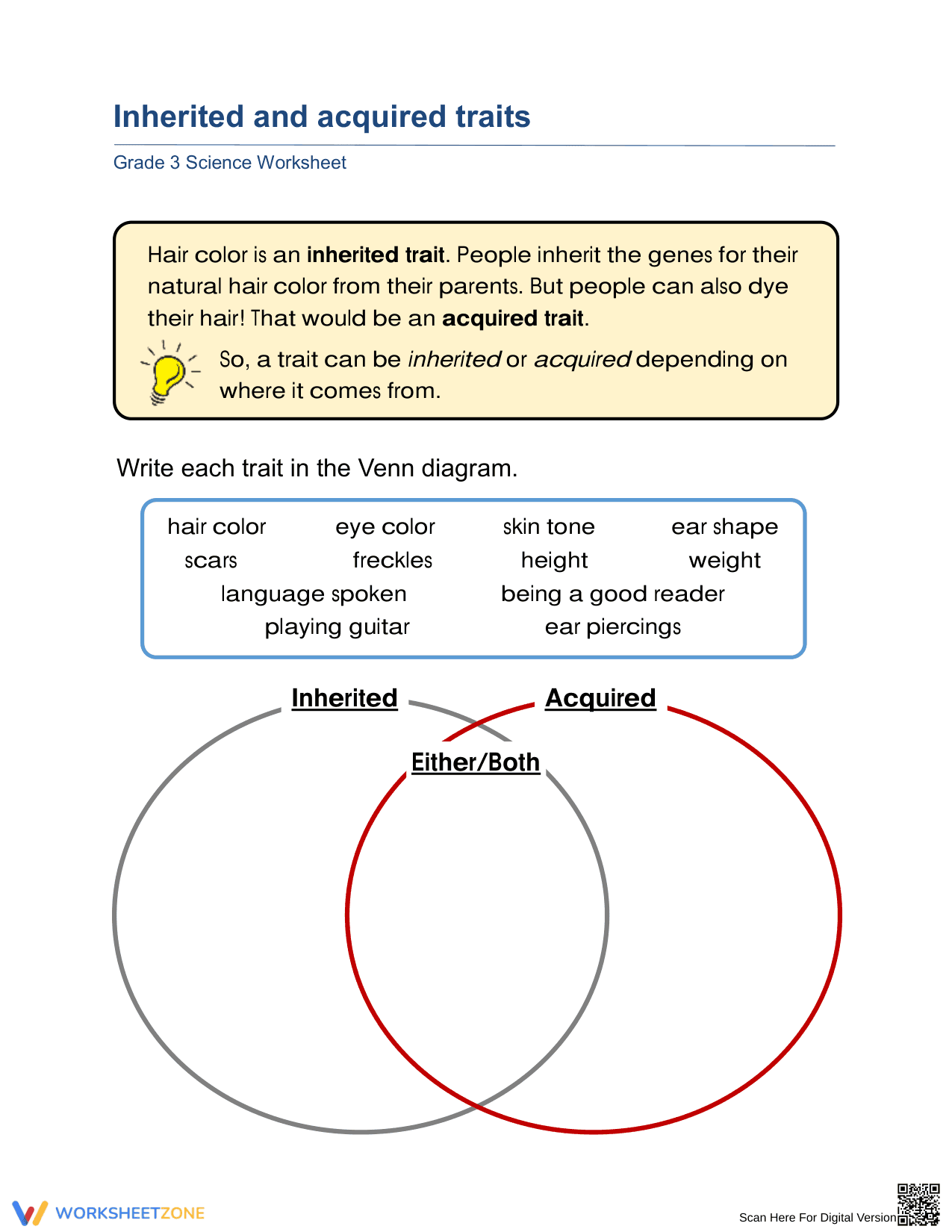
This Grade 3 science worksheet provides a clear and focused exploration of the differences between inherited and acquired traits. Students will observe 12 specific characteristics and determine whether they stem from genetic inheritance or environmental factors. By engaging with this high-utility Venn diagram activity, learners solidify their understanding of biological variation and heredity.
At a Glance
- Grade: 3 · Subject: Living Things
- Standard:
3-LS3-2— Use evidence to explain how traits are influenced by the environment- Skill Focus: Distinguishing inherited vs. acquired traits
- Format: 1 page · 12 problems · Answer key included · PDF
- Best For: Independent practice or a quick science check
- Time: 15–20 minutes
What's Inside
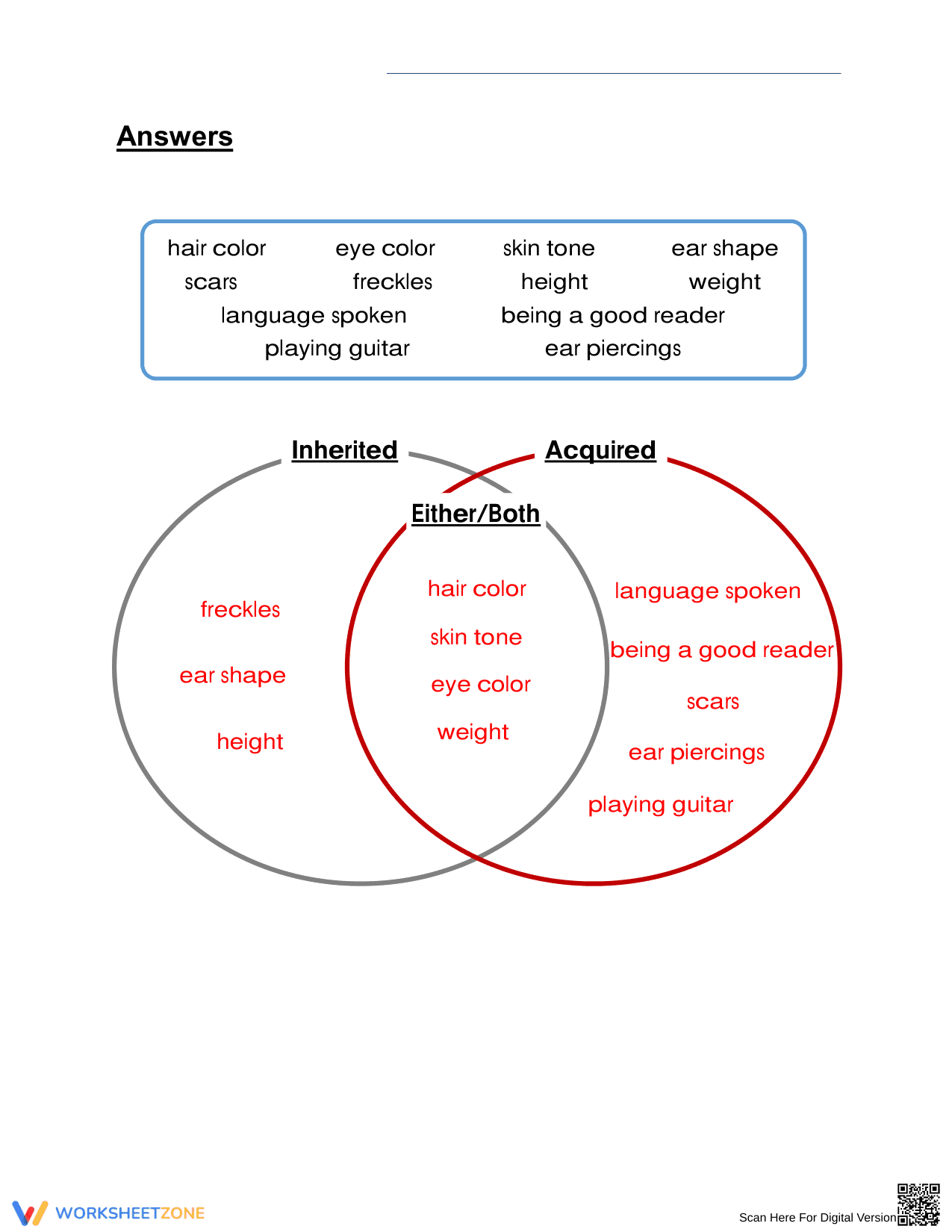
The worksheet features a definition box at the top, using hair color to illustrate both inherited and acquired traits. Students categorize 12 items, such as "language spoken" and "ear shape," into a Venn diagram. This single-page PDF includes a full answer key for efficient grading and review.
Zero-Prep Workflow
This resource uses a three-step zero-prep workflow. Print the single-page document in 30 seconds. Distribute the copies for students to read the definitions independently. Finally, review the completed diagrams in under 10 minutes. Total teacher preparation time is under two minutes, making it perfect for sub plans.
Standards Alignment
This resource is aligned to the Next Generation Science Standard `3-LS3-2`: "Use evidence to support the explanation that traits can be influenced by the environment." By requiring students to identify acquired traits alongside inherited ones, the worksheet provides the evidentiary basis for understanding variation. This standard code can be copied directly into lesson plans, IEP goals, or district curriculum mapping tools.
How to Use It
Use this worksheet as a formative assessment following a direct instruction lesson on heredity. It serves as an excellent check to gauge student mastery of vocabulary before moving to complex inheritance patterns. Alternatively, assign it as a homework reinforcement task. Observe if students struggle with traits like "weight," which can fit into multiple categories, and use that as a prompt for a class discussion on nature versus nurture.
Who It's For
The worksheet is designed for Grade 3 students but is highly effective for Grade 4 review or for ESL/ELL learners who benefit from the clear categorization and limited text density. The inclusion of common, relatable traits makes the abstract concept of genetics accessible to all learners. It pairs naturally with a reading passage about animal adaptations or a direct instruction slide deck on the life cycles of organisms.
The distinction between inherited and acquired traits is a foundational concept in elementary science, serving as a critical prerequisite for understanding biological variation. According to the RAND AIRS 2024 report, structured categorization tasks like Venn diagrams are highly effective for Grade 3 learners because they provide a necessary visual framework for organizing abstract scientific data. By analyzing 12 distinct traits through the lens of standard `3-LS3-2`, students move beyond simple memorization to active, evidence-based reasoning. This worksheet ensures that students can accurately identify how both genetic blueprints and environmental factors work together to shape the final phenotype of an organism. The use of familiar examples like "playing guitar" and "ear piercings" ensures high student engagement while maintaining rigorous academic standards. This resource provides the essential scaffolding needed for students to master the performance expectation within a standard 20-minute science block, preparing them for more advanced studies in genetics.


