


























Views
Plays

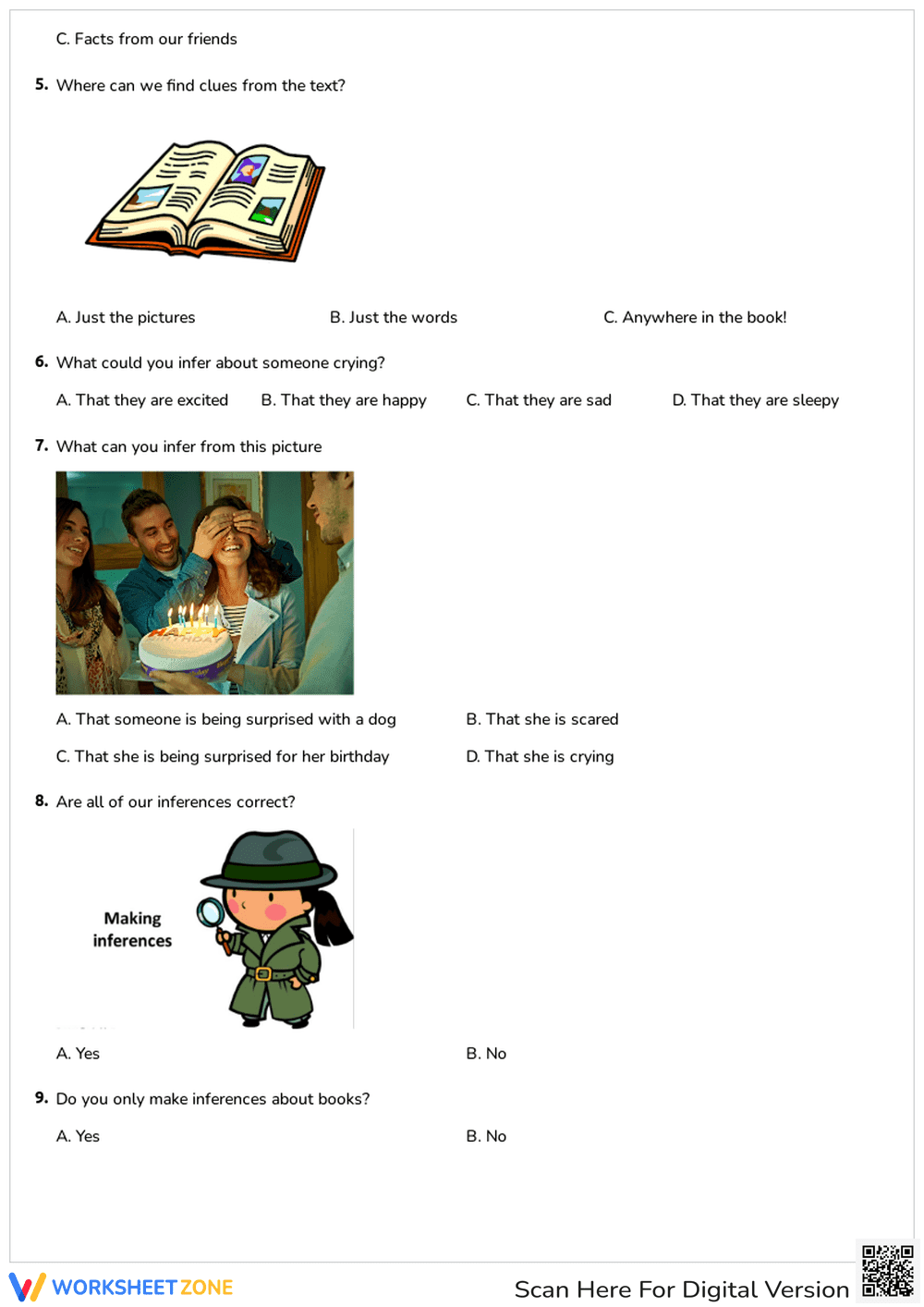


Grade 4 Making Inferences — Printable No-Prep Worksheet
Paste this activity's link or code into your existing LMS (Google Classroom, Canvas, Teams, Schoology, Moodle, etc.).
Students can open and work on the activity right away, with no student login required.
You'll still be able to track student progress and results from your teacher account.
This reading comprehension worksheet helps students master the essential skill of making inferences by combining background knowledge (schema) with text and visual clues. By analyzing real-world scenarios and images, students develop the critical thinking required to draw logical conclusions that go beyond explicitly stated facts.
At a Glance
- Grade: 4 · Subject: ELA
- Standard:
CCSS.ELA-LITERACY.RL.4.1— Draw inferences from a text- Skill Focus: Making Inferences and Schema
- Format: 3 pages · 13 problems · Answer key included · PDF
- Best For: Independent practice or quick assessment
- Time: 15–20 minutes
Inside this resource, educators will find a comprehensive three-page quiz featuring 13 multiple-choice questions. The task types alternate between defining key vocabulary like "schema," analyzing short descriptive sentences, and interpreting engaging visual prompts (such as photographs of people expressing different emotions). A complete answer key is provided to ensure accurate and efficient grading.
Designed for a zero-prep experience:
- Print (1 minute): Print the three-page PDF packet. No special formatting required.
- Distribute (1 minute): Hand out the worksheets as a standalone assignment, morning work, or a quick comprehension check.
- Review (3 minutes): Use the included answer key to rapidly grade submissions or guide a whole-class review session.
With a total teacher prep time of under two minutes, this activity is an excellent, self-explanatory option for emergency sub plans or busy instructional days.
This worksheet is tightly aligned to CCSS.ELA-LITERACY.RL.4.1: "Refer to details and examples in a text when explaining what the text says explicitly and when drawing inferences from the text." It also supports fifth-grade progression by reinforcing how visual and contextual clues inform logical conclusions. Both standard codes can be copied directly into lesson plans, IEP goals, or district curriculum mapping tools.
Deploy this worksheet during the independent practice phase of a reading lesson. After direct instruction on schema and inferencing, assign these 13 problems to solidify understanding. Alternatively, use it as a formative assessment at the end of the week. While students work, observe whether they rely solely on the images or if they successfully integrate their own background knowledge to select the correct multiple-choice option. Most students will complete the assignment within 15 to 20 minutes.
Designed for fourth and fifth-grade students, the heavy use of visual prompts also makes it accessible for English Language Learners and special education students. The clear, multiple-choice format reduces writing fatigue while still rigorously testing comprehension. It pairs perfectly with an anchor chart on "Schema + Text Clues = Inference" or a read-aloud session focused on character motivations.
Mastering the ability to draw inferences from a text is a foundational component of advanced reading comprehension and critical thinking. According to Fisher & Frey (2014), explicit instruction in combining background knowledge with textual evidence significantly improves students' capacity to navigate complex texts, synthesize information, and understand nuanced narratives. This targeted worksheet directly supports CCSS.ELA-LITERACY.RL.4.1 by requiring learners to actively apply their schema to both visual and written scenarios, bridging the gap between concrete observation and abstract reasoning. By practicing with these 13 structured multiple-choice problems, students transition from basic literal comprehension to deeper analytical thinking. Regular engagement with inference-based tasks ensures that learners are better equipped to tackle rigorous academic demands across all subject areas. Ultimately, this consistent practice fosters more independent, confident, and critical readers who can successfully interpret the world around them.


