


























Views
Downloads

Indoor Halloween Treasure Trail | Printable Activity
Paste this activity's link or code into your existing LMS (Google Classroom, Canvas, Teams, Schoology, Moodle, etc.).
Students can open and work on the activity right away, with no student login required.
You'll still be able to track student progress and results from your teacher account.
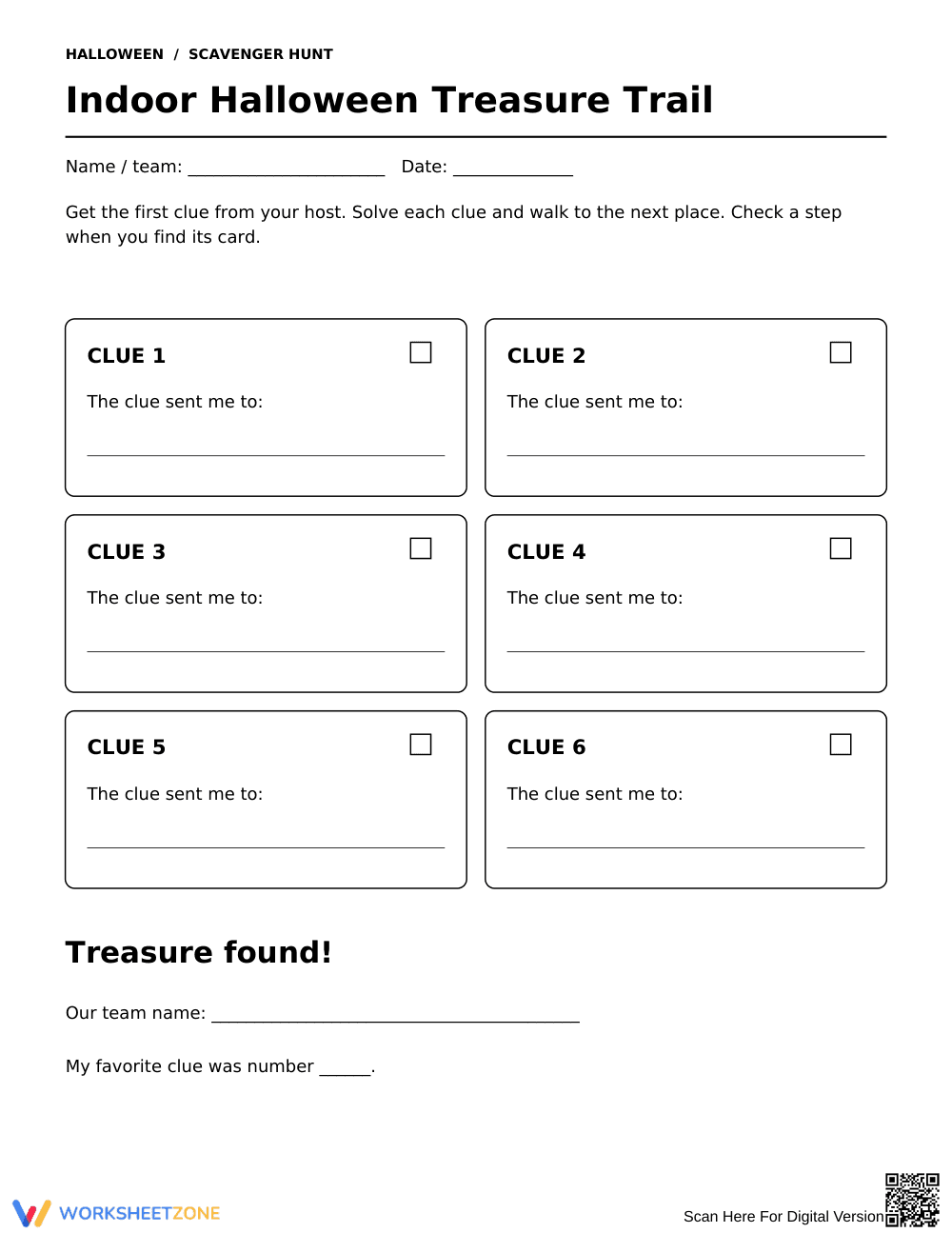
This indoor Halloween treasure trail gives students 10 rhyming clue cards that guide them through a spooky scavenger hunt around the classroom or home. Students practice close reading, inference, and directional comprehension as they decode each clue to find the next hidden location, building literacy skills inside a festive, engaging activity.
At a Glance
- Grade: K–4 · Subject: ELA / Reading
- Standard:
CCSS.ELA-LITERACY.RL.2.1— Ask and answer questions about key details in a text- Skill Focus: Reading comprehension, inference, following clues
- Format: 2 pages · 10 clue cards · Answer key included · PDF
- Best For: Halloween party activity or brain break
- Time: 15–25 minutes
What's Inside
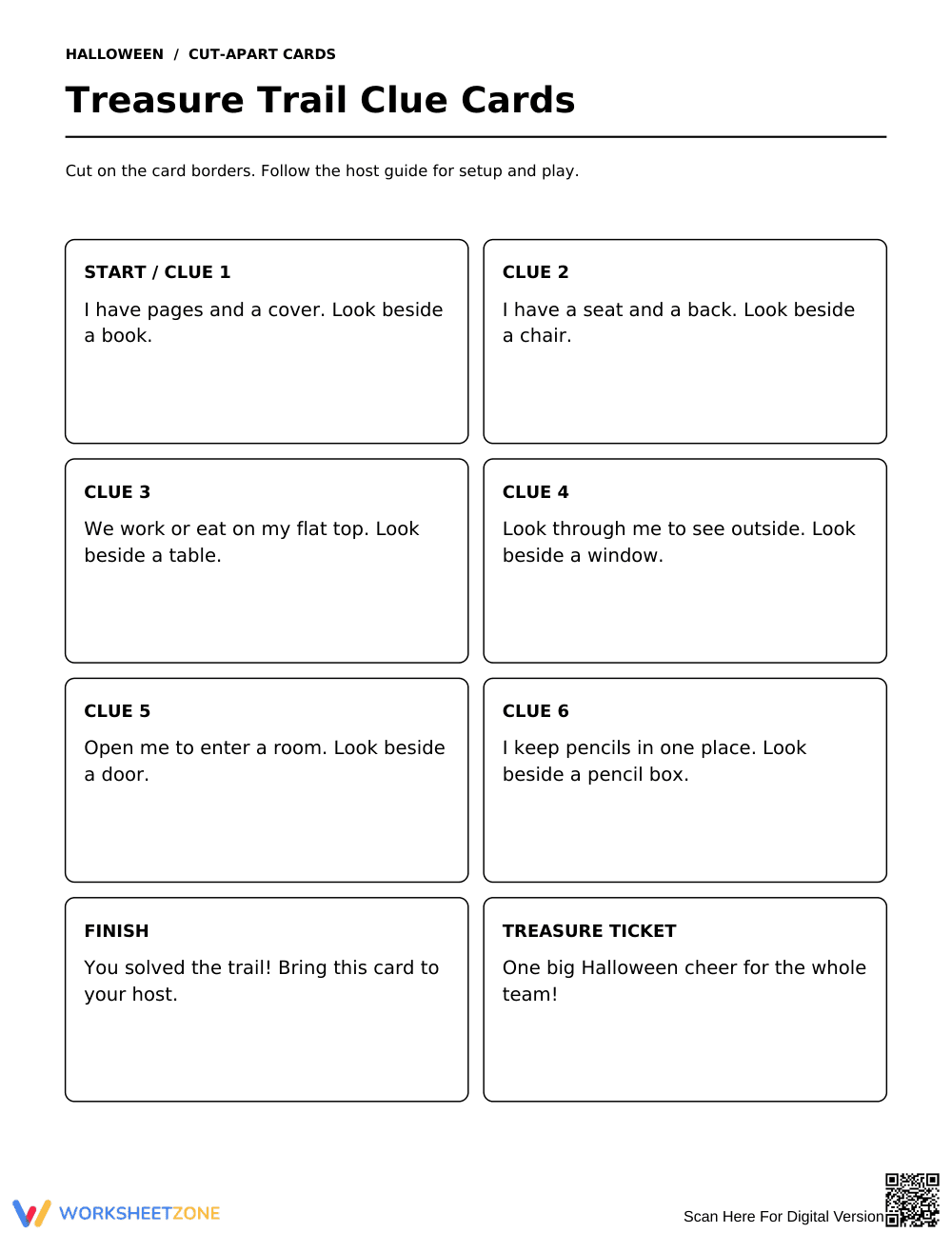
The worksheet includes 10 numbered clue cards, each featuring a short rhyming riddle that points students toward a common indoor location such as a pillow, a fridge, a shoe, or a mirror. Each clue is framed with a Halloween-themed border and uses accessible vocabulary suitable for emerging and developing readers. The answer key lists every clue alongside its corresponding hiding spot, making setup fast and error-free for teachers or parents.
Zero-Prep Workflow
- Print (1 minute): Print the two clue-card pages and cut along the dotted lines. No laminating required.
- Distribute (2 minutes): Hide each numbered card at the location described by the previous clue. Use the answer key to place cards accurately.
- Review (2 minutes): Hand students Clue 1 and let them work independently or in pairs. Collect completed trails and discuss tricky riddles as a group.
Total teacher prep time is under 5 minutes, making this activity ideal for substitute plans, Halloween classroom parties, or a quick reward activity. No additional materials are needed beyond scissors and a printer.
Standards Alignment
This treasure trail aligns to CCSS.ELA-LITERACY.RL.2.1: "Ask and answer such questions as who, what, where, when, why, and how to demonstrate understanding of key details in a text." Each clue card requires students to identify key details within a short rhyming passage and infer a physical location. A supporting standard, CCSS.ELA-LITERACY.RL.2.4, is addressed as students determine the meaning of words and phrases within the context of each riddle. Both standard codes can be copied directly into lesson plans, IEP goals, or district curriculum mapping tools.
How to Use It
Use this treasure trail as a culminating activity after direct instruction on inference or context clues. Observe which students need re-reads versus those who solve clues immediately — this provides a quick formative check on reading fluency and comprehension. Alternatively, assign it during a Halloween party block as structured literacy play. Most students complete the full trail in 15 to 25 minutes.
Who It's For
Designed for students in Grades K–4, this activity works well for mixed-ability groups because stronger readers can assist emerging readers during partner work. Pair it with a Halloween read-aloud or vocabulary anchor chart featuring seasonal words to extend the learning.
This indoor Halloween treasure trail targets CCSS.ELA-LITERACY.RL.2.1, asking students to read short rhyming clues and infer real-world locations based on key textual details. The activity reinforces the inference and close-reading skills that Fisher & Frey (2014) identify as foundational to the gradual release of responsibility framework, where students move from guided to independent application of comprehension strategies. With 10 clue cards, a complete answer key, and a print-ready PDF format, the resource provides a structured yet playful context for practicing detail-oriented reading. Teachers can use completion accuracy as an informal comprehension check, noting which clues required rereading or adult support to gauge individual student progress toward grade-level reading benchmarks.


