


























Views
Downloads

Essential Action Verbs Worksheet | Grade 1-3 ELA Printable
Paste this activity's link or code into your existing LMS (Google Classroom, Canvas, Teams, Schoology, Moodle, etc.).
Students can open and work on the activity right away, with no student login required.
You'll still be able to track student progress and results from your teacher account.
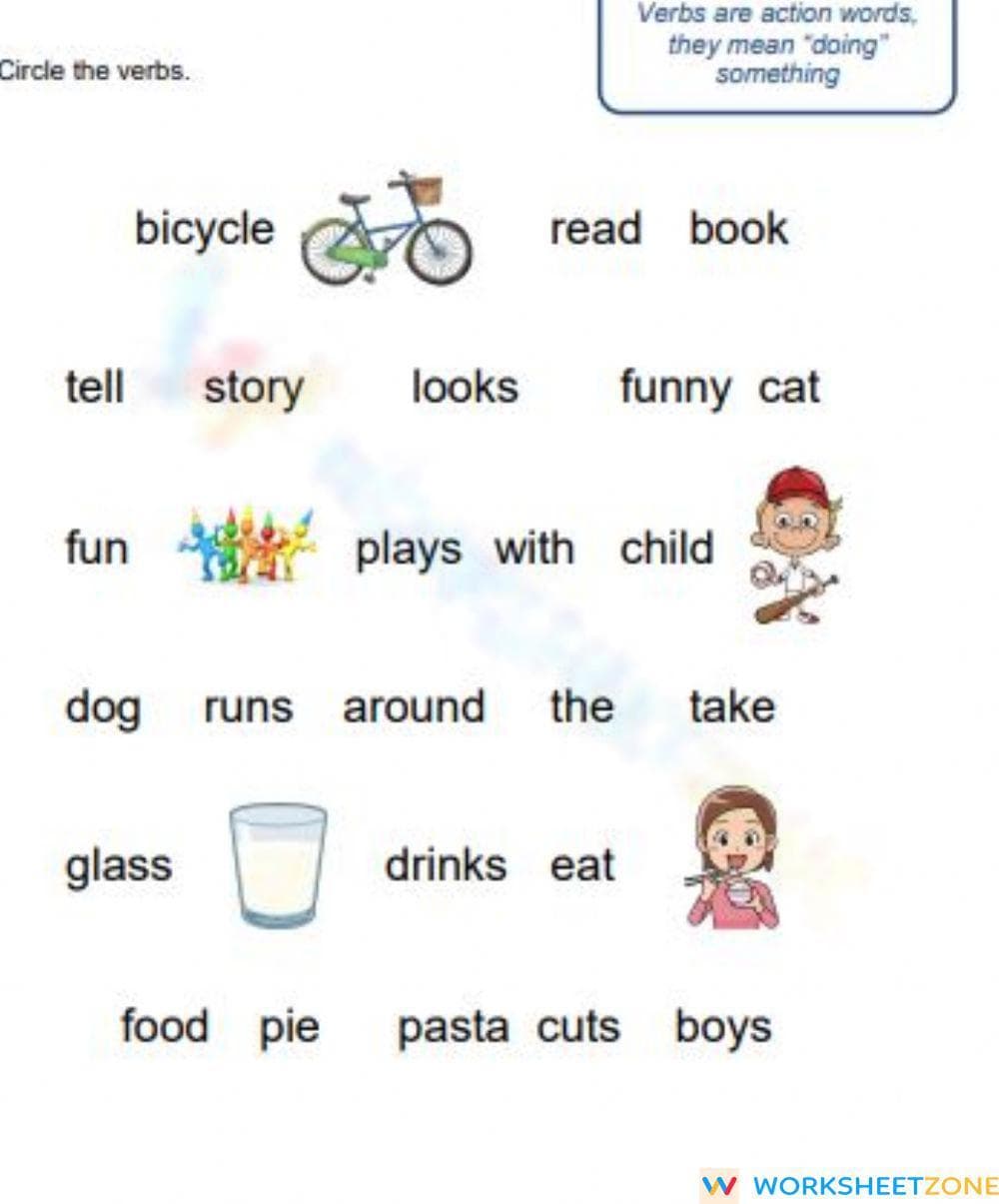
This printable Identifying Action Verbs worksheet helps elementary students distinguish between nouns and verbs through focused circling exercises. By isolating "doing" words from objects and descriptors, learners build a fundamental understanding of sentence structure and grammatical conventions. This resource ensures students can confidently recognize action-oriented language in their everyday reading and writing tasks.
At a Glance
- Grade: 1-3 · Subject: English Language Arts
- Standard:
CCSS.ELA-LITERACY.L.1.1— Correctly identify and use action verbs in basic grammar practice- Skill Focus: Identifying Action Verbs and Doing Words
- Format: 1 printable page · 23 total problems · Answer key included · High-quality PDF
- Best For: Literacy centers, grammar homework, and independent practice
- Time: 10–15 minutes
What's Inside
This single-page PDF features 23 distinct word choices accompanied by supportive illustrations for visual learners. The worksheet includes a clear definition box stating that verbs are "action words" that mean "doing something," providing an immediate reference point. Students encounter common nouns like "bicycle" and "book" alongside clear action verbs such as "read," "eat," and "run," allowing for direct comparison and discrimination.
Skill Progression
- Guided practice: The first items pair simple nouns with high-frequency verbs, allowing teachers to model the identification process during direct instruction.
- Supported practice: Middle-tier tasks include visual cues, such as images of a child playing or a girl eating, which help students connect text to concrete actions.
- Independent practice: The final section presents words without images, requiring students to rely on their understanding of word classes to make correct selections.
This gradual-release approach moves students from observation to independent mastery of the action verb concept using a scaffolded instructional model.
Standards Alignment
This worksheet is primarily aligned with CCSS.ELA-LITERACY.L.1.1, which requires students to demonstrate command of the conventions of standard English grammar and usage. It also supports CCSS.ELA-LITERACY.L.K.1.B by providing practice with frequently occurring verbs. Both standard codes can be copied directly into lesson plans, IEP goals, or district curriculum mapping tools.
How to Use It
Use this worksheet as a formative assessment during a grammar unit. Assign it as a "bell-ringer" or "exit ticket" to gauge student understanding of action words before moving to verb tenses. During the activity, observe if students rely on the pictures or the text; those struggling with non-illustrated items may need additional instruction. Most students will complete the exercise in approximately 12 minutes.
Who It's For
This resource is designed for Grade 1 through Grade 3 students building foundational grammar skills. It is especially effective for English Language Learners (ELLs) who benefit from visual associations between words and actions. This worksheet pairs naturally with a parts-of-speech anchor chart, a classroom word wall, or a short reading passage where students can highlight verbs.
The Identifying Action Verbs worksheet leverages the proven methodology of discrete categorization to reinforce lexical acquisition. According to research from Fisher & Frey (2014), the use of visual scaffolds alongside text-based tasks significantly enhances the ability of early learners to distinguish between word classes like nouns and verbs. By providing 23 unique opportunities for discrimination, this resource ensures that the CCSS.ELA-LITERACY.L.1.1 standard is addressed through high-repetition practice, which is essential for long-term retention of grammatical rules. Educational analysis indicates that students who master basic verb identification in early grades are better prepared for complex writing tasks involving subject-verb agreement and tense consistency later in their academic careers. This printable PDF serves as a reliable tool for classroom teachers and interventionists seeking a focused, evidence-based approach to grammar instruction and foundational literacy development.


