




























Views
Downloads
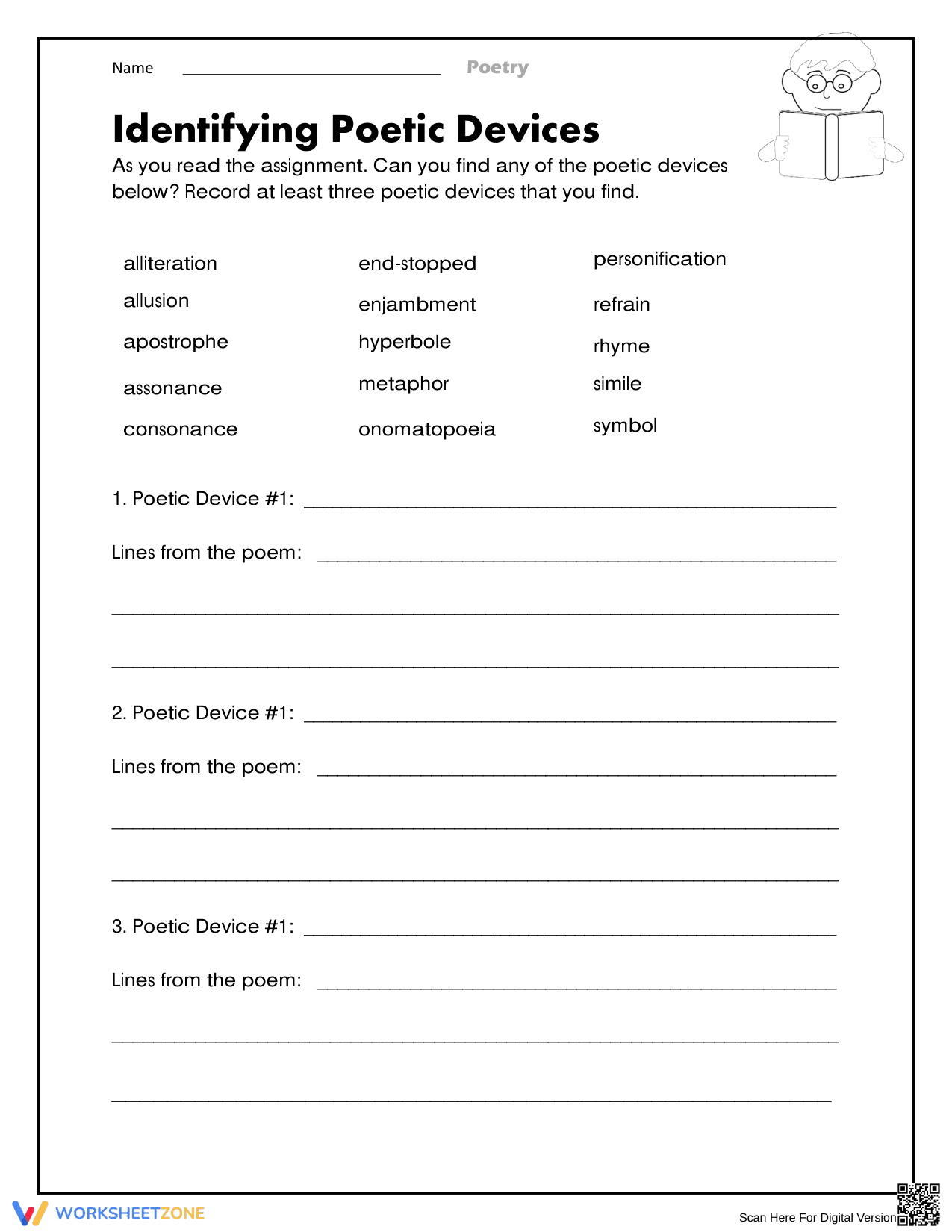

Essential Identifying Poetic Devices Worksheet | Grade 6-7

Paste this activity's link or code into your existing LMS (Google Classroom, Canvas, Teams, Schoology, Moodle, etc.).
Students can open and work on the activity right away, with no student login required.
You'll still be able to track student progress and results from your teacher account.
This essential Grade 6-7 ELA worksheet empowers students to master the identification of poetic devices within any literary text. By providing a comprehensive word bank and structured recording fields, it simplifies the complex process of literary analysis. Students gain confidence in spotting figurative language, enabling them to deconstruct poems with precision and deep understanding.
At a Glance
- Grade: 6–7 · Subject: ELA Poetry
- Standard:
CCSS.ELA-LITERACY.RL.6.4— Determine the meaning of words and phrases including figurative and connotative meanings- Skill Focus: Identifying Poetic Devices
- Format: 1 page · 3 tasks · Answer key included · PDF
- Best For: Independent practice or quick formative assessment
- Time: 15–20 minutes
This single-page PDF features a robust word bank of 15 essential poetic devices, including alliteration, metaphor, and enjambment. The worksheet provides three designated sections where students record a specific device found in their current reading assignment and transcribe the corresponding lines for evidence. A clear, minimalist layout ensures students stay focused on the text analysis without distractions.
Zero-Prep Workflow
The zero-prep workflow for this resource is designed for teacher efficiency. First, print the single-page PDF (30 seconds). Second, distribute to students with any poem (1 minute). Third, review student responses using the included answer key (5 minutes). Total preparation time is under two minutes, making it an ideal choice for sub plans or quick lesson transitions.
Standards Alignment
This resource is directly aligned to CCSS.ELA-LITERACY.RL.6.4, which requires students to determine the meaning of words and phrases as they are used in a text, including figurative meanings. By requiring students to cite specific lines, the worksheet supports evidence-based analysis. Both standard codes can be copied directly into lesson plans, IEP goals, or district curriculum mapping tools.
How to Use It
Use this worksheet as a formative assessment during a poetry unit to check for student understanding of figurative language. Alternatively, it serves as an excellent extension activity after a direct instruction lesson on specific devices like hyperbole or personification. Teachers should observe if students can correctly match the lines from the poem to the technical term in the word bank to gauge mastery.
Who It's For
This worksheet is designed for middle school students in grades 6 and 7, particularly those developing their literary analysis skills. It provides necessary scaffolding through the provided word bank while allowing for high-level thinking through text-to-term matching. This resource pairs naturally with any standard poetry anthology or short-form verse used during direct instruction.
Middle school literacy development hinges on the ability to recognize how authors use specific language choices to create meaning. According to research from Fisher & Frey (2014), structured tools that provide vocabulary support—like the word bank in this CCSS.ELA-LITERACY.RL.6.4 aligned resource—allow students to move toward independent mastery of complex literary concepts. Identifying poetic devices such as alliteration and metaphor is a gateway to deeper reading comprehension. By isolating three specific examples and requiring textual evidence, this worksheet ensures students engage in the high-leverage practice of close reading. This systematic approach to analyzing poetic devices has been shown to improve student performance in ELA assessments by building a robust vocabulary and a keener eye for authorial intent. This resource provides a reliable framework for students to practice these essential interpretive skills across various literary genres and text types.


