


























Views
Plays


Grade 4 Parts of Speech — Printable No-Prep Worksheet
Paste this activity's link or code into your existing LMS (Google Classroom, Canvas, Teams, Schoology, Moodle, etc.).
Students can open and work on the activity right away, with no student login required.
You'll still be able to track student progress and results from your teacher account.
This Grade 4 grammar worksheet provides immediate practice with identifying parts of speech to help students strengthen their foundational language skills. By categorizing nouns, verbs, adjectives, adverbs, and pronouns in isolation and within sentences, learners build the grammatical awareness necessary for stronger reading comprehension and writing.
At a Glance
- Grade: 4 · Subject: ELA
- Standard:
CCSS.ELA-LITERACY.L.4.1— Demonstrate command of standard English grammar conventions- Skill Focus: Identifying parts of speech
- Format: 2 pages · 15 problems · Answer key included · PDF
- Best For: Quick formative assessment
- Time: 10–15 minutes
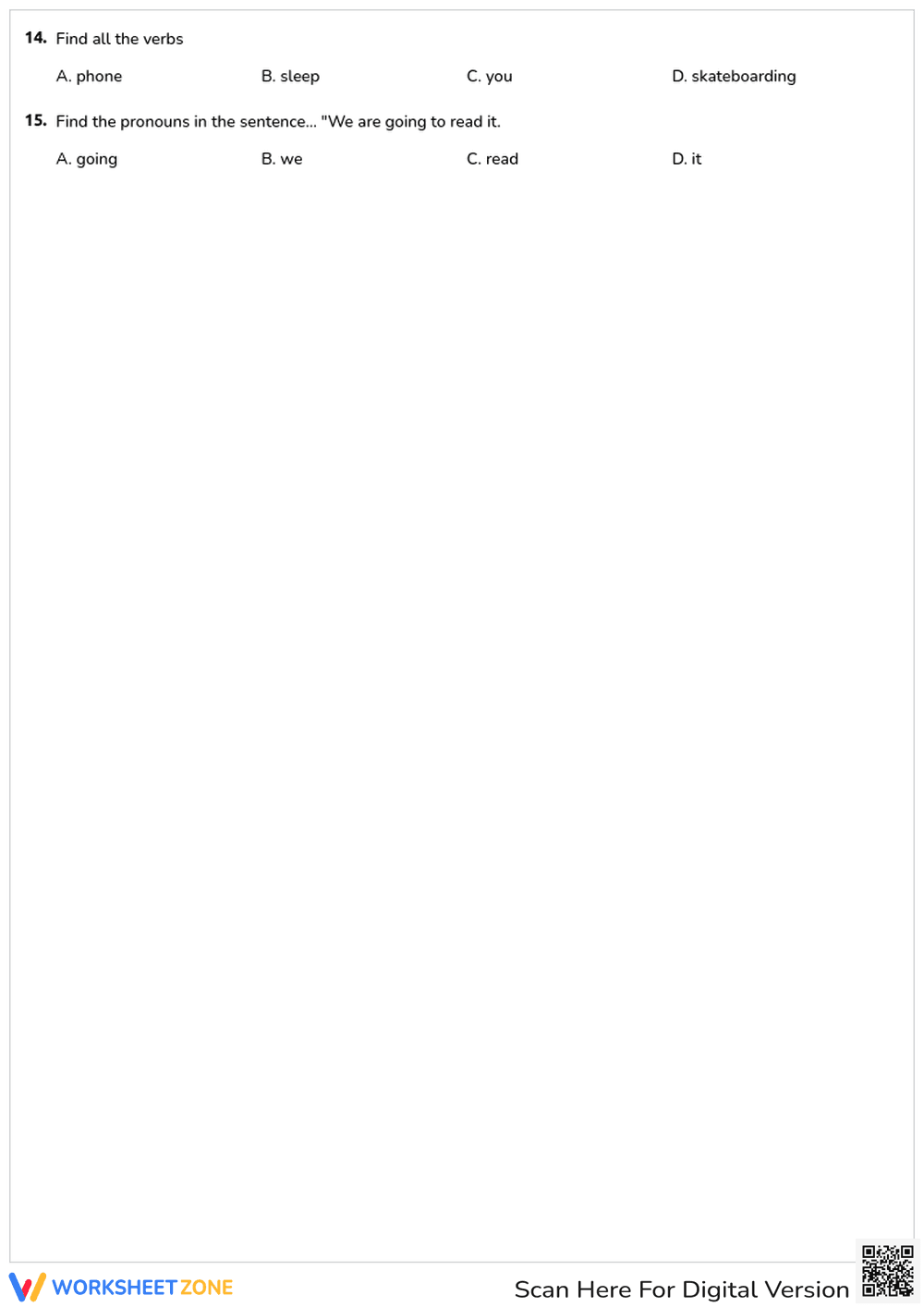
This resource features a straightforward, 15-question multiple-choice quiz spanning two pages. Students are tasked with identifying specific parts of speech from a list of words, determining the correct part of speech for a given word, and locating specific word types within short sentences. The clear formatting minimizes distractions, and a complete answer key is included to ensure accurate and efficient grading.
Designed for maximum efficiency, this worksheet requires zero teacher setup:
- Print (1 minute): The two-page layout is ready to print or copy immediately.
- Distribute (1 minute): Hand out to students as a bell-ringer, independent practice activity, or quiz.
- Review (3 minutes): Use the provided answer key to grade quickly or facilitate a whole-class review session.
With under two minutes of total teacher prep time required, this activity is an excellent addition to any emergency sub plan or last-minute lesson adjustment.
This worksheet is aligned to primary standard CCSS.ELA-LITERACY.L.4.1, requiring students to demonstrate command of the conventions of standard English grammar and usage when writing or speaking. It also supports foundational review of earlier grade-level expectations regarding the function of nouns, pronouns, verbs, adjectives, and adverbs. Both standard codes can be copied directly into lesson plans, IEP goals, or district curriculum mapping tools.
Deploy this worksheet after direct instruction on the basic parts of speech to gauge student understanding. It serves perfectly as a Friday grammar quiz or a mid-week independent practice assignment. As a formative assessment observation tip, note whether students consistently confuse adjectives and adverbs; this common misconception can quickly inform your small-group reteaching strategy for the following week. Expected completion time is 10 to 15 minutes.
This resource is designed for 4th and 5th-grade general education students, though it serves as an excellent review tool for middle school students needing foundational grammar reinforcement. The multiple-choice format provides built-in scaffolding for English Language Learners and students with IEPs who benefit from structured options rather than open-ended generation. Pair this worksheet with a classroom anchor chart detailing the definitions and examples of each part of speech for optimal results.
Mastery of foundational grammar, such as identifying parts of speech, is a critical component of overall literacy development. According to Fisher & Frey (2014), explicit instruction and structured practice in language conventions significantly improve students' ability to construct complex sentences and comprehend rigorous academic texts. This resource supports that instructional goal by providing targeted practice aligned to CCSS.ELA-LITERACY.L.4.1, ensuring students can demonstrate command of standard English grammar conventions. By isolating specific word classes—nouns, verbs, adjectives, adverbs, and pronouns—educators can pinpoint exact areas of grammatical weakness before they impact broader writing proficiency. Utilizing focused, multiple-choice assessments allows for rapid identification of these gaps, facilitating timely and effective instructional interventions that keep learners on track for grade-level reading and writing success.


