


























Views
Downloads
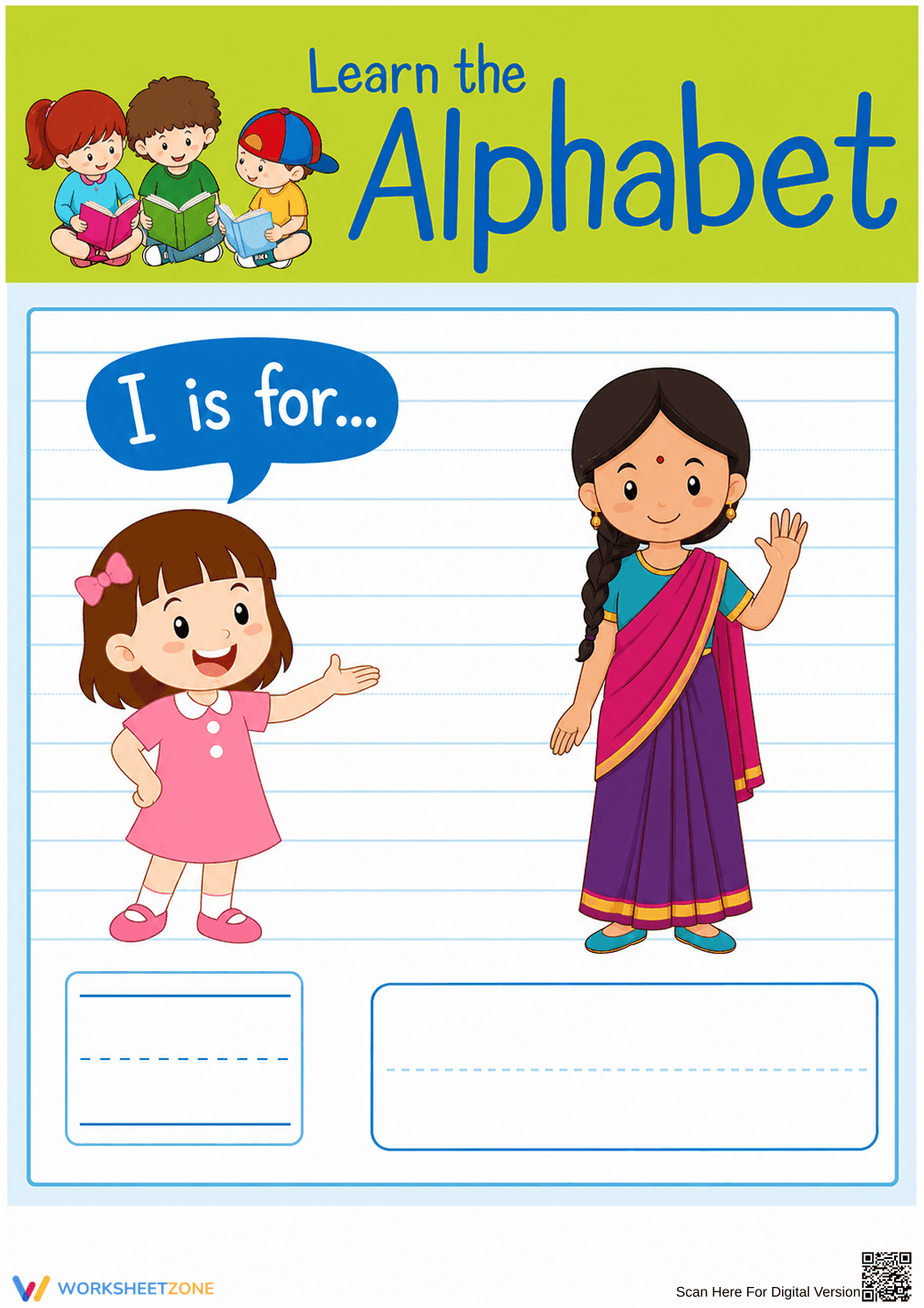

Letter I Beginning Sound Worksheet | Grade K-2 Essential
Paste this activity's link or code into your existing LMS (Google Classroom, Canvas, Teams, Schoology, Moodle, etc.).
Students can open and work on the activity right away, with no student login required.
You'll still be able to track student progress and results from your teacher account.
This Letter I beginning sound worksheet helps early learners connect the phoneme /i/ to its grapheme through visual association and handwriting practice. Students identify the initial sound in the word "Indian" and practice letter formation on primary ruled lines. This activity builds the foundational phonemic awareness necessary for early reading success.
At a Glance
- Grade: Kindergarten · Subject: ELA Phonics
- Standard:
CCSS.ELA-LITERACY.RF.K.3.A— Demonstrate basic knowledge of one-to-one letter-sound correspondences for consonants and vowels- Skill Focus: Letter I Beginning Sound
- Format: 1 page · 2 tasks · No answer key needed · PDF
- Best For: Initial phonics instruction and letter recognition
- Time: 10–15 minutes
The worksheet features a vibrant "Learn the Alphabet" header with engaging illustrations of children reading. The main workspace includes a speech bubble prompt "I is for..." paired with a culturally representative illustration of an Indian woman. At the bottom, students find two distinct handwriting areas: a small box for the capital or lowercase letter and a wider box for the full word, both using dotted midline guides to support fine motor development.
The zero-prep workflow for this resource is designed for maximum efficiency in busy classrooms. First, print the single-page PDF (30 seconds). Second, distribute the sheets to students during your phonics block or morning work rotation (1 minute). Finally, review the beginning sound orally as a group to reinforce the phoneme-grapheme connection (30 seconds). This resource is an ideal "grab-and-go" option for substitute folders or unexpected transition times when students need meaningful, independent work.
This resource aligns with `CCSS.ELA-LITERACY.RF.K.3.A`, which requires students to demonstrate basic knowledge of one-to-one letter-sound correspondences. It also supports `CCSS.ELA-LITERACY.L.K.1.A` by providing a structured space for printing upper- and lowercase letters. Both standard codes can be copied directly into lesson plans, IEP goals, or district curriculum mapping tools to ensure all instructional minutes are standards-aligned.
Use this worksheet during the "You Do" phase of a gradual release lesson on the letter I. After introducing the sound /i/ with an anchor chart, have students complete this page independently to demonstrate mastery. It also serves as an effective formative assessment tool; observe student pencil grip and letter formation directionality as they work. Completion typically takes 10 to 15 minutes depending on the student's fine motor development and familiarity with the alphabet.
This activity is designed for Kindergarten students, though it provides excellent remedial support for Grade 1 and Grade 2 learners who need additional phonics reinforcement. It pairs naturally with a letter-of-the-week curriculum or a specific phonics reader focusing on short vowel sounds. The visual cues make it accessible for English Language Learners (ELLs) building basic vocabulary while mastering English phonemes.
Research from Fisher & Frey (2014) emphasizes the importance of multi-modal learning where visual cues and physical writing tasks reinforce phonemic awareness. This worksheet applies these principles by linking the auditory /i/ sound to a visual image and the kinesthetic act of tracing. By focusing on `CCSS.ELA-LITERACY.RF.K.3.A`, the resource ensures that students are meeting high-frequency literacy benchmarks early in their academic careers. According to the RAND AIRS 2024 report, consistent exposure to letter-sound correspondence through structured worksheets significantly improves decoding speed in primary grades. This 1-page resource provides the targeted practice necessary for students to move from simple recognition to fluent production of the letter I. The inclusion of primary ruled lines ensures that students develop proper spatial awareness and letter sizing, which are critical components of early writing proficiency.


