


























Views
Downloads

Essential Grade 1 Science: How Animals Help Their Young
Paste this activity's link or code into your existing LMS (Google Classroom, Canvas, Teams, Schoology, Moodle, etc.).
Students can open and work on the activity right away, with no student login required.
You'll still be able to track student progress and results from your teacher account.
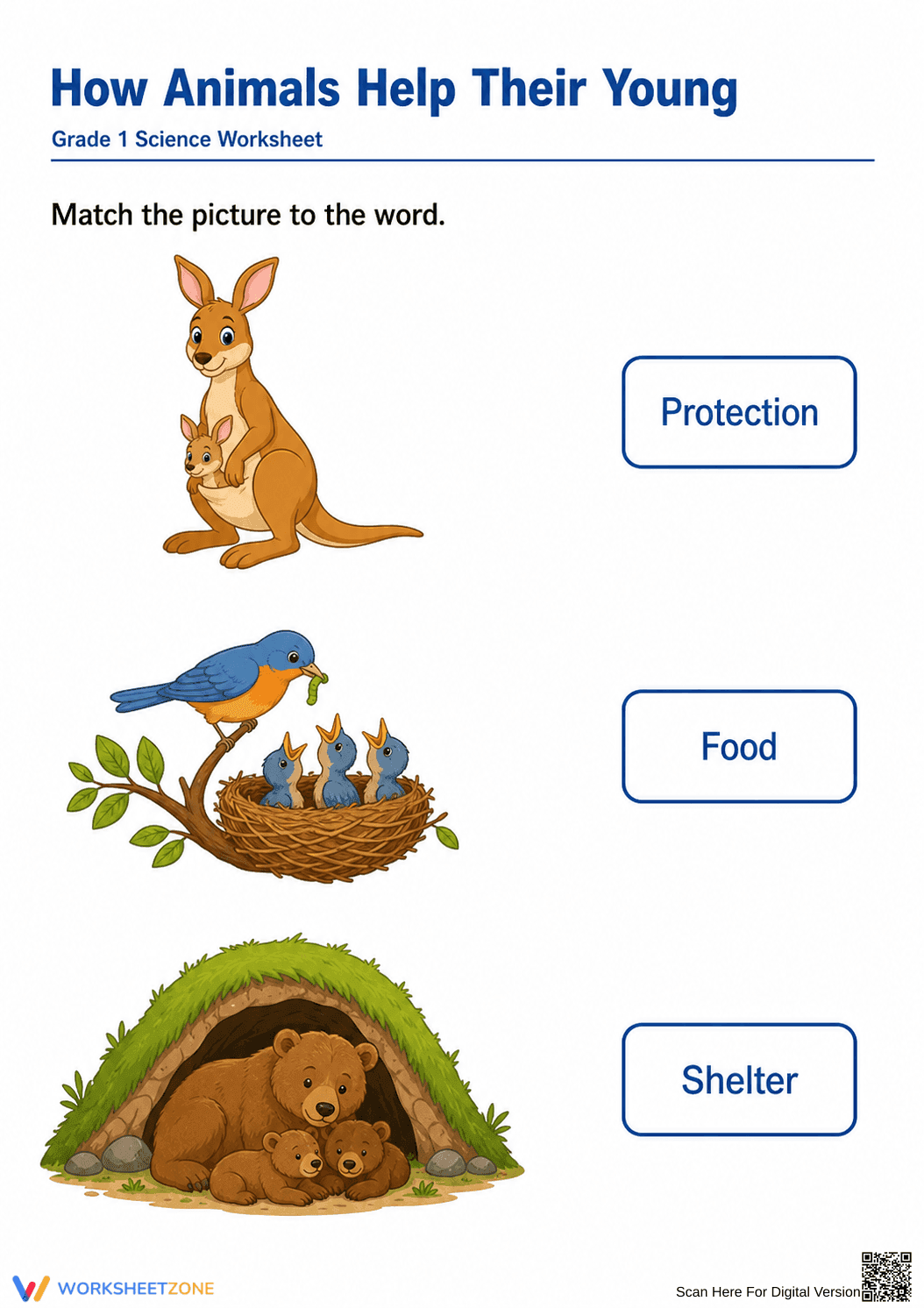
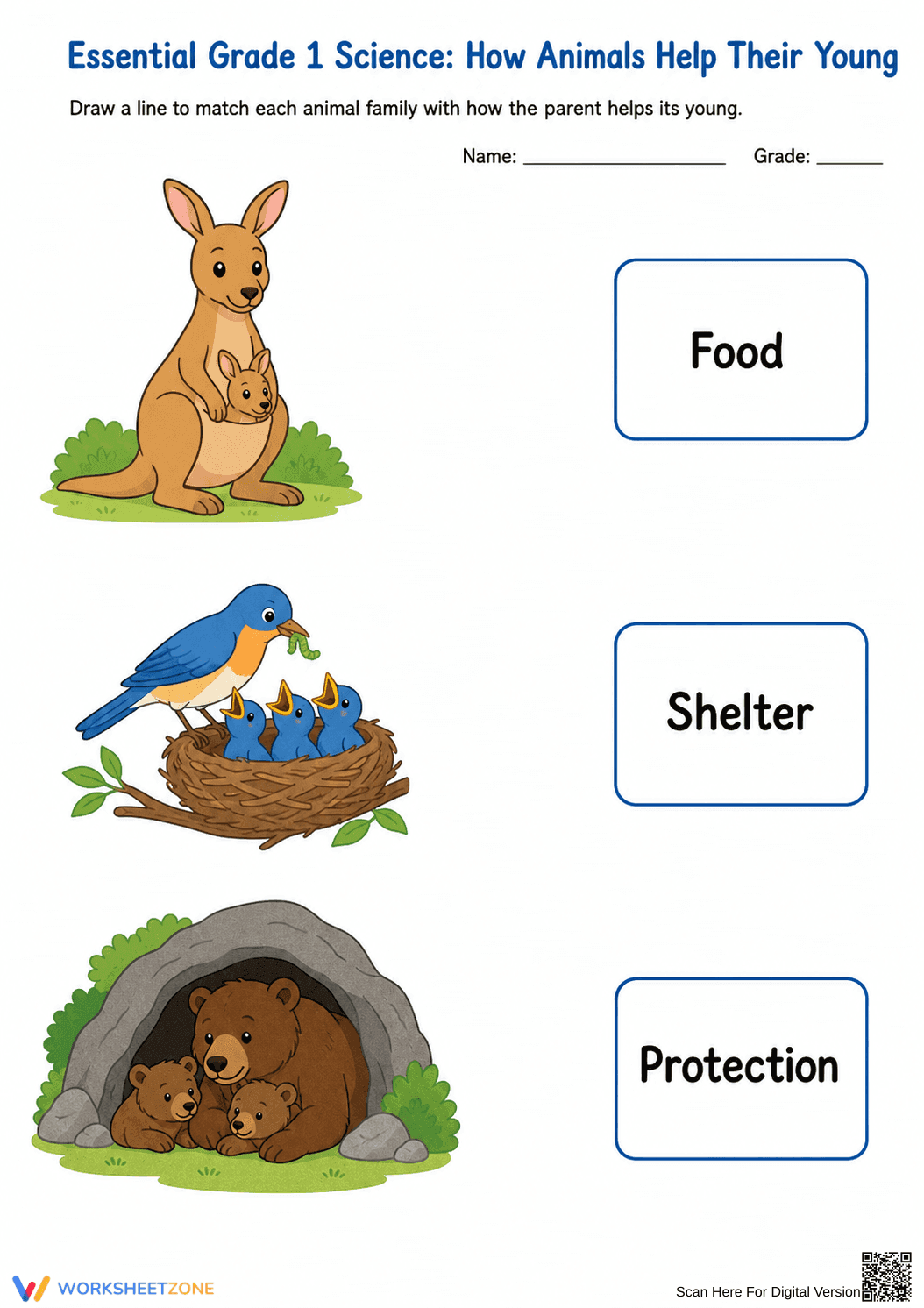
Students will identify essential survival patterns in animal families by matching parental behaviors to offspring needs. This Grade 1 science worksheet focuses on food, shelter, and protection through clear illustrations. It allows learners to describe how animals support their young, meeting primary life science standards while building foundational observation skills.
At a Glance
- Grade: 1 · Subject: Science
- Standard:
1-LS1-2— Determine patterns in behaviors of parents and offspring that help offspring survive- Skill Focus: Parental care and survival needs
- Format: 1 page · 3 problems · Answer key included · PDF
- Best For: Introduction to animal life cycles and needs
- Time: 10–15 minutes
This printable features a high-quality single-page layout with three matching tasks. Students observe visual cues—a kangaroo with a joey, a bird feeding chicks, and a bear family—to connect them with food, shelter, and protection. A full-color answer key is included for rapid grading or student self-correction.
Zero-Prep Workflow
This resource is designed for immediate classroom use. Teachers can follow these three steps to integrate the activity:
- Print: Copy for the class in under 30 seconds.
- Distribute: Hand out as a warm-up in less than 1 minute.
- Review: Use the answer key for checks in 5 minutes.
The clear visual instructions make this an ideal choice for substitute teacher plans or independent morning work folders.
Standards Alignment
The content is primarily aligned with 1-LS1-2, which requires students to read texts or use media to determine patterns in behavior of parents and offspring that help offspring survive. By analyzing the provided images, students identify the mechanics behind parental care strategies. This standard code can be copied directly into lesson plans, IEP goals, or district curriculum mapping tools.
How to Use It
Use this as a formative assessment after teaching animal families. Observe if students distinguish between "shelter" and "protection." Allow 12 minutes for independent work before discussing the examples as a group. This identifies students needing vocabulary support. It is perfect for reinforcing scientific terminology through visual evidence during direct instruction.
Who It's For
This is crafted for first-grade students but works for Kindergarten introductions. It is effective for English Language Learners as visual literacy reduces linguistic barriers to scientific concepts. Pair this with an informational passage or anchor chart about wildlife to deepen the connection between the worksheet and the natural world.
Research from RAND AIRS 2024 indicates that integrating visual matching tasks in early science education significantly improves the retention of biological concepts among primary learners. This worksheet addresses 1-LS1-2 by requiring students to identify patterns in behavior that ensure offspring survival, such as the provision of food, shelter, and protection. By focusing on these core survival strategies, the activity builds the conceptual framework necessary for later mastery of ecosystem dynamics. Fisher & Frey (2014) emphasize that such scaffolds are vital for the gradual release of responsibility, moving students from guided observation to independent reasoning. This evidence-based approach ensures the worksheet is a structured component of a rigorous science curriculum that meets developmental needs while adhering to national frameworks. It provides a measurable way to track student progress toward mastering NGSS performance expectations.


