


























Views
Downloads
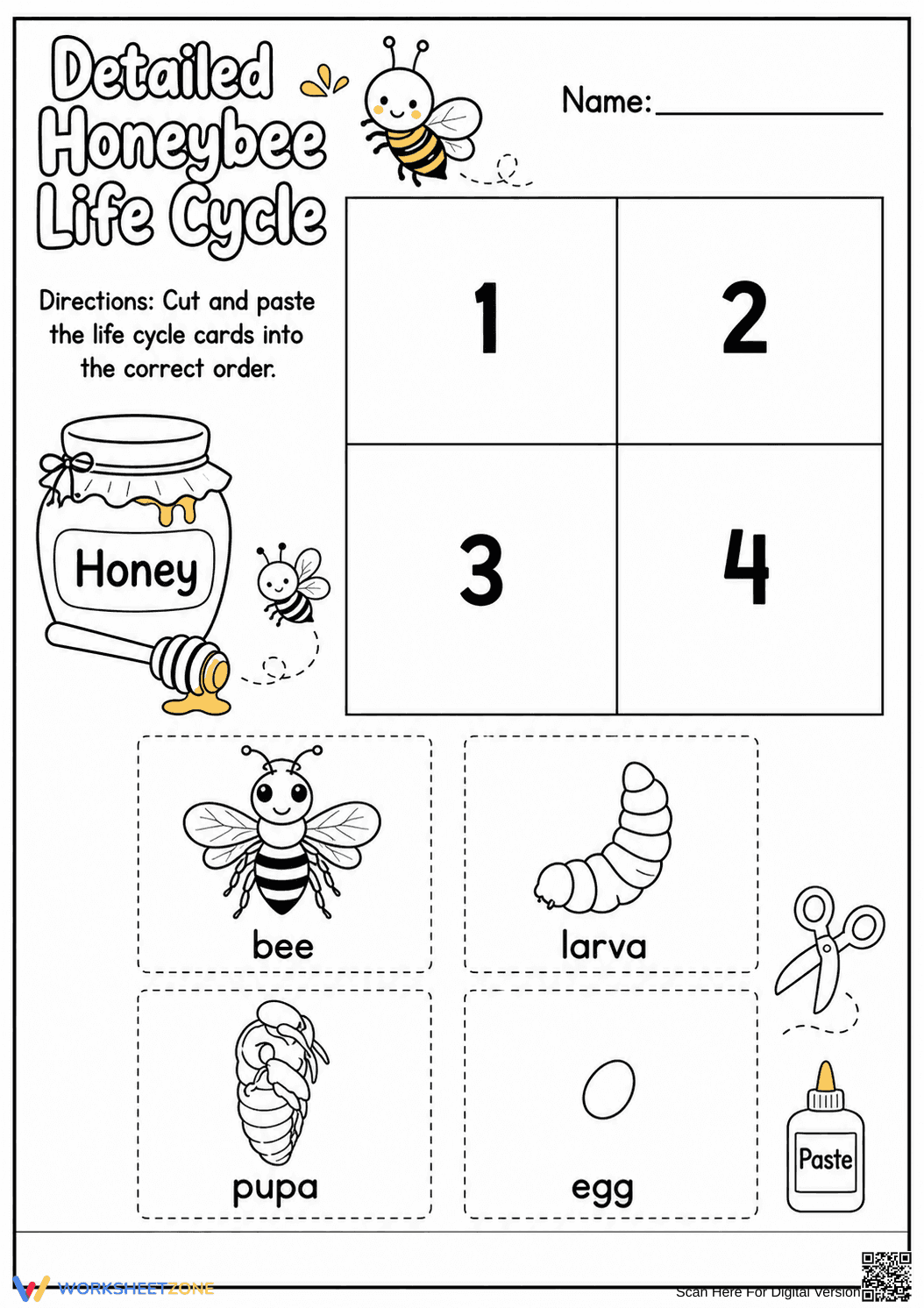

Grade 3 Honeybee Life Cycle — Printable No-Prep Worksheet
Paste this activity's link or code into your existing LMS (Google Classroom, Canvas, Teams, Schoology, Moodle, etc.).
Students can open and work on the activity right away, with no student login required.
You'll still be able to track student progress and results from your teacher account.
This Grade 3 science worksheet lets students sequence the four stages of a honeybee's development. By cutting and pasting the egg, larva, pupa, and adult bee into the correct order, learners model biological growth while reinforcing fine motor and chronological reasoning skills.
At a Glance
- Grade: 3 · Subject: Science
- Standard:
3-LS1-1— Model the unique and diverse life cycles of organisms- Skill Focus: Sequencing biological life cycles
- Format: 1 page · 4 problems · Answer key included · PDF
- Best For: Independent practice and science centers
- Time: 15–20 minutes
This single-page resource features a four-step numbered grid alongside four illustration cards depicting the honeybee life cycle. Students cut out the labeled cards—egg, larva, pupa, and bee—and paste them sequentially into the grid. The worksheet includes bold text, engaging line-art illustrations suitable for coloring, and a complete answer key for quick grading.
Designed for immediate classroom implementation, this activity requires minimal setup:
- Print (1 minute): Generate copies of the single-page PDF and answer key.
- Distribute (1 minute): Hand out worksheets, scissors, and glue sticks.
- Review (3 minutes): Briefly discuss the four stages before independent work.
With total teacher prep time under two minutes, this resource is perfect for emergency sub plans or science centers.
Aligned with Next Generation Science Standard 3-LS1-1: Develop models to describe that organisms have unique and diverse life cycles. By physically arranging the stages of the honeybee, students create a tangible model of this biological process. Both standard codes can be copied directly into lesson plans, IEP goals, or district curriculum mapping tools.
Deploy this worksheet during independent practice, immediately following direct instruction on insect development. It serves as an excellent tactile activity to solidify vocabulary. Alternatively, use it as a formative assessment tool. As students work, observe their ability to correctly identify the transition from larva to pupa. Expected completion time ranges from 15 to 20 minutes.
Designed for third-grade science students, this resource is easily adaptable for second-grade enrichment or fourth-grade review. The visual cut-and-paste format provides built-in scaffolding for English Language Learners and kinesthetic learners. Pair this worksheet with a nonfiction read-aloud about bees or a classroom anchor chart for maximum instructional impact.
Integrating hands-on modeling tasks like sequencing the honeybee life cycle significantly enhances student retention of foundational biological concepts. Aligned with 3-LS1-1, this activity requires learners to model the unique and diverse life cycles of organisms through direct tactile engagement. According to a recent ScienceDirect TpT Analysis, incorporating kinesthetic elements such as cutting and pasting into elementary science instruction demonstrably improves both conceptual understanding and fine motor coordination. When students physically manipulate the distinct stages of development—moving sequentially from egg to larva, pupa, and adult bee—they build much stronger cognitive pathways than they would through passive observation or rote memorization alone. This active learning approach ensures that essential science vocabulary is firmly anchored in concrete, sequential logic, ultimately preparing students for more complex ecological and environmental studies in subsequent grade levels.


