


























Views
Downloads
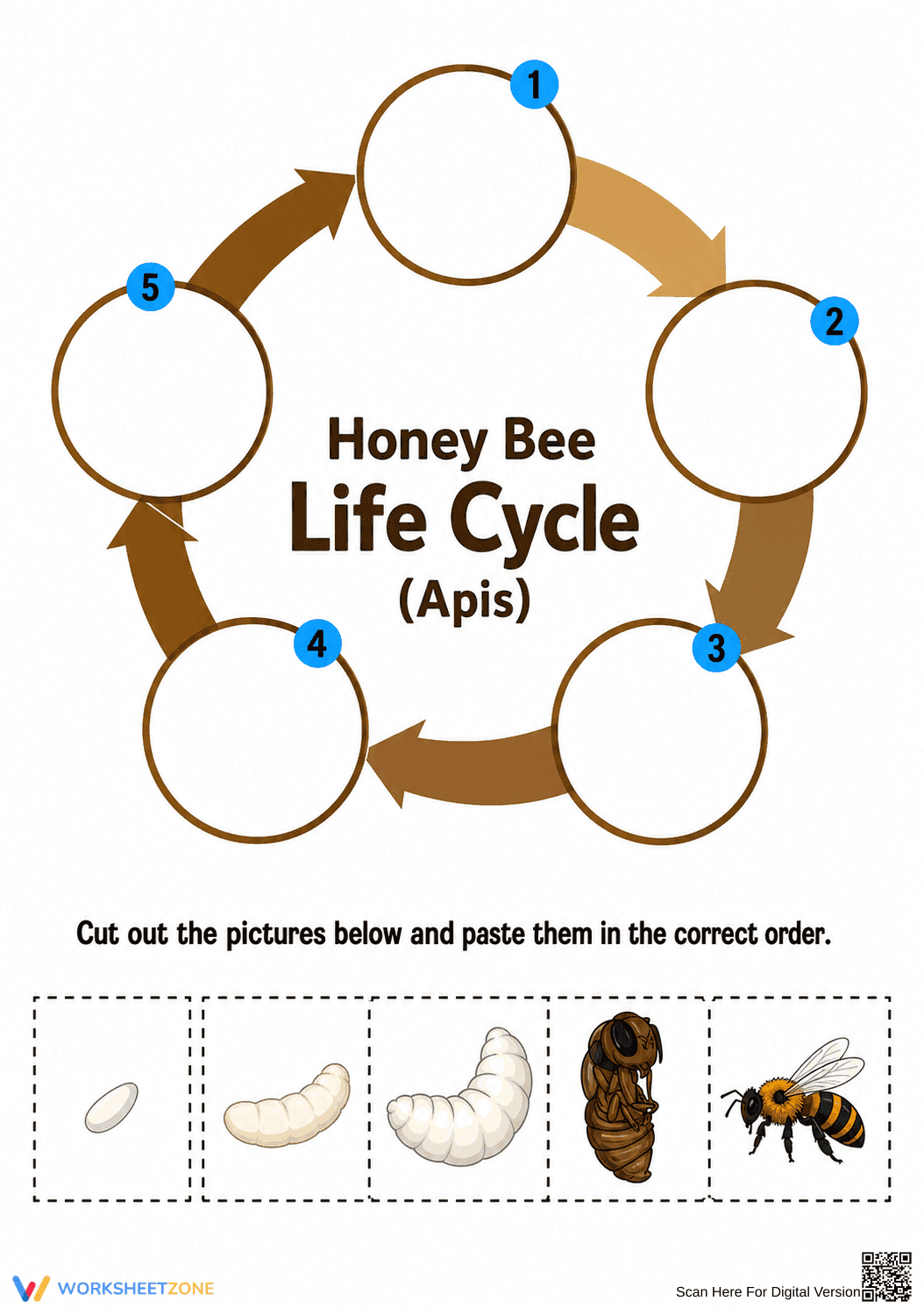

Grade 3 Honey Bee Life Cycle — Printable No-Prep Worksheet
Paste this activity's link or code into your existing LMS (Google Classroom, Canvas, Teams, Schoology, Moodle, etc.).
Students can open and work on the activity right away, with no student login required.
You'll still be able to track student progress and results from your teacher account.
This Grade 3 science worksheet helps students visualize and sequence the biological development of a honey bee. By cutting and pasting five distinct developmental stages into a circular diagram, learners actively build their understanding of insect life cycles while practicing essential fine motor and chronological ordering skills.
At a Glance
- Grade: 3 · Subject: Science
- Standard:
3-LS1-1— Develop models describing unique and diverse organism life cycles- Skill Focus: Sequencing life cycle stages
- Format: 1 page · 5 problems · Answer key included · PDF
- Best For: Independent practice and science centers
- Time: 15–20 minutes
What's Inside
Inside this single-page resource, educators will find a clear, circular life cycle diagram featuring five numbered placeholders. The bottom of the page provides five detailed, scientifically accurate illustrations of the honey bee (Apis) in its egg, larval, pupal, and adult stages. Students complete five cut-and-paste tasks to arrange these illustrations into the correct sequential order. A complete answer key is included for quick grading.
Zero-Prep Workflow
- Print (1 minute): Simply print the PDF copies for your class. No special materials are required beyond standard scissors and glue sticks.
- Distribute (1 minute): Hand out the worksheets during your science block or place them in a designated independent learning center.
- Review (3 minutes): Use the included answer key to quickly verify that students have placed the egg, larva, pupa, and adult stages in the correct chronological order.
Total teacher prep time is under two minutes, making this an excellent, reliable option for emergency sub plans.
Standards Alignment
This resource is aligned to primary standard 3-LS1-1: Develop models to describe that organisms have unique and diverse life cycles but all have in common birth, growth, reproduction, and death. This activity serves as a concrete model of the growth and development phases of an insect. Both standard codes can be copied directly into lesson plans, IEP goals, or district curriculum mapping tools.
How to Use It
This resource works perfectly as an independent practice activity immediately after direct instruction on insect life cycles. Alternatively, it can be used as a hands-on science center station where students collaborate to determine the correct sequence. As a formative assessment observation tip, watch how students order the multiple larval and pupal stages before pasting to gauge their understanding of gradual metamorphosis. Expected completion time is 15 to 20 minutes.
Who It's For
This worksheet is designed for third-grade science students, though it is easily adaptable for second or fourth graders studying biology. The visual nature of the cut-and-paste activity provides built-in differentiation for English Language Learners and visual learners who benefit from reduced text complexity. It pairs naturally with an informational text passage or a read-aloud book about bees and pollination.
Aligning science instruction with hands-on modeling tasks significantly improves student retention of foundational biological concepts in the elementary classroom. This worksheet directly targets standard 3-LS1-1, requiring students to develop models describing unique and diverse organism life cycles. According to a ScienceDirect TpT Analysis (2024), integrating interactive, tactile elements like cut-and-paste sequencing into elementary science worksheets increases task completion rates and deepens conceptual understanding of chronological processes compared to traditional fill-in-the-blank alternatives. By physically moving the distinct developmental stages of the honey bee from egg to adult, learners actively construct a mental model of metamorphosis that static reading simply cannot provide. This active engagement strategy ensures that foundational biology concepts are firmly anchored in observable, sequential logic, ultimately preparing students for more complex ecological and environmental studies in later grades.


