


























Views
Downloads


Printable Homophones Worksheet | Grade 1 ELA Practice
Paste this activity's link or code into your existing LMS (Google Classroom, Canvas, Teams, Schoology, Moodle, etc.).
Students can open and work on the activity right away, with no student login required.
You'll still be able to track student progress and results from your teacher account.
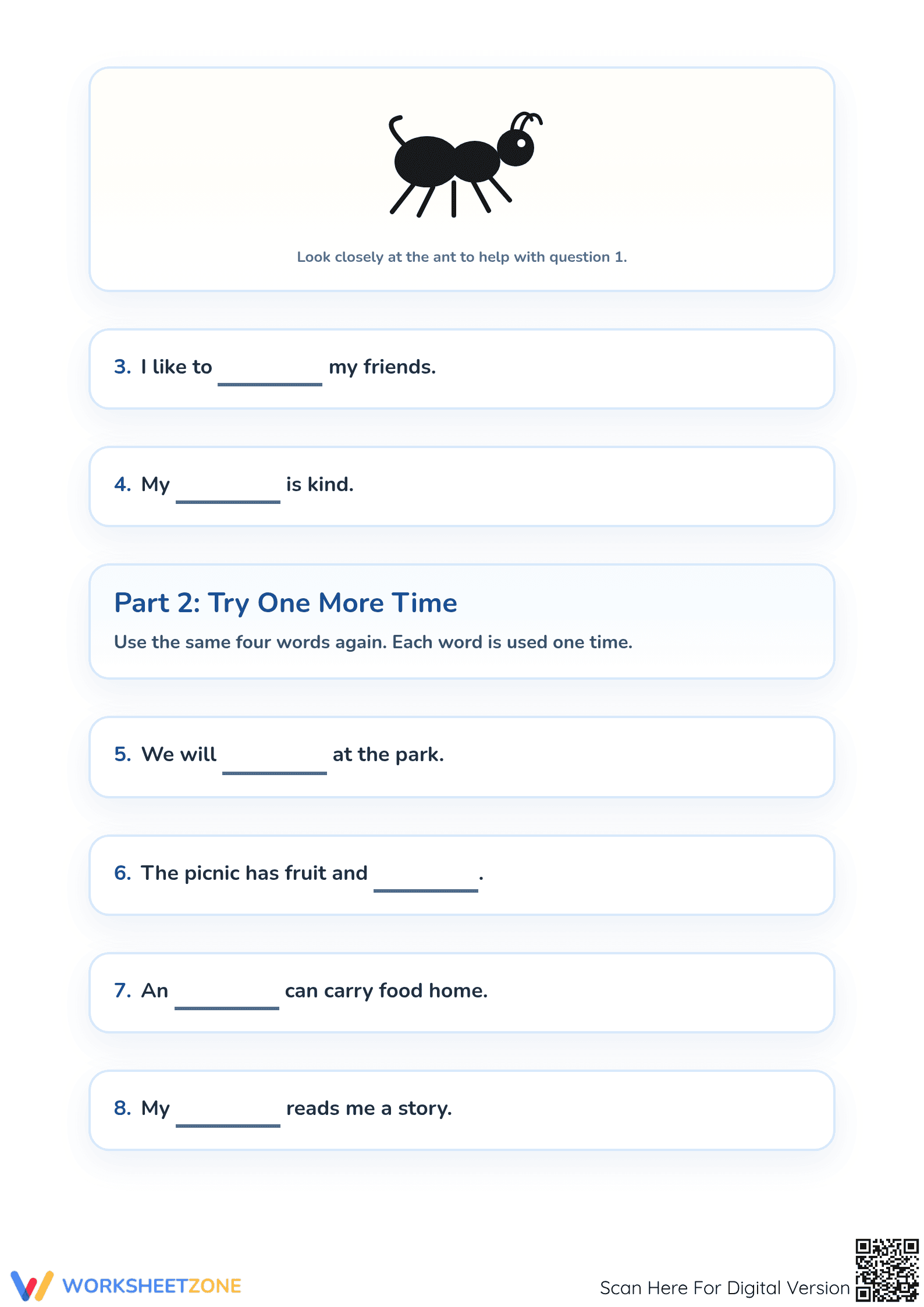
This printable Grade 1 homophones worksheet helps young learners distinguish between words that sound identical but carry different meanings and spellings. By engaging with sentences featuring common pairs like "ant/aunt" and "meat/meet," students build essential vocabulary and decoding skills. This resource ensures students can accurately select the correct lexical choice based on context clues provided in every sentence.
At a Glance
- Grade: 1 · Subject: English Language Arts (ELA)
- Standard:
CCSS.ELA-LITERACY.L.1.4— Determine or clarify the meaning of multiple-meaning words and phrases in context.- Skill Focus: Homophone Differentiation and Usage
- Format: 2 pages · 8 problems · Answer key included · PDF
- Best For: Independent practice or literacy centers
- Time: 15–20 minutes
What's Inside
The worksheet is organized into two parts across two pages for first-grade readability. Part 1 includes a Word Bank with four words—meet, meat, ant, and aunt—and four initial sentences. Part 2, "Try One More Time," applies those same words to four different sentences, ensuring mastery through repeated exposure. A full answer key is included to facilitate quick student feedback and grading.
Zero-Prep Workflow
Teachers can deploy this resource with zero lead time. The three-step workflow is simple: Print the two pages (30 seconds), distribute to the class (1 minute), and review with the included key (5 minutes). This efficient process makes it perfect for sub plans or quick transitions between reading blocks, requiring less than two minutes of total teacher preparation.
Standards Alignment
This resource is explicitly aligned to CCSS.ELA-LITERACY.L.1.4, which requires students to determine or clarify the meaning of unknown and multiple-meaning words and phrases. By selecting the correct homophone to complete a sentence, students demonstrate an understanding of how context dictates word choice. Both standard codes can be copied directly into lesson plans, IEP goals, or district curriculum mapping tools.
How to Use It
Deploy this during literacy rotations after a lesson on homophones. Teachers can observe which students use the ant illustration versus sentence context to make their choices. It works well as a 15-minute morning work task or a formative assessment. Observing student choices helps identify those who need extra support with multiple-meaning words in a classroom setting.
Who It's For
This activity is designed for Grade 1 students who are beginning to explore lexical nuances and spelling variations. It provides excellent support for English Language Learners (ELLs) who may struggle with auditory word confusion. This worksheet pairs naturally with an anchor chart displaying common homophones or a short reading passage that highlights "meat" and "meet" in a narrative setting.
The development of lexical precision in early elementary education is a critical milestone for literacy development, particularly regarding homophones. This worksheet targets the CCSS.ELA-LITERACY.L.1.4 standard by requiring students to distinguish between words that share auditory characteristics but differ in orthography and meaning. According to research by Fisher & Frey (2014) on the gradual release of responsibility, structured practice that utilizes context clues—such as the sentence frames provided here—helps bridge the gap between word recognition and reading comprehension. By focusing on high-frequency pairs like "ant/aunt" and "meat/meet," this resource provides the necessary scaffolding for first graders to develop semantic awareness. This systematic approach to vocabulary acquisition ensures that students are not merely memorizing spellings but are actively processing the relationship between sound, symbol, and sense in written English. It is a robust tool for formative assessment in any Grade 1 ELA classroom.


