


























Views
Downloads
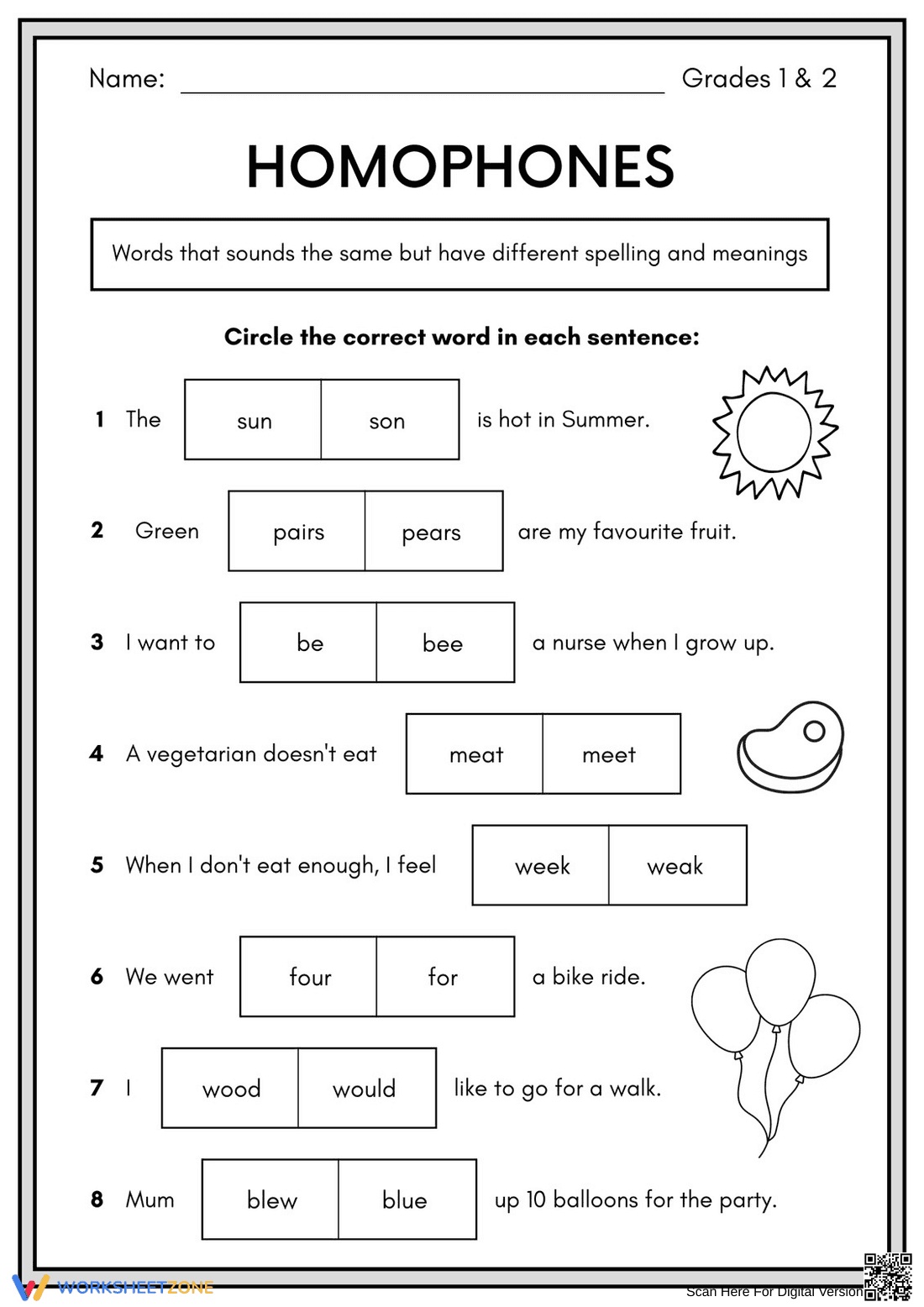

Grade 1-2 Homophones — Printable No-Prep Worksheet
Paste this activity's link or code into your existing LMS (Google Classroom, Canvas, Teams, Schoology, Moodle, etc.).
Students can open and work on the activity right away, with no student login required.
You'll still be able to track student progress and results from your teacher account.
This foundational vocabulary worksheet helps early readers master homophones by relying on sentence-level context clues. Students read simple sentences and select the correct spelling for words that sound alike but have different meanings. This targeted practice builds reading comprehension and spelling accuracy for first and second graders.
At a Glance
- Grade: 1-2 · Subject: ELA
- Standard:
CCSS.ELA-LITERACY.L.2.4— Use context clues to determine word meaning- Skill Focus: Homophones
- Format: 1 page · 8 problems · Answer key included · PDF
- Best For: Independent practice
- Time: 10–15 minutes
This single-page resource features eight sentence-completion tasks. Each problem presents a brief sentence alongside a choice between two common homophones (like sun/son or meat/meet). Students circle the correct word fitting the context. The clean layout includes helpful visual cues, such as simple line drawings, to support emerging readers. A complete answer key is provided.
Designed for immediate classroom implementation, this resource requires minimal teacher setup:
- Print (1 minute): Generate copies of the single-page PDF for your entire class.
- Distribute (1 minute): Hand out the worksheets during morning work or literacy centers. The instructions are self-explanatory.
- Review (3 minutes): Use the included answer key to quickly check student responses or project it for whole-class self-correction.
Total teacher prep time is under two minutes, making this an ideal, reliable option for emergency sub plans or unexpected schedule changes.
This activity is directly aligned to CCSS.ELA-LITERACY.L.2.4: Use sentence-level context as a clue to the meaning of a word or phrase. By forcing students to evaluate the surrounding words to choose the correct homophone, the task reinforces critical vocabulary acquisition skills. Both standard codes can be copied directly into lesson plans, IEP goals, or district curriculum mapping tools.
Deploy this worksheet during literacy centers after direct instruction on homophones. Students can work independently to apply what they have learned about context clues. Alternatively, use it as a formative assessment tool at the end of a vocabulary unit. While students complete the eight problems, teachers can observe whether they are reading the full sentence for context or simply guessing. Expected completion time ranges from 10 to 15 minutes.
This resource is primarily designed for first and second-grade students developing their foundational reading and spelling skills. The straightforward format also makes it highly effective for English Language Learners (ELLs) who need explicit practice distinguishing between English words that sound identical. Pair this worksheet with a visual anchor chart displaying common homophone pairs to provide additional scaffolding for students who need it.
Mastering homophones is a critical step in early literacy development, directly impacting both reading comprehension and written expression. According to Fisher & Frey (2014), explicit vocabulary instruction that requires students to analyze words within context significantly improves their ability to decode meaning independently. This worksheet targets exactly that skill, aligning with CCSS.ELA-LITERACY.L.2.4 by asking students to use context clues to determine word meaning. When young learners practice distinguishing between words like "week" and "weak" or "wood" and "would" in complete sentences, they build the cognitive flexibility necessary for fluent reading. The eight structured tasks provide immediate, actionable data on student understanding. By integrating this targeted practice into regular literacy routines, educators can effectively bridge the gap between phonetic decoding and deep semantic comprehension, ensuring a robust vocabulary foundation.


