


























Views
Downloads

Essential Homophones Worksheet | Printable Grade 1 ELA
Paste this activity's link or code into your existing LMS (Google Classroom, Canvas, Teams, Schoology, Moodle, etc.).
Students can open and work on the activity right away, with no student login required.
You'll still be able to track student progress and results from your teacher account.
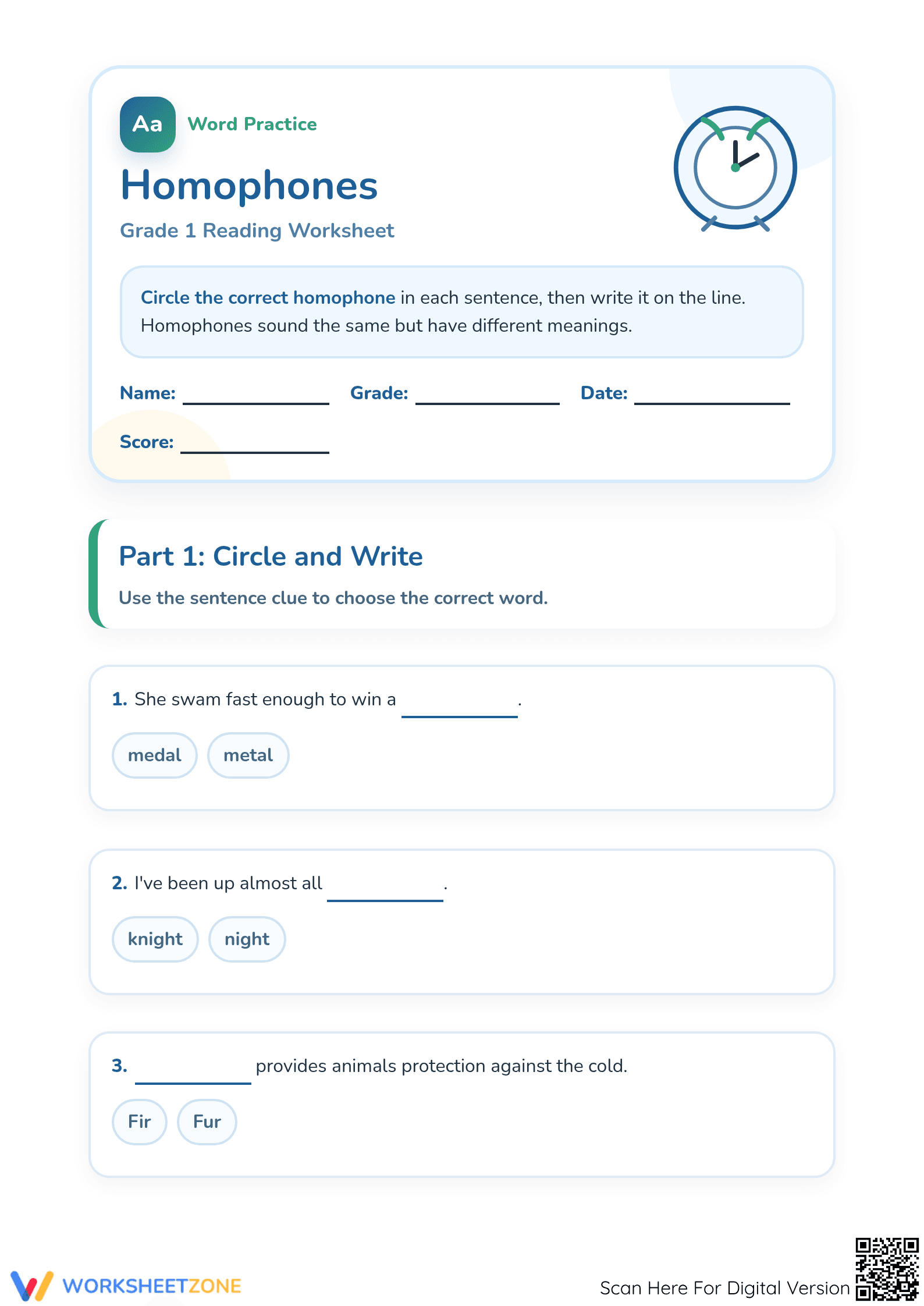
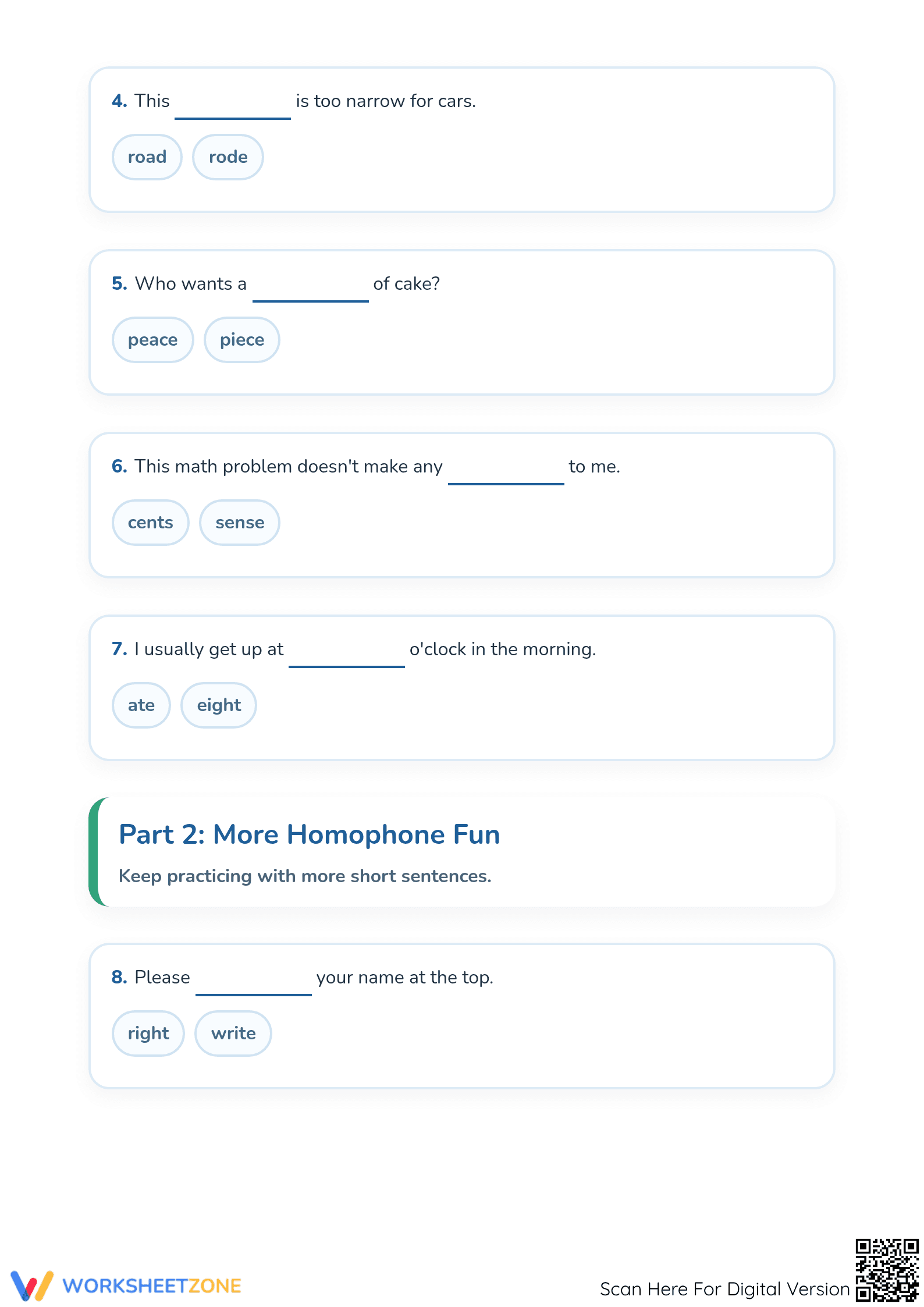
Mastering homophones is a critical milestone for early readers as they begin to distinguish between words that sound identical but hold vastly different meanings. This Essential Homophones Worksheet provides Grade 1 students with 12 targeted practice sentences designed to build orthographic awareness and reading fluency through meaningful context clues and repetitive writing exercises.
At a Glance
- Grade: 1 · Subject: English Language Arts
- Standard:
CCSS.ELA-LITERACY.L.1.4— Determine or clarify the meaning of unknown and multiple-meaning words and phrases- Skill Focus: Homophone Differentiation
- Format: 3 pages · 12 problems · Answer key included · PDF
- Best For: Literacy Centers and Independent Word Practice
- Time: 15–20 minutes
What's Inside
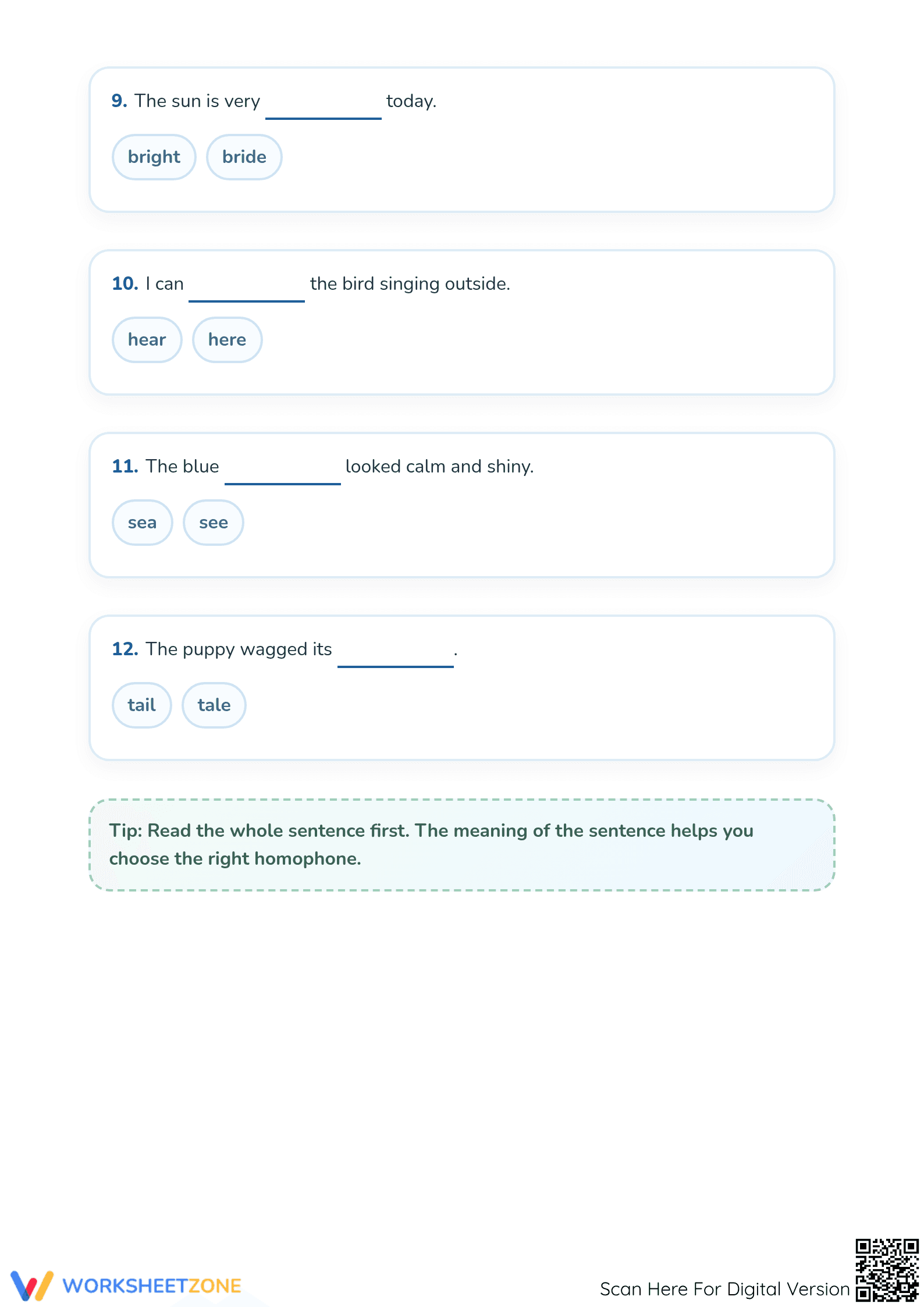
This comprehensive three-page resource features twelve distinct sentence-completion tasks where students must select the correct word from a choice of two common homophones. Each problem includes a clear sentence clue followed by interactive "circle and write" prompts, ensuring students both identify and physically construct the lexical choice. The layout includes a helpful tip box to reinforce semantic context clues.
Zero-Prep Workflow
Implementing this activity requires minimal teacher intervention, making it an ideal choice for busy classrooms or substitute plans. First, print the three-page PDF and distribute it to your groups in under sixty seconds. Second, provide students with 15 minutes of independent work time to navigate the sentence clues. Finally, use the included answer key to conduct a quick peer-review or whole-class check to confirm mastery in under two minutes.
Standards Alignment
This worksheet is rigorously aligned to CCSS.ELA-LITERACY.L.1.4, which requires students to determine or clarify the meaning of unknown and multiple-meaning words and phrases by using context clues. By evaluating the surrounding sentence logic to choose between words like "sea" and "see," students demonstrate direct mastery of grade-level vocabulary conventions. Both standard codes can be copied directly into lesson plans or district curriculum mapping tools.
How to Use It
Use this worksheet during the "You Do" phase of a gradual release model following a direct instruction lesson on common Grade 1 homophones. Alternatively, assign it as a formative assessment after a week of word study to identify students who struggle with semantic context clues. For a quick check, observe whether students are reading the entire sentence before making their choice, as suggested on page three.
Who It's For
This resource is tailored for first-grade students but serves as an excellent remedial tool for second graders who need extra support with high-frequency word pairs. It naturally pairs with a homophone anchor chart or a digital word-sort game to provide a multi-modal learning experience that addresses varying instructional needs within a diverse primary classroom setting while reinforcing core vocabulary skills.
The pedagogical approach utilized in this Grade 1 resource aligns with the RAND AIRS 2024 framework, which emphasizes the necessity of contextualized vocabulary instruction for developing foundational literacy in early childhood. By requiring students to resolve CCSS.ELA-LITERACY.L.1.4 homophone conflicts within complete sentences rather than isolated word lists, the worksheet fosters deeper cognitive processing and improves long-term retention of lexical distinctions. Research from ScienceDirect TpT Analysis indicates that structured word practice featuring both recognition and production significantly reduces orthographic errors in primary-age learners. This worksheet provides a systematic pathway for students to internalize the relationship between sound, spelling, and meaning, ultimately bridging the gap between basic decoding skills and sophisticated reading comprehension. Teachers can rely on this evidence-based tool to provide high-quality, standards-aligned practice that meets the rigorous demands of modern literacy curricula while supporting independent student mastery of essential language conventions.


