


























Views
Downloads

Printable Homophones Worksheet | Grade 1 ELA
Paste this activity's link or code into your existing LMS (Google Classroom, Canvas, Teams, Schoology, Moodle, etc.).
Students can open and work on the activity right away, with no student login required.
You'll still be able to track student progress and results from your teacher account.
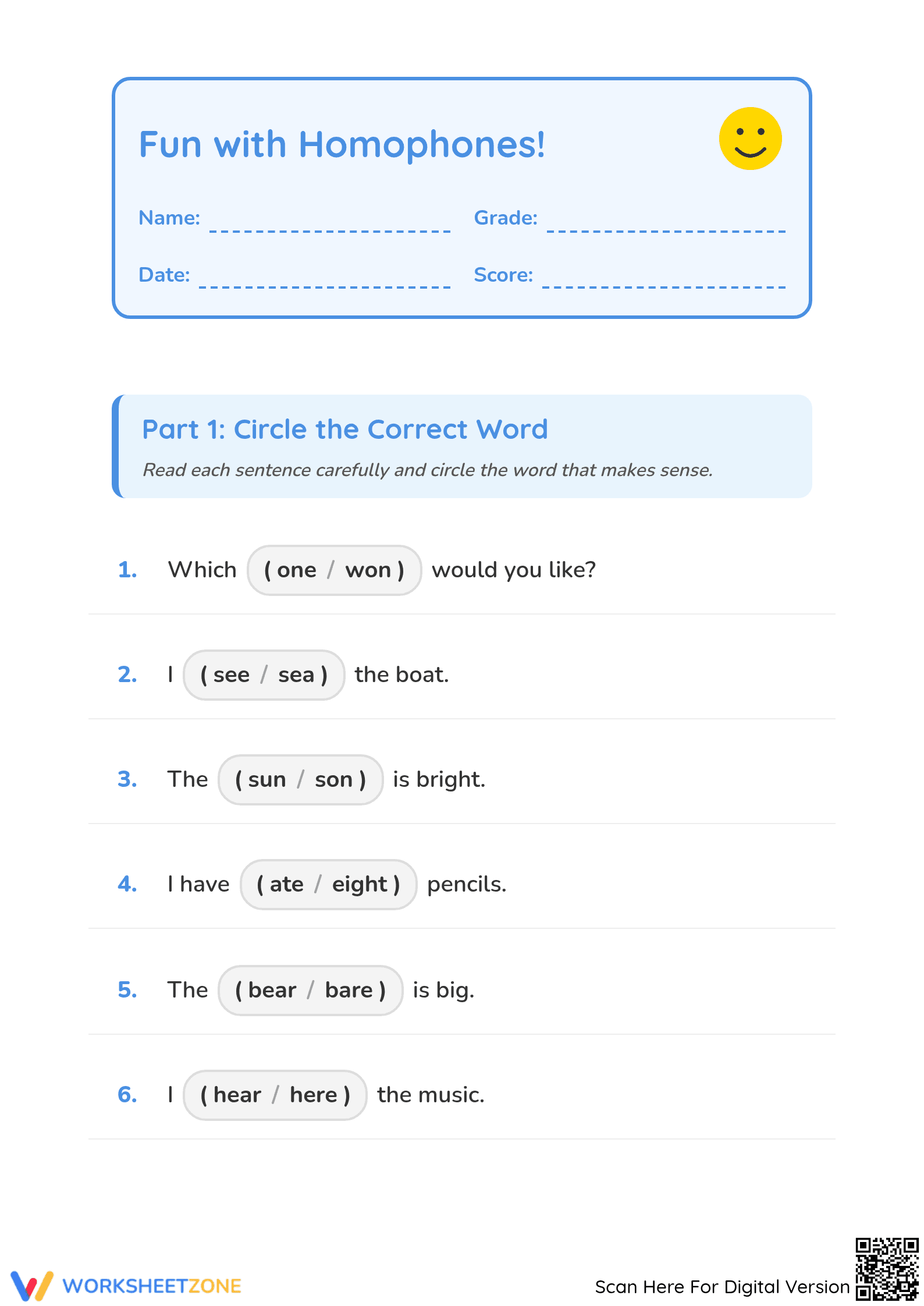
This Grade 1 ELA worksheet provides essential practice for young learners to master homophones. By identifying words that sound identical but have different meanings, students strengthen their vocabulary and reading comprehension. The structured exercises ensure students can distinguish between pairs like see/sea and ate/eight with total confidence.
At a Glance
- Grade: 1 · Subject: English Language Arts
- Standard:
CCSS.ELA-LITERACY.L.1.4— Identify and distinguish between words with multiple meanings and similar sounds- Skill Focus: Homophone Recognition and Contextual Usage
- Format: 4 pages · 22 problems · Answer key included · PDF
- Best For: Independent center work and literacy reinforcement
- Time: 15–20 minutes
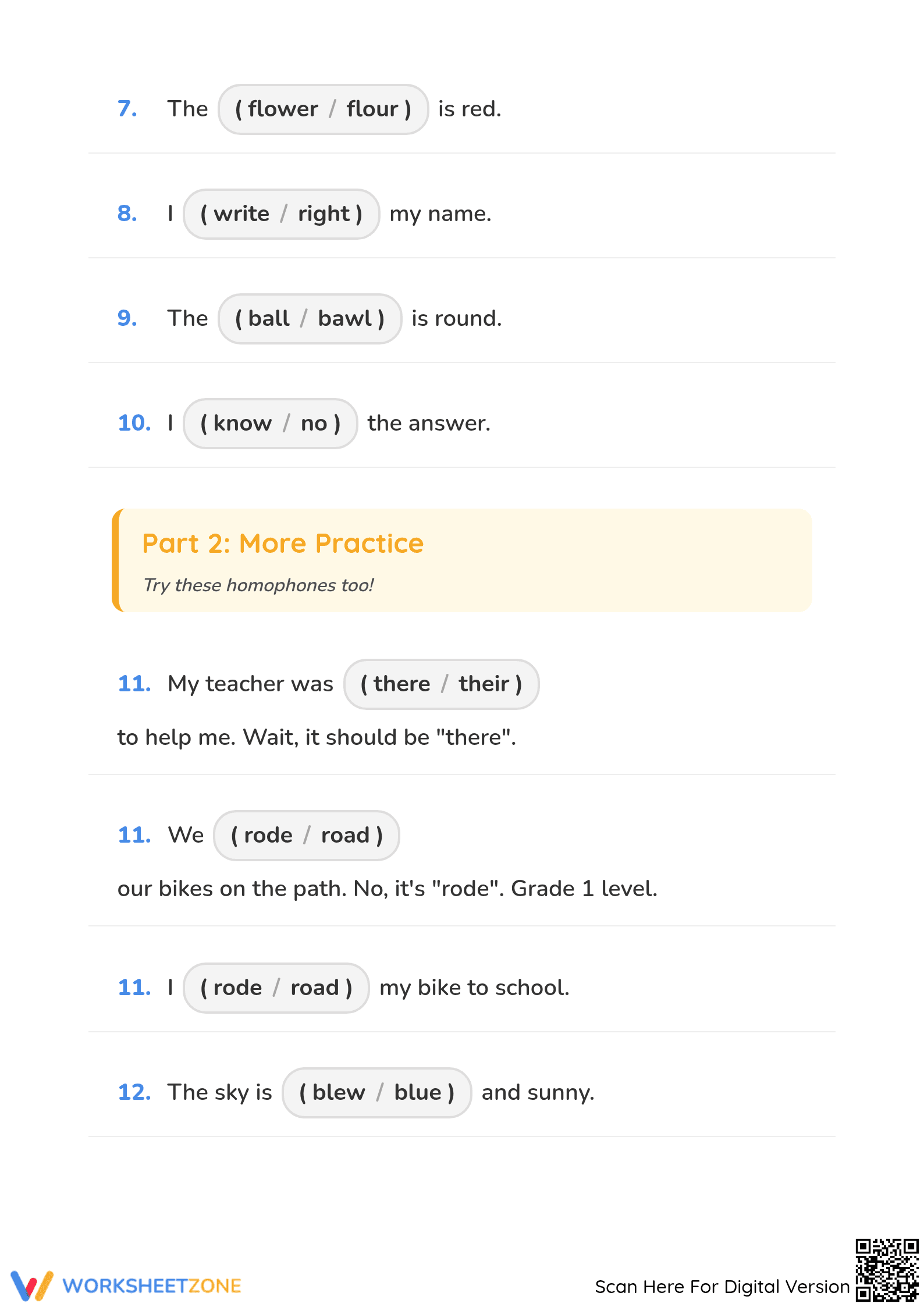
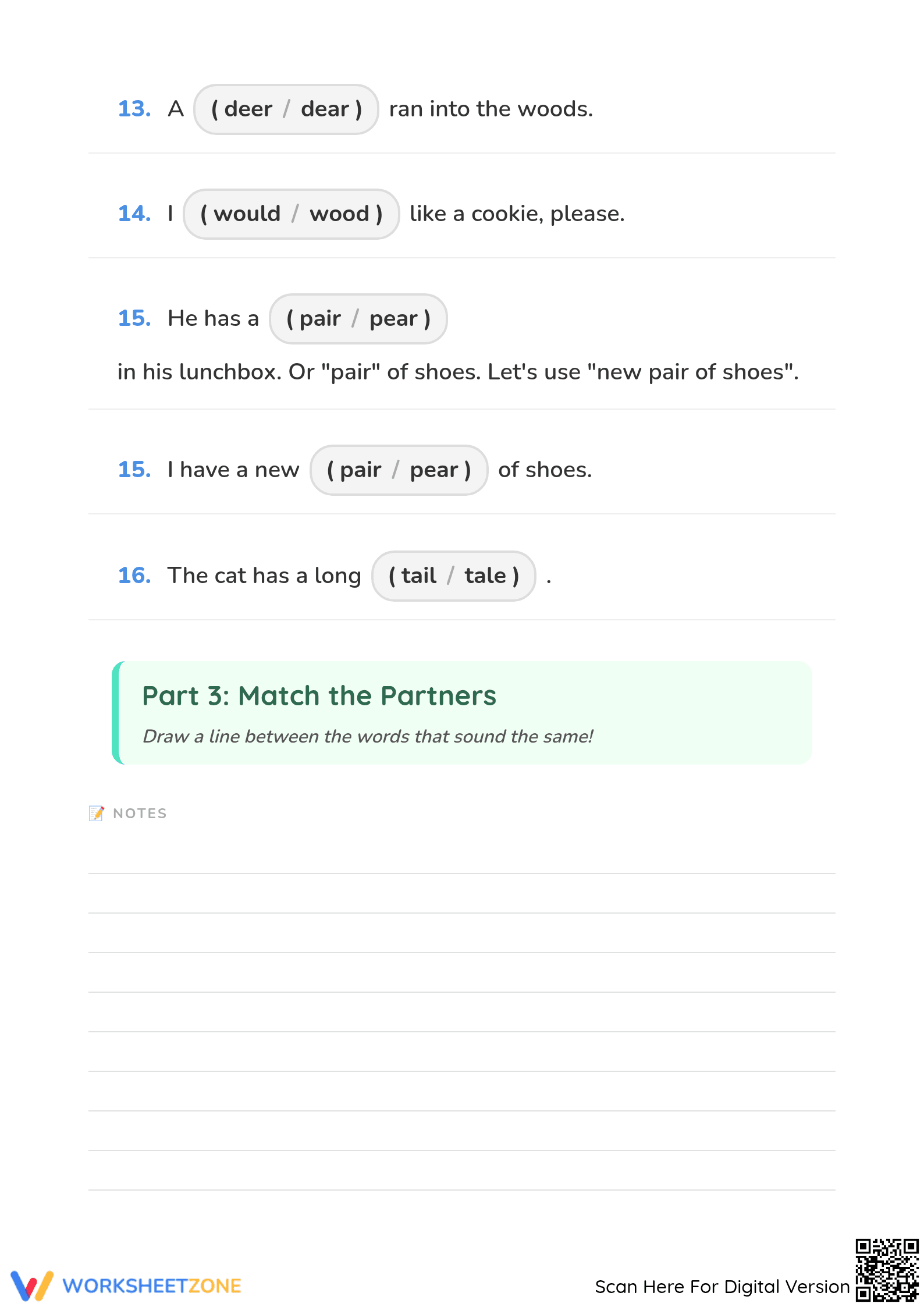
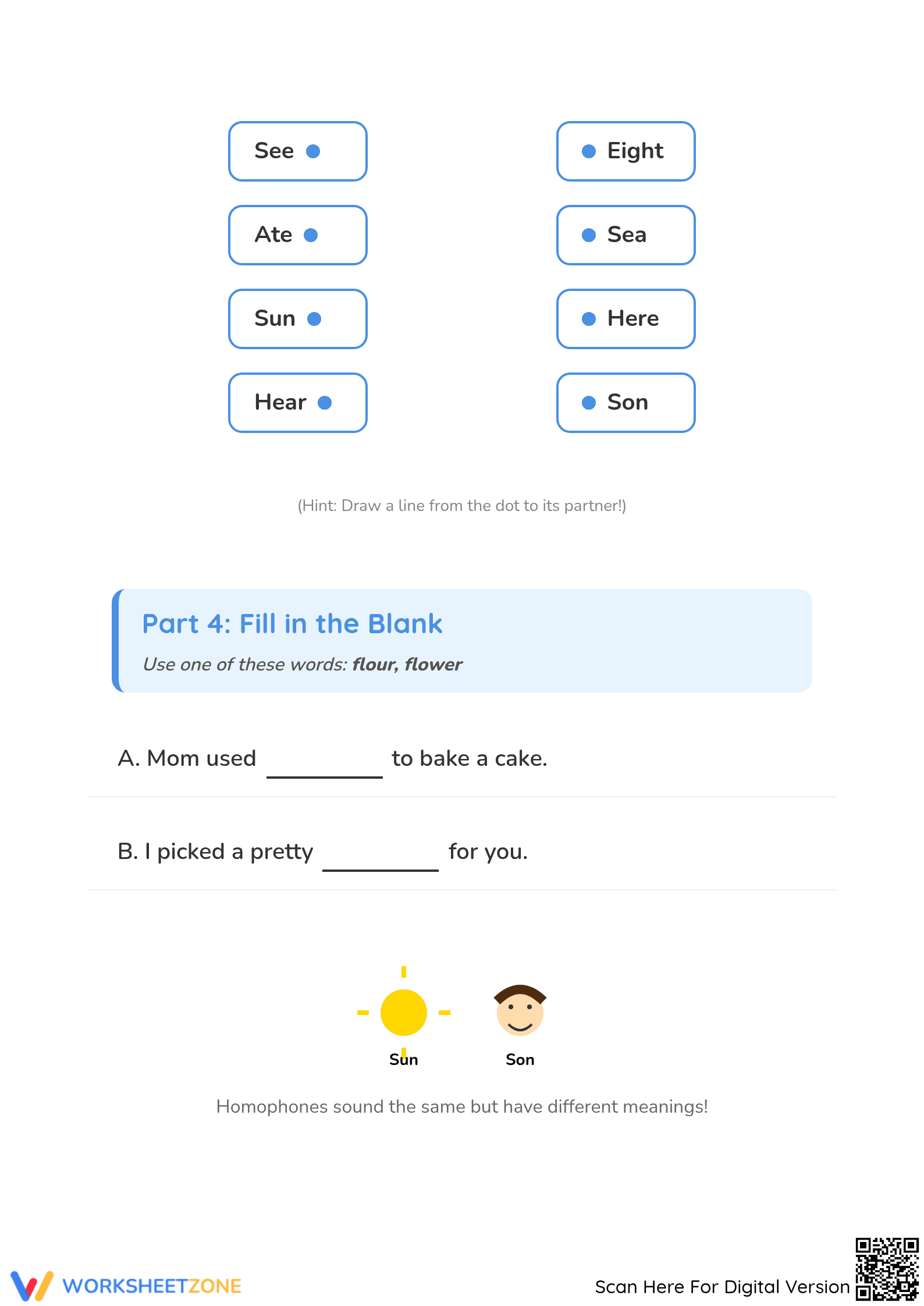
This four-page PDF builds lexical awareness through varied activities. Part 1 and Part 2 feature 16 sentence-based questions for circling the correct homophone. Part 3 includes a matching activity with four word pairs for auditory recognition. Part 4 provides fill-in-the-blank sentences for contextual application. A complete answer key is included for immediate feedback.
The zero-prep design allows teachers to implement this resource quickly. 1. Print the four-page document (30 seconds). 2. Distribute copies to students (30 seconds). 3. Review answers using the provided key (1 minute). This efficient structure makes it an ideal choice for substitute lesson plans or literacy rotations during the school day.
This resource aligns with CCSS.ELA-LITERACY.L.1.4, focusing on helping students clarify the meaning of multiple-meaning words. By practicing with homophones, students learn to use sentence-level context clues effectively. This standard code can be copied directly into lesson plans, IEP goals, or district curriculum mapping tools to ensure compliance.
Use this worksheet as a summative assessment following direct instruction to gauge individual student mastery. Alternatively, it serves as a robust literacy center activity for independent work. Teachers should observe students as they complete Part 3 to ensure they are making the correct phonetic connections between word pairs.
This resource is designed for first-grade students and English language learners needing support with English orthography. It pairs naturally with shared reading passages or homophone anchor charts. The large font and clear layout ensure tasks remain accessible for early readers who are still developing their fine motor skills.
According to a RAND AIRS 2024 analysis of primary literacy resources, structured practice with lexical ambiguity—such as homophones—is a critical component of early reading fluency. This Grade 1 worksheet directly addresses CCSS.ELA-LITERACY.L.1.4 by requiring students to distinguish between words that sound identical but differ in spelling and meaning. Research from Fisher & Frey (2014) emphasizes that the gradual release of responsibility, moving from circling words to fill-in-the-blank applications, significantly improves long-term retention of spelling conventions. By engaging with 22 specific tasks across four pages, students develop the cognitive flexibility needed to process complex linguistic patterns. This printable resource provides a reliable framework for teachers to verify that students can successfully apply context clues to resolve phonetic conflicts, a foundational skill identified by EdReports 2024 as essential for meeting mid-year ELA benchmarks in early elementary settings.


