


























Views
Downloads

Printable Homophones Worksheet | Grade 1 ELA Essential
Paste this activity's link or code into your existing LMS (Google Classroom, Canvas, Teams, Schoology, Moodle, etc.).
Students can open and work on the activity right away, with no student login required.
You'll still be able to track student progress and results from your teacher account.
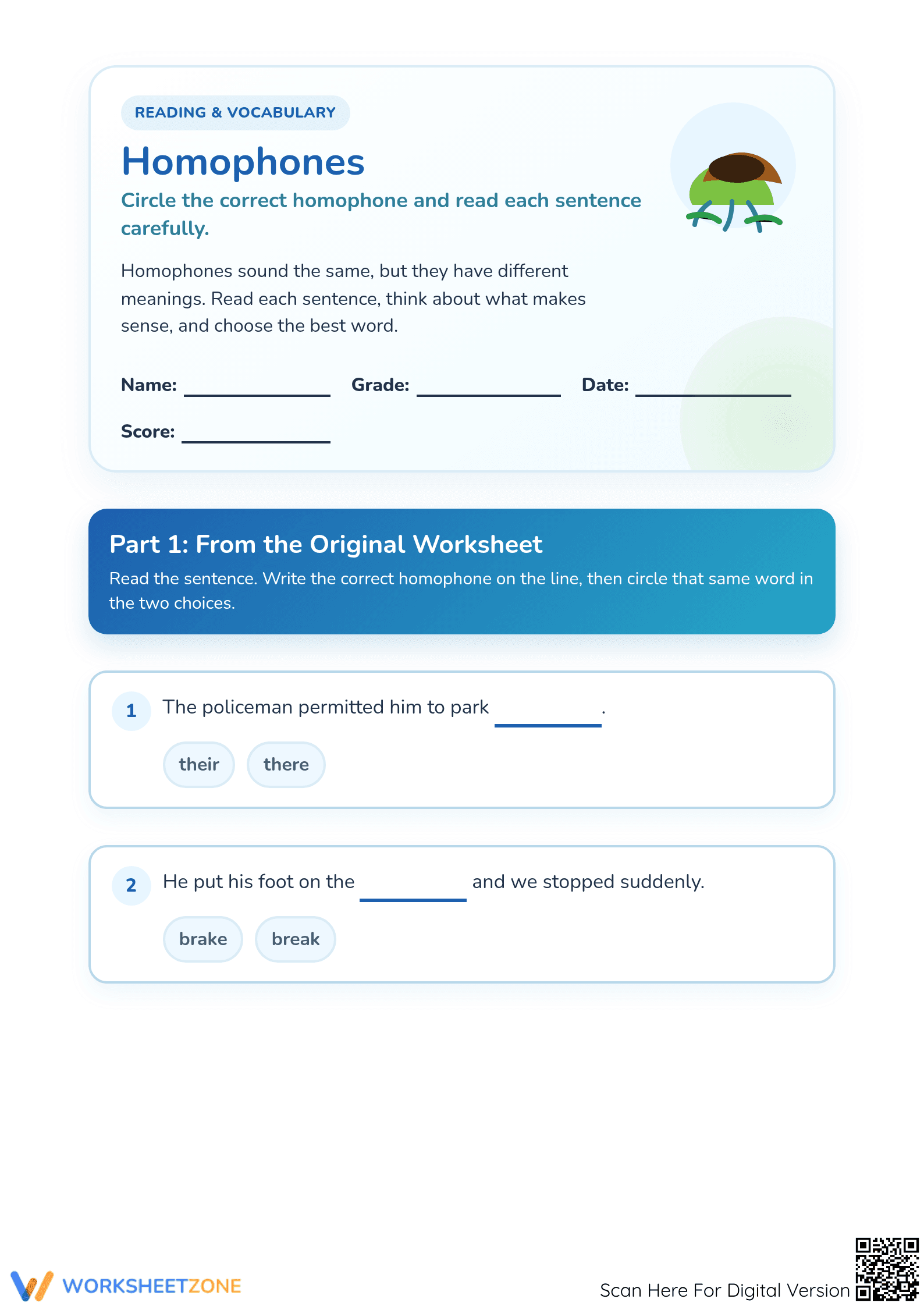
Strengthen early literacy and grammar skills with this essential Grade 1 homophones worksheet. Designed specifically for beginning readers, this resource helps students distinguish between words that sound the same but have different meanings and spellings. By applying context clues, learners build the linguistic agility needed for fluent reading and accurate writing outcomes.
At a Glance
- Grade: 1 · Subject: English Language Arts
- Standard:
CCSS.ELA-LITERACY.L.1.4— Determine the meaning of multiple-meaning words using sentence-level context clues- Skill Focus: Contextual Homophone Selection
- Format: 3 pages · 11 problems · Answer key included · PDF
- Best For: Independent Literacy Centers and Morning Work
- Time: 15–20 minutes
What's Inside
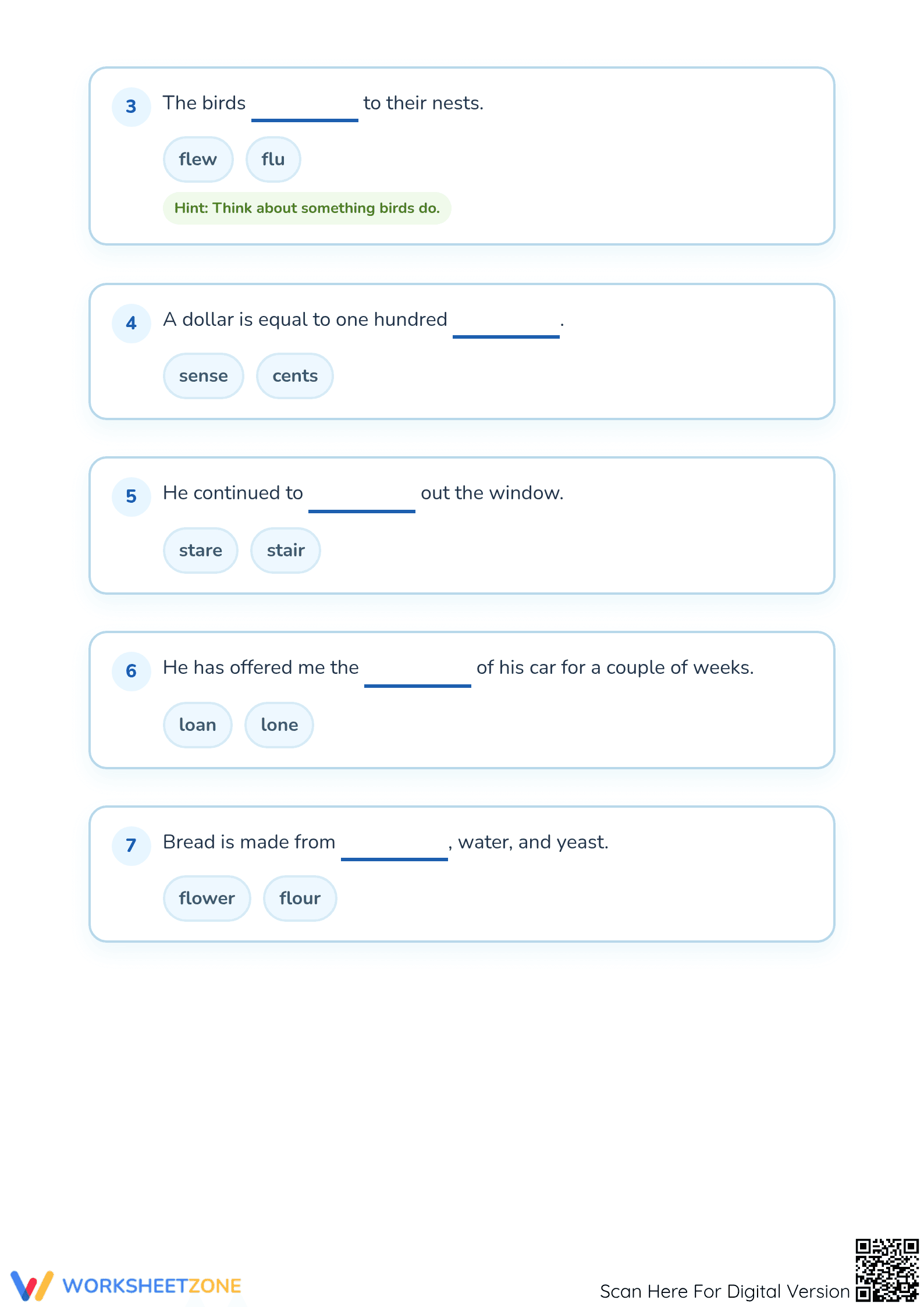
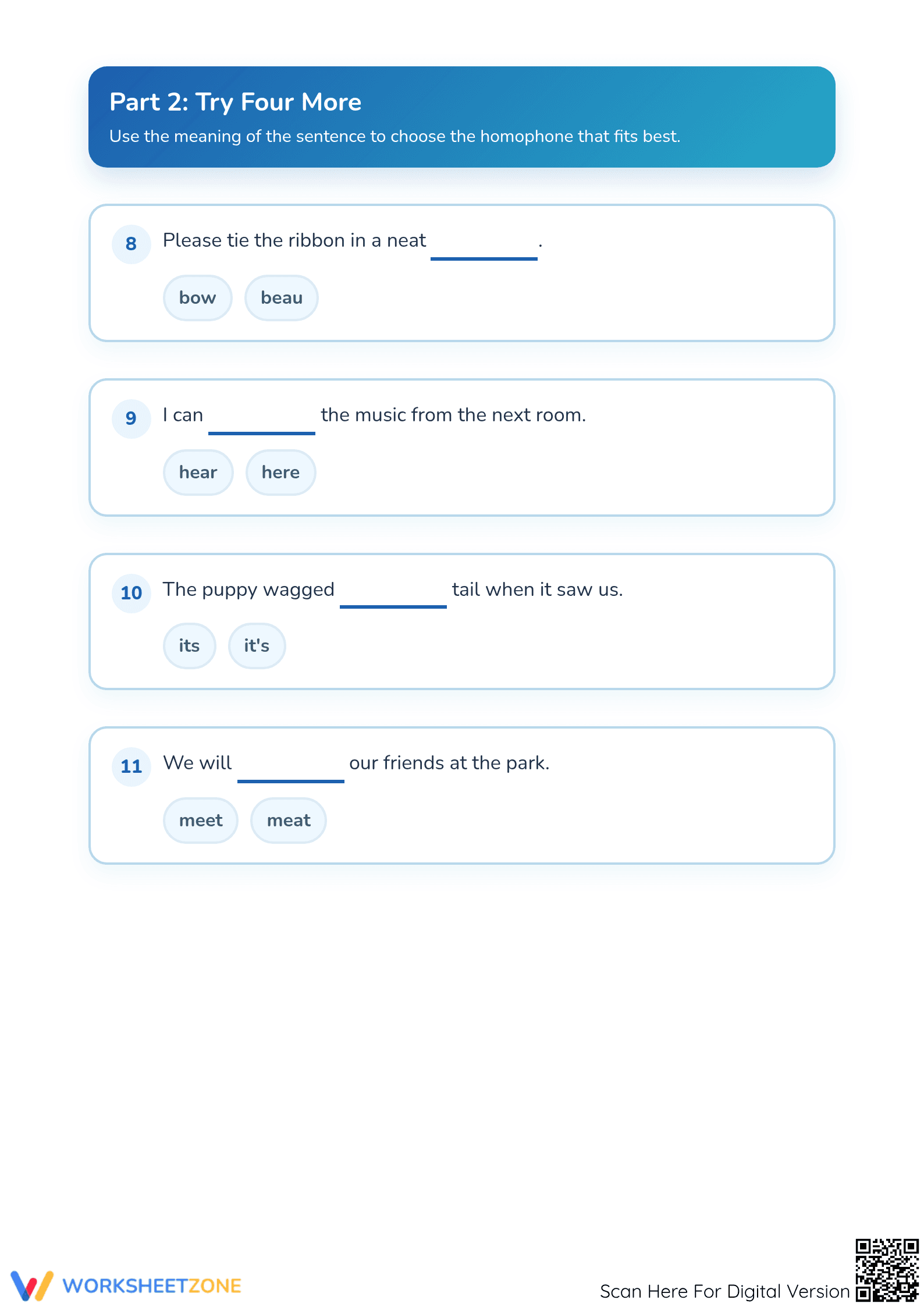
This comprehensive 3-page PDF features 11 structured sentence-completion tasks. Each problem presents a high-frequency sentence with a missing word, followed by two homophone choices (such as their/there, brake/break, and meet/meat). The worksheet includes clear visual cues, a dedicated score box for easy grading, and a complete answer key to support student self-correction or rapid teacher review.
Zero-Prep Workflow
- Print (30 seconds): Download the PDF and print enough copies for your class or small group. No cutting or assembly required.
- Distribute (1 minute): Hand out the worksheets as a transition activity or sub plan. The clear instructions ensure students can start immediately.
- Review (2 minutes): Use the included answer key to check for understanding. The layout is optimized for quick visual scanning of student choices.
Standards Alignment
This resource aligns directly with `CCSS.ELA-LITERACY.L.1.4`, focusing on the student's ability to use sentence-level context as a clue to the meaning of a word or phrase. It specifically targets the lexical challenges of Grade 1 spelling and grammar. This standard code can be copied directly into lesson plans, IEP goals, or district curriculum mapping tools to ensure compliance with state frameworks.
How to Use It
Deploy this worksheet during your direct instruction on word classes to provide immediate practice. It works perfectly as a formative assessment tool; observe whether students read the entire sentence before circling a choice to gauge their use of context clues. Expected completion time is approximately 15 minutes, making it an ideal choice for literacy rotations or as a focused homework assignment.
Who It's For
While designed for Grade 1 students, this worksheet is also highly effective for ESL/ELL learners who struggle with English phonology. The simple sentence structures provide enough support for struggling readers while offering meaningful lexical practice. Pair this resource with a homophone anchor chart or a short reading passage to reinforce these often-confusing word pairs across different instructional modes.
Effective vocabulary instruction in early elementary grades requires students to move beyond isolated word lists toward meaningful context-clue application. According to RAND AIRS 2024, the cognitive load of distinguishing between phonetically identical but semantically distinct words is best managed through scaffolded sentence completion. This worksheet targets CCSS.ELA-LITERACY.L.1.4 by requiring Grade 1 learners to analyze sentence meaning before selecting the correct lexical class. By engaging with words like "their/there" and "meet/meat" in situational contexts, students develop stronger orthographic memory and reading fluency. Research from EdReports 2024 suggests that immediate feedback via answer keys—a core feature of this resource—accelerates the transition from phonetic decoding to automated word recognition. This instructional design ensures that students do not just memorize spelling variations but understand the underlying syntactic requirements of each word, providing a robust foundation for more complex informational and literary text analysis in subsequent grade levels.


