


























Views
Downloads
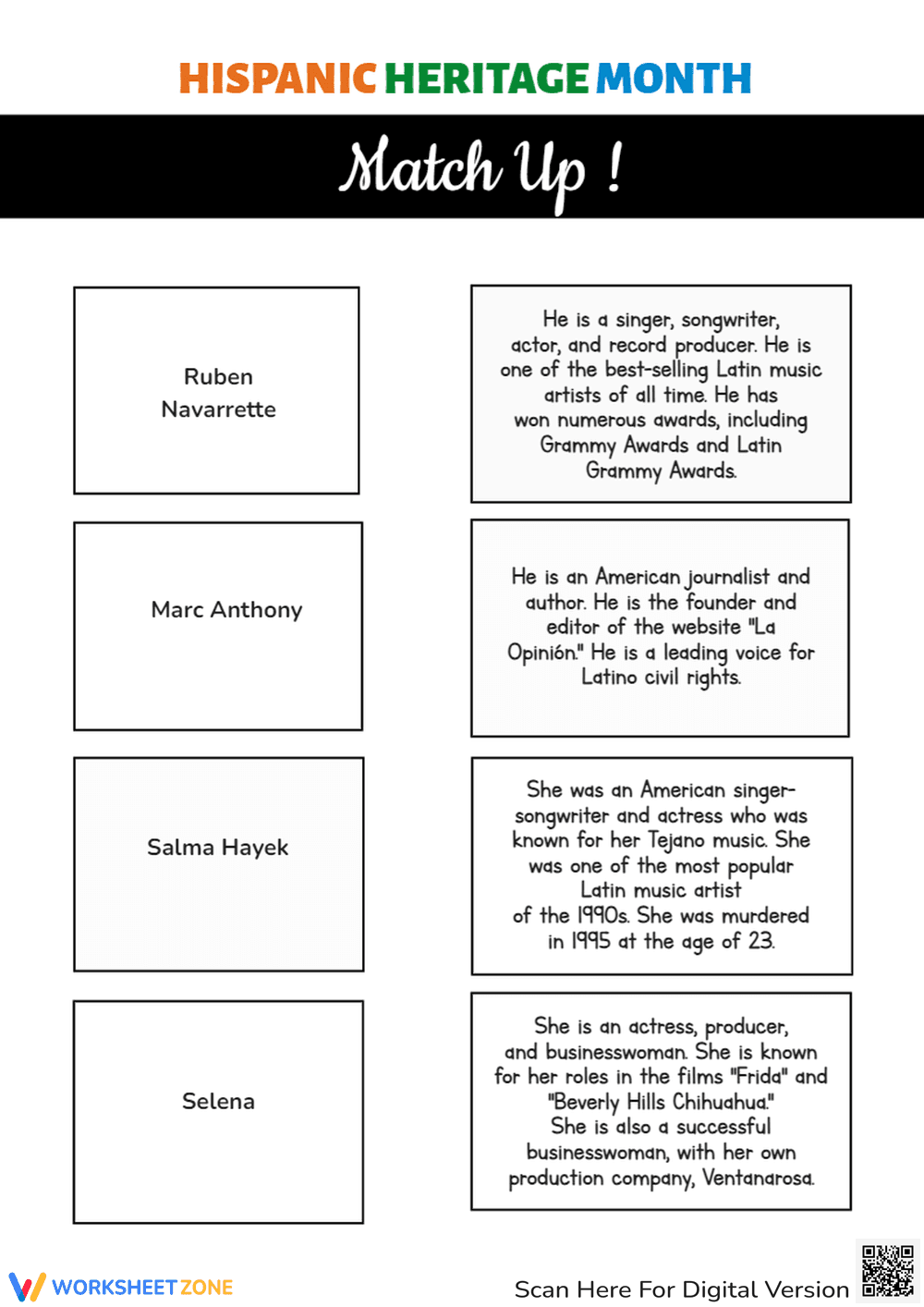

Hispanic Heritage Month Matching | Essential Grade 2
Paste this activity's link or code into your existing LMS (Google Classroom, Canvas, Teams, Schoology, Moodle, etc.).
Students can open and work on the activity right away, with no student login required.
You'll still be able to track student progress and results from your teacher account.
This Hispanic Heritage Month matching worksheet helps students identify influential figures by connecting names to their professional achievements. Students practice reading informational text to distinguish between biographies of singers, journalists, and actors. It provides a clear, structured way to introduce cultural history while reinforcing reading comprehension skills during social studies or ELA blocks.
At a Glance
- Grade: 2 · Subject: Social Studies
- Standard:
CCSS.ELA-LITERACY.RI.2.1— Ask and answer questions about key details in a text- Skill Focus: Biographical matching and reading comprehension
- Format: 1 page · 4 problems · Answer key included · PDF
- Best For: Quick cultural awareness and reading practice
- Time: 10–15 minutes
The resource consists of a single-page PDF featuring four prominent Hispanic figures: Ruben Navarrette, Marc Anthony, Salma Hayek, and Selena. Each name is paired with a descriptive paragraph detailing their career highlights and contributions to society. The layout is clean and accessible, using clear fonts and distinct boxes to help young learners focus on the text-to-name relationship. A full answer key is provided for rapid grading.
This worksheet is designed for a zero-prep classroom environment. Teachers can print the document in less than 30 seconds. Distribution takes approximately 1 minute, as the instructions are self-explanatory for second and third graders. Reviewing the answers as a whole group takes about 3 minutes, allowing for a total instructional footprint of under 20 minutes. It is an ideal resource for emergency sub plans or morning work.
The primary alignment is CCSS.ELA-LITERACY.RI.2.1, which requires students to demonstrate understanding of key details in a text. By matching the specific biographical facts to the correct individual, students prove they can extract information from short informational passages. Additionally, it supports social studies standards regarding the contributions of historical and contemporary figures. Both standard codes can be copied directly into lesson plans, IEP goals, or district curriculum mapping tools.
Use this activity during the "during instruction" phase of a Hispanic Heritage Month unit to reinforce biographies discussed in class. It also serves as an effective formative assessment tool; observe if students are using keywords like "singer" or "journalist" to make their selections. Completion typically takes 10 to 15 minutes, making it a perfect transition activity between subjects.
This worksheet is tailored for Grade 1 through Grade 3 students, with the text complexity most closely aligned to Grade 2. It is excellent for English Language Learners (ELLs) who benefit from short, high-interest reading passages. Pair this resource with a classroom anchor chart featuring photos of the individuals mentioned to provide additional visual support.
According to the RAND AIRS 2024 report, the integration of culturally relevant informational texts significantly improves student engagement and retention of reading comprehension strategies. This worksheet addresses the need for diverse representation in early elementary curricula by highlighting the achievements of Hispanic leaders in media and the arts. By utilizing the CCSS.ELA-LITERACY.RI.2.1 standard, the activity ensures that students are not just memorizing names but are actively analyzing text for evidence. Research from Fisher & Frey (2014) suggests that short, focused matching tasks help solidify vocabulary and conceptual links in social studies. This resource provides a structured environment for students to practice these skills independently. The inclusion of figures like Selena and Ruben Navarrette allows for a broader discussion on civil rights and cultural influence, meeting both literacy and social-emotional learning goals within a standard 15-minute instructional window.


