




























Views
Downloads

Helping My Family Worksheet | Grade 2 Essential

Paste this activity's link or code into your existing LMS (Google Classroom, Canvas, Teams, Schoology, Moodle, etc.).
Students can open and work on the activity right away, with no student login required.
You'll still be able to track student progress and results from your teacher account.
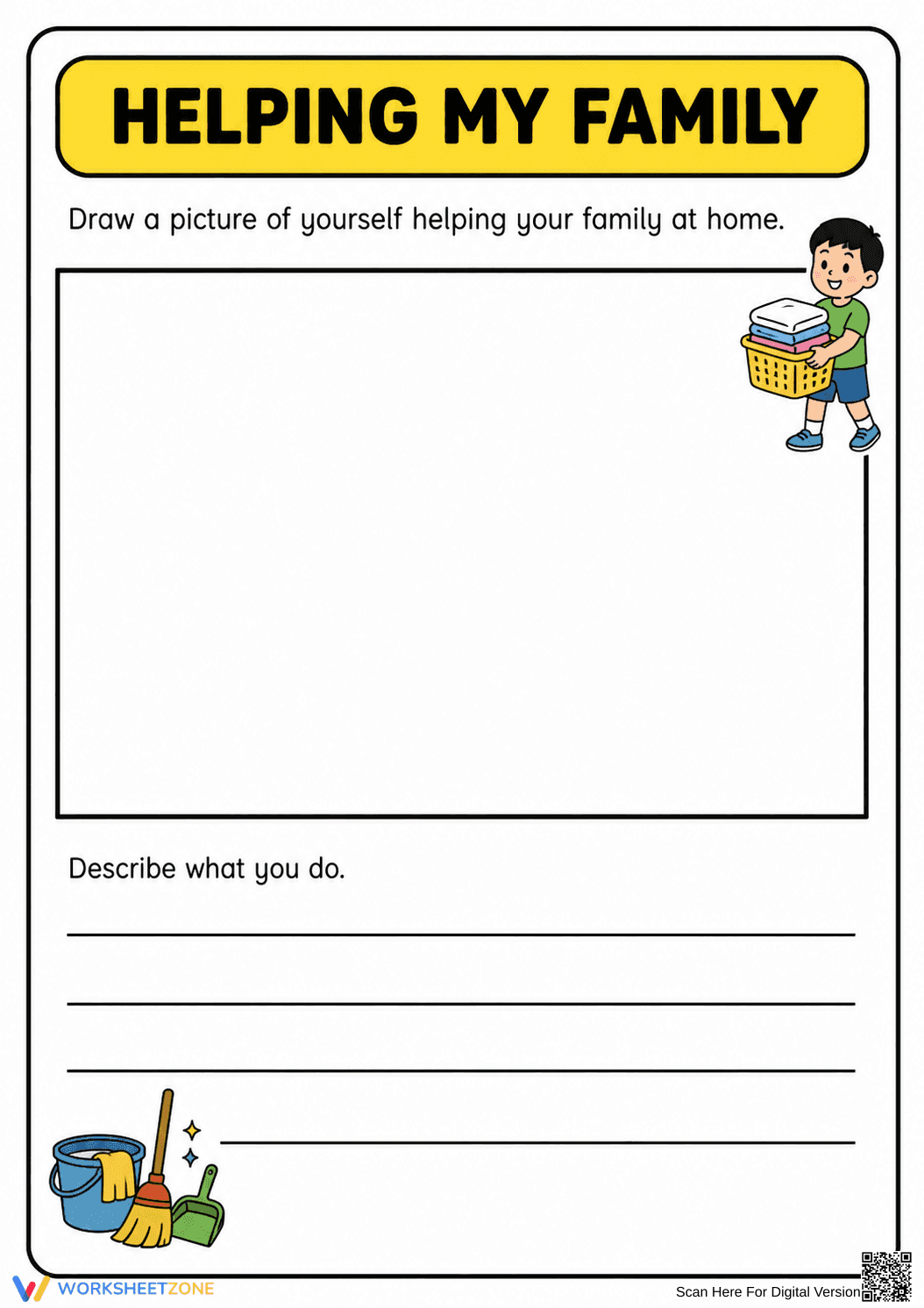
This Grade 2 Helping My Family worksheet facilitates social-emotional learning by asking students to visualize and document their contributions to the household. By combining artistic expression with descriptive writing, learners articulate their roles within a family unit, fostering a sense of agency and personal responsibility through a structured, reflective exercise.
At a Glance
- Grade: 2 · Subject: Social Skills
- Standard:
CCSS.ELA-LITERACY.W.2.2— Write informative texts to explain a topic and provide facts- Skill Focus: Descriptive writing and responsibility
- Format: 1 page · 2 tasks · Answer key N/A · PDF
- Best For: SEL lessons and morning work
- Time: 15–20 minutes
The worksheet features a large, dedicated illustration box where students can sketch themselves performing a specific chore or act of kindness. Below the drawing area, four primary-ruled lines provide ample space for a written description. The layout includes friendly clip art of cleaning supplies and a child helping with laundry to provide visual cues and inspiration for students who may struggle to brainstorm ideas.
This resource is designed for immediate classroom implementation with a three-step workflow. First, print the single-page PDF (30 seconds). Second, distribute the sheets during a social studies or SEL block (1 minute). Third, facilitate a brief share-and-show session where students present their drawings to a partner (5 minutes). Total teacher preparation time is under 2 minutes, making it an ideal choice for sub plans or transition periods.
This activity aligns with CCSS.ELA-LITERACY.W.2.2, which requires students to write informative or explanatory texts in which they introduce a topic, use facts and definitions to develop points, and provide a concluding statement. By describing their specific helping actions, students practice factual reporting on their own lives. This standard code can be copied directly into lesson plans, IEP goals, or district curriculum mapping tools.
Use this worksheet as a formative assessment during a unit on community or family roles. Observe whether students can identify a concrete action, such as feeding a pet, versus a vague concept. It also serves as an excellent follow-up to a read-aloud about cooperation. Expect students to spend approximately 10 minutes on the illustration and 10 minutes on the written component.
This activity is tailored for Grade 2 students but is easily adaptable for Grade 1 or Grade 3 learners depending on writing proficiency. It is particularly effective for English Language Learners (ELLs) as the drawing component provides a non-verbal way to demonstrate comprehension before attempting the English text. Pair this with an anchor chart listing common household chores to support vocabulary development.
According to Fisher & Frey (2014), the integration of visual representation with written text—often referred to as dual coding—significantly enhances a student's ability to organize thoughts and retain conceptual knowledge. This worksheet utilizes that research-backed strategy by requiring students to first visualize their helping role before translating that mental image into a written explanation. By focusing on the CCSS.ELA-LITERACY.W.2.2 standard, the activity ensures that even personal reflection remains grounded in academic rigor. The inclusion of specific household tasks as prompts helps bridge the gap between abstract social-emotional concepts and concrete daily actions. This approach has been shown in various NAEP studies to improve engagement among early elementary writers who benefit from high-interest, self-relevant topics. Educators can use this tool to build a classroom culture of mutual support and responsibility while meeting core literacy requirements.


