


























Views
Downloads
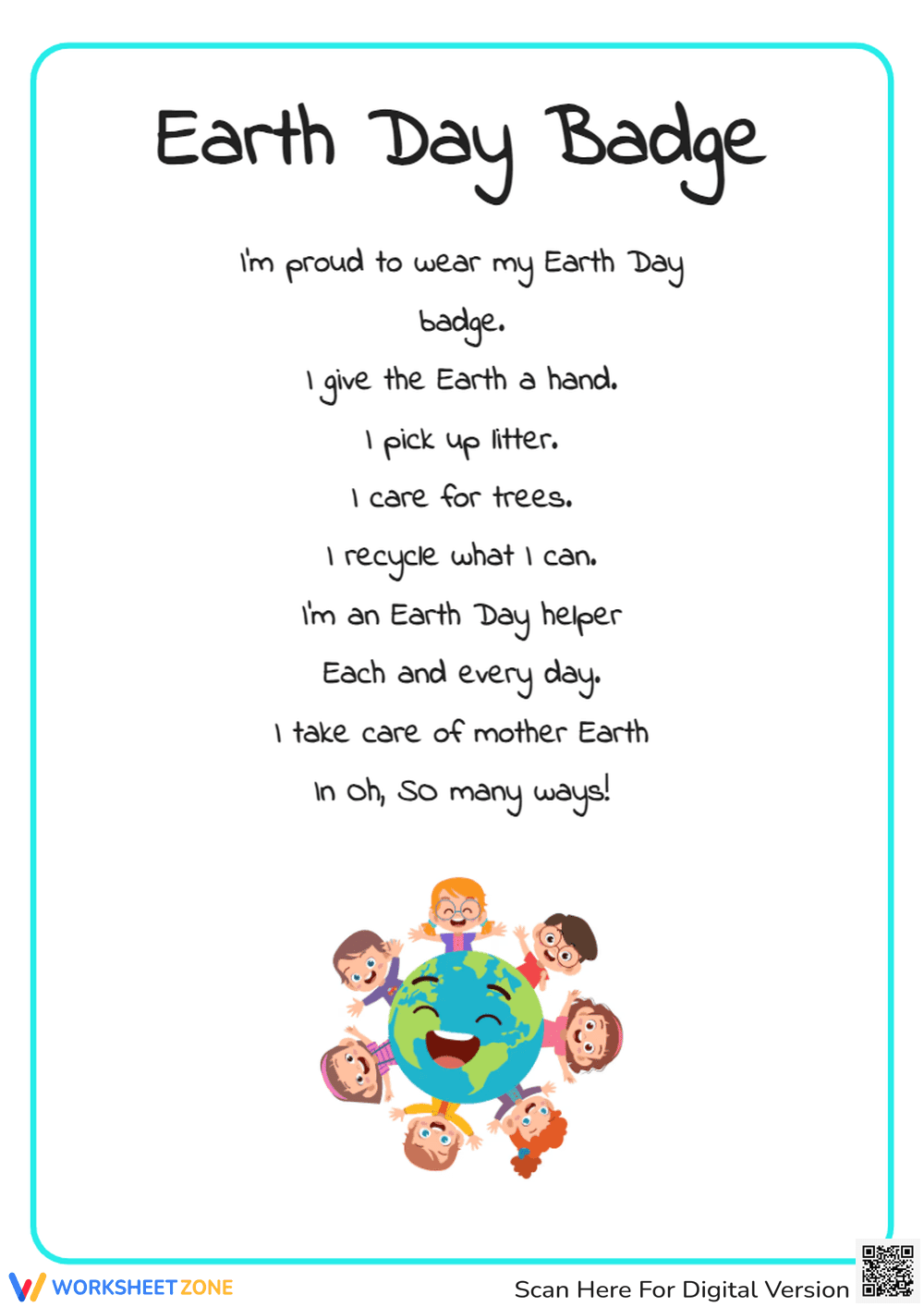

Grade 2 Earth Day Poem — Printable No-Prep Worksheet
Paste this activity's link or code into your existing LMS (Google Classroom, Canvas, Teams, Schoology, Moodle, etc.).
Students can open and work on the activity right away, with no student login required.
You'll still be able to track student progress and results from your teacher account.
Introduce young learners to environmental awareness with this engaging Earth Day poem worksheet. Students read and recite the poem to build reading fluency, vocabulary, and phonics skills. This resource helps children connect literacy practice with real-world conservation concepts, fostering both reading confidence and environmental responsibility in early elementary classrooms.
At a Glance
- Grade: Grade 2 · Subject: ELA Reading
- Standard:
CCSS.ELA-LITERACY.RL.2.4— Describe how words and phrases supply rhythm and meaning in a poem- Skill Focus: Poetry reading and fluency
- Format: 1 page · 1 reading task · No answer key needed · PDF
- Best For: Earth Day ELA morning work
- Time: 10–15 minutes
This single-page printable features a structured ten-line poem titled "Earth Day Badge" written in accessible language for early readers. The layout includes clear, large-print text paired with a colorful illustration of diverse children holding hands around the globe. This visual aid reinforces the central theme of global community and environmental stewardship, making the text highly accessible for visual learners.
Integrate this resource into your daily schedule with a simple three-step workflow. First, print the single-page PDF for your class, taking less than 1 minute of preparation. Second, distribute the sheet to students for independent reading or choral recitation, requiring about 10 minutes of class time. Third, review the poem together as a group to discuss key vocabulary and rhyming patterns, taking 5 minutes. This zero-prep design makes the worksheet an ideal option for emergency substitute plans or quick morning work activities.
This worksheet aligns directly with the Common Core State Standard CCSS.ELA-LITERACY.RL.2.4, which requires students to describe how words and phrases supply rhythm and meaning in a story, poem, or song. By analyzing the simple rhyme scheme and rhythmic structure of the text, students practice identifying poetic elements. Both standard codes can be copied directly into lesson plans, IEP goals, or district curriculum mapping tools.
Use this worksheet during direct instruction to introduce poetry elements like rhyme and rhythm. Read the poem aloud first, then have students highlight rhyming word pairs. For formative assessment, observe students during choral reading to check their pronunciation, pacing, and expression. The activity takes approximately 15 minutes to complete and serves as an excellent warm-up before a creative writing session.
This resource is designed for second and third-grade students developing foundational reading skills. It works well for general education classrooms, English language learners needing structured vocabulary support, and special education students practicing fluency. Pair this worksheet with an anchor chart about recycling or a read-aloud book about Earth Day to create a comprehensive thematic lesson.
Integrating thematic poetry into early elementary instruction supports vocabulary acquisition and reading engagement. According to the Fisher & Frey (2014) framework for gradual release of responsibility, structured shared reading experiences build the necessary scaffolding for independent comprehension. This worksheet utilizes a simple rhyme scheme and repetitive structure to help students decode words and understand the central message of environmental care. By focusing on standard CCSS.ELA-LITERACY.RL.2.4, the resource ensures that students engage with text structure while building essential phonological awareness. Educators can confidently implement this tool to meet district ELA requirements while celebrating Earth Day. The clear layout and thematic focus make it a reliable addition to any early reading curriculum, helping teachers bridge the gap between foundational literacy skills and content-area learning in science and social studies.


