


























Views
Downloads

Hallway Expectations Worksheet | Grade 1 Printable
Paste this activity's link or code into your existing LMS (Google Classroom, Canvas, Teams, Schoology, Moodle, etc.).
Students can open and work on the activity right away, with no student login required.
You'll still be able to track student progress and results from your teacher account.
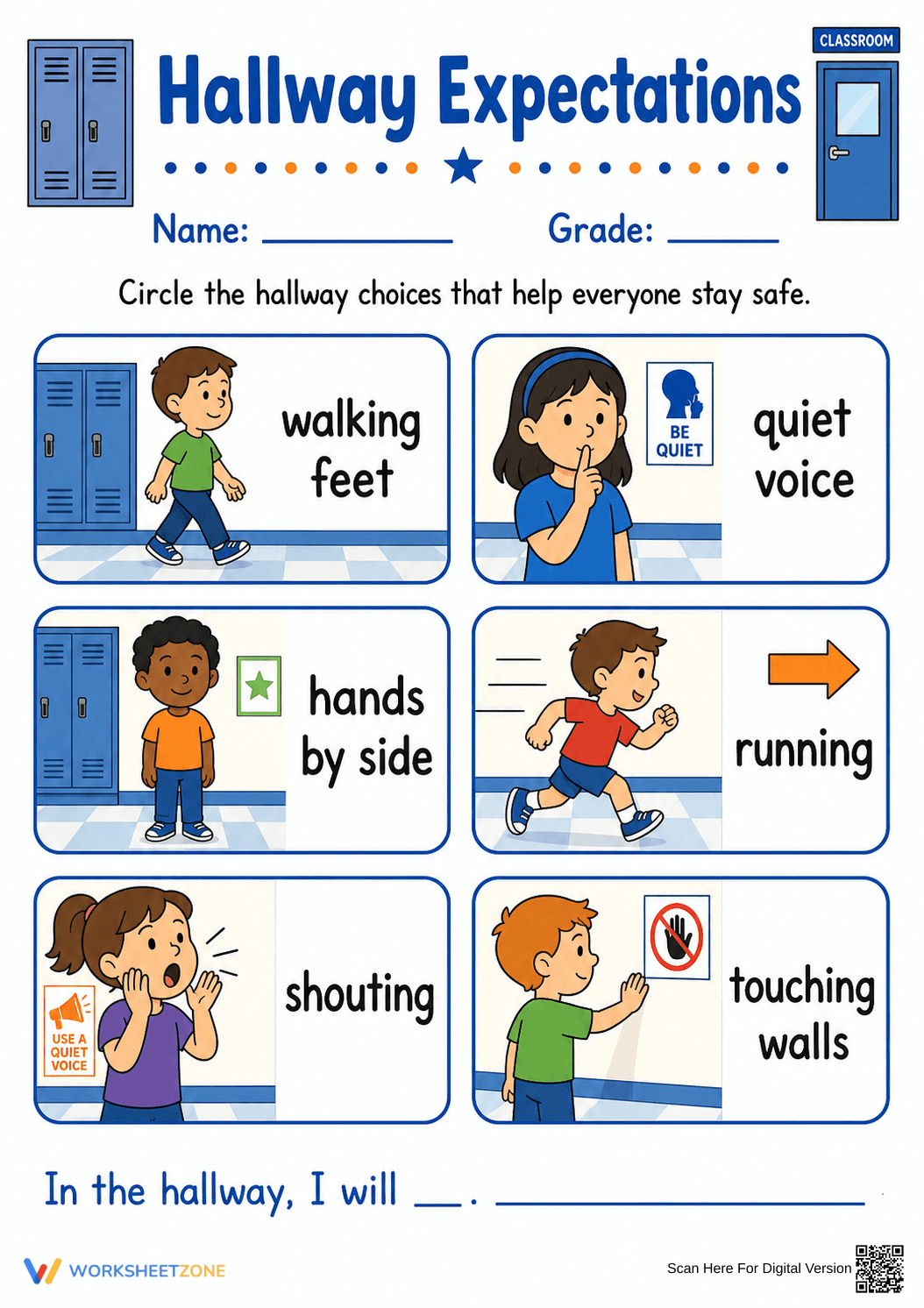
This Grade 1 hallway expectations worksheet helps students identify and practice safe school behaviors. By evaluating six common scenarios, young learners distinguish between expected and unexpected choices in shared school spaces. The visual format ensures students clearly understand how to maintain a safe, respectful environment outside the classroom.
At a Glance
- Grade: 1 · Subject: SEL
- Standard:
CCSS.ELA-LITERACY.RI.1.7— Use illustrations to describe key ideas- Skill Focus: Identifying safe hallway behaviors
- Format: 1 page · 7 problems · Answer key included · PDF
- Best For: Beginning of year routines
- Time: 10–15 minutes
Inside this resource, educators will find a single-page activity featuring six picture-choice cards and one sentence-completion prompt. The visual cards depict common hallway actions, such as using walking feet, maintaining a quiet voice, running, and shouting. Students circle the illustrations representing safe choices. A fill-in-the-blank sentence reinforces personal accountability. An answer key is provided, and the layout uses clear icons to support early readers.
This resource is designed for immediate classroom implementation:
- Print (1 minute): The design prints quickly, requiring no special formatting.
- Distribute (1 minute): Hand out the activity during morning meeting.
- Review (3 minutes): Go over the correct choices as a group, allowing students to discuss why certain behaviors keep everyone safe.
Total teacher preparation time is under two minutes, making this ideal for sub plans.
This activity aligns with CCSS.ELA-LITERACY.RI.1.7: "Use the illustrations and details in a text to describe its key ideas." By analyzing the visual cues in each picture card, students extract meaning and apply it to real-world school expectations. It also supports foundational speaking and listening skills as students discuss their choices. Both standard codes can be copied directly into lesson plans, IEP goals, or district curriculum mapping tools.
Teachers can introduce this worksheet before the first whole-class trip to the library or recess. Using it proactively sets clear boundaries before students enter the hallway. Alternatively, it serves as an effective reteaching activity after a disruptive transition. As a formative assessment tip, observe which students struggle to identify "touching walls" as an unexpected behavior; they may need a quick reminder. Expected completion time is 10 to 15 minutes.
This worksheet is primarily designed for kindergarten through second-grade students mastering basic school routines. The heavy reliance on visual supports makes it highly accessible for English Language Learners and students receiving special education services who benefit from explicit behavior instruction. It pairs perfectly with a classroom anchor chart detailing school-wide positive behavior interventions and supports (PBIS) expectations.
Explicit instruction in school routines is a foundational element of effective classroom management. This resource targets CCSS.ELA-LITERACY.RI.1.7, requiring students to use illustrations to describe key ideas about safe hallway behaviors. According to EdReports 2024, integrating visual supports with behavioral expectations significantly reduces transition times and minimizes disruptions. When young learners visually distinguish between expected and unexpected actions, they are more likely to internalize rules and demonstrate self-regulation. By providing clear, illustrated examples of choices, educators foster a safer, more predictable school environment. This structured approach ensures all students have the opportunity to understand and meet behavioral standards effectively.


