


























Views
Downloads

Halloween Riddles Worksheet | Printable Grade 2 ELA
Paste this activity's link or code into your existing LMS (Google Classroom, Canvas, Teams, Schoology, Moodle, etc.).
Students can open and work on the activity right away, with no student login required.
You'll still be able to track student progress and results from your teacher account.
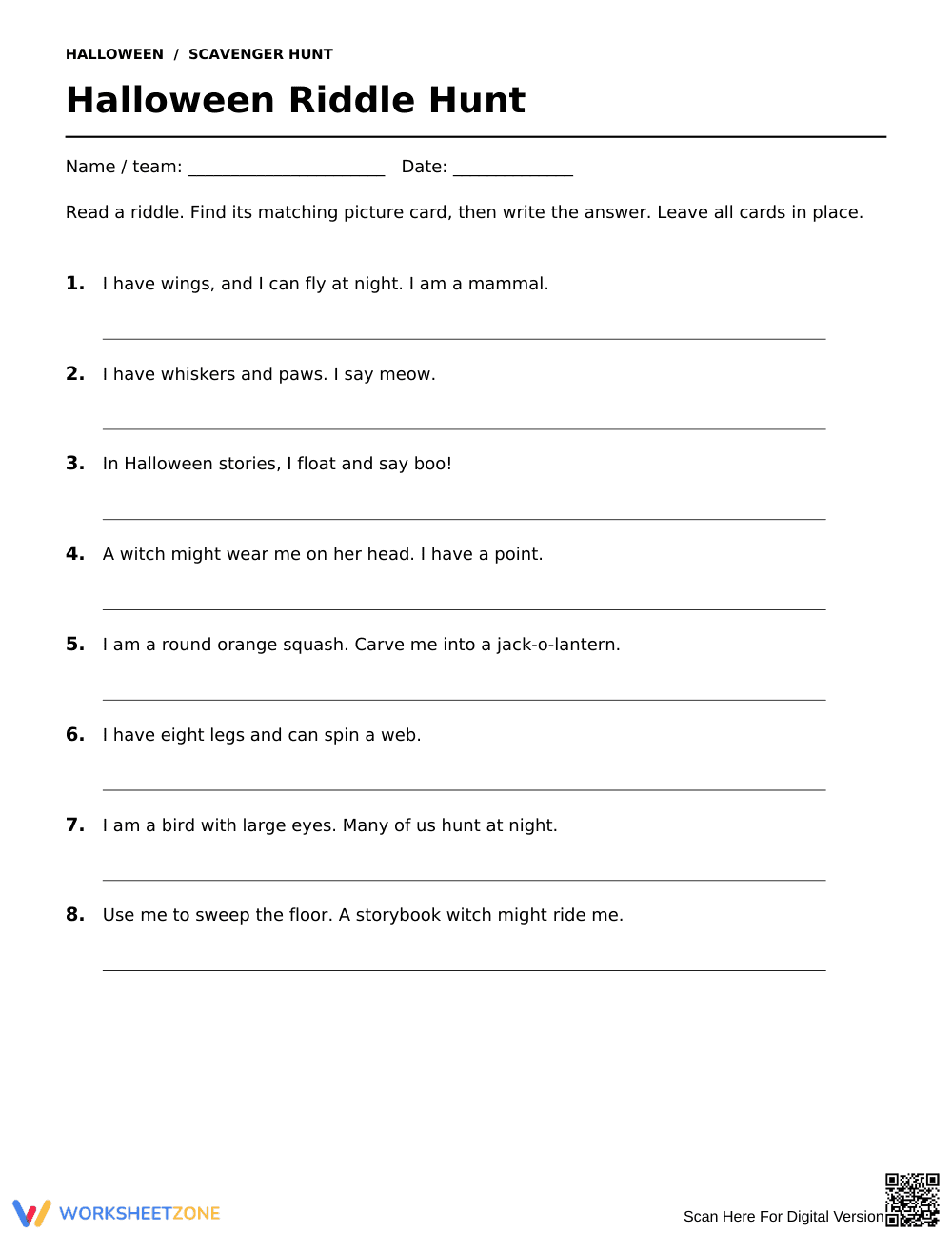
This Halloween riddle scavenger hunt builds reading comprehension and inferential thinking in young learners. Students read 8 descriptive clues, analyze textual evidence to deduce mystery objects, and locate corresponding picture cards around the learning space. The activity strengthens text-dependent reasoning while keeping primary students physically engaged in targeted literacy practice.
At a Glance
- Grade: 2 · Subject: English Language Arts
- Standard:
CCSS.ELA-LITERACY.RI.2.1— Ask and answer questions about key details in informational text- Skill Focus: Reading comprehension, descriptive clue inferencing, and vocabulary
- Format: 2 pages · 8 problems · Answer key included · PDF
- Best For: Interactive literacy stations and partner scavenger hunts
- Time: 10–15 minutes
What's Inside
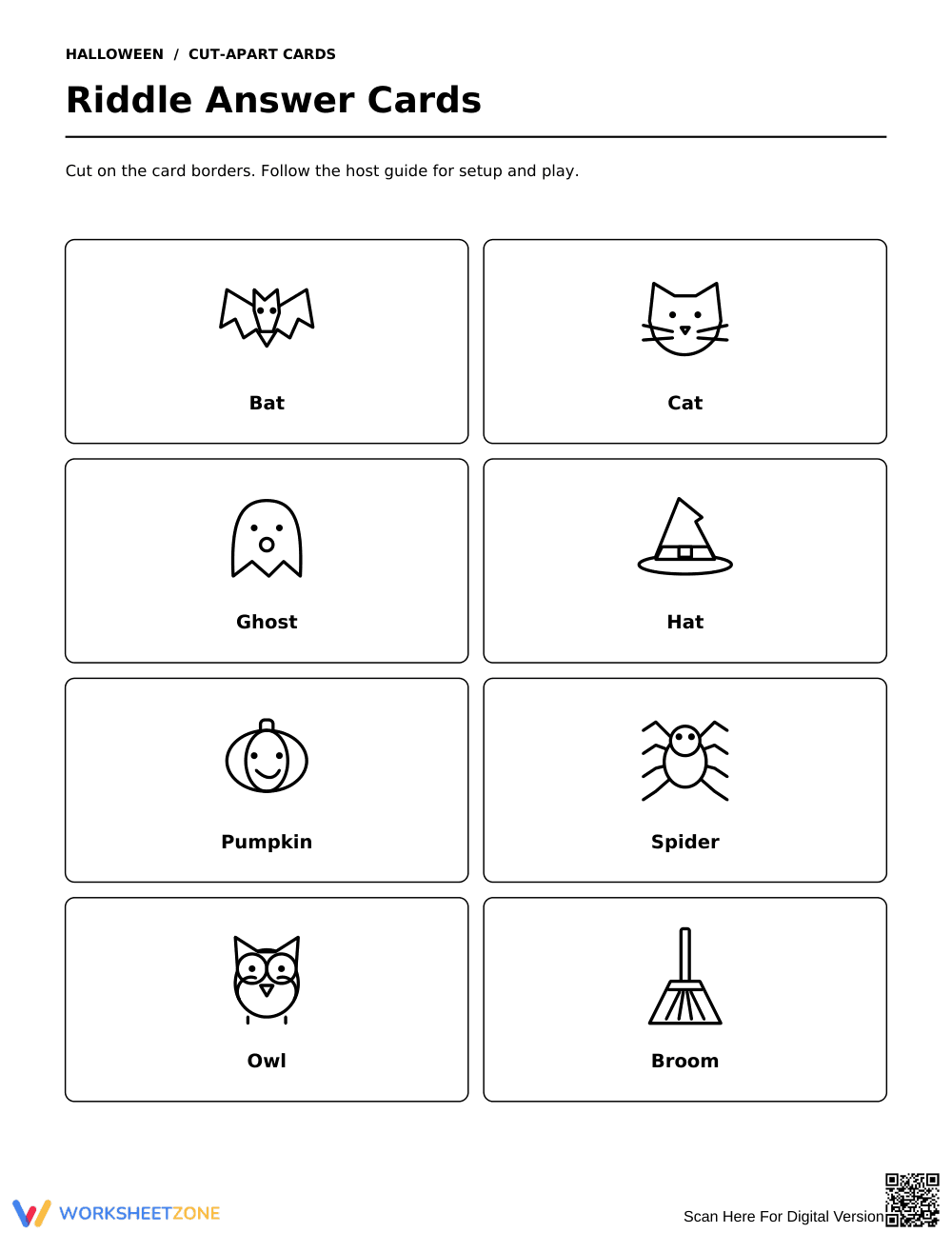
The printable PDF package contains a full student recording sheet featuring 8 distinct riddle prompts, a separate cut-apart page with 8 labeled visual cards, and a comprehensive host guide with an answer key. The cards provide clear visual and phonetic support, allowing students of varying reading abilities to verify their deductive conclusions independently.
Skill Progression
- Guided practice: Riddles 1 and 2 introduce familiar animal traits (wings, night flight, whiskers, paws), establishing how clue keywords signal category and attributes.
- Supported practice: Riddles 3 through 5 challenge students to combine cultural and descriptive details, matching objects like jack-o-lanterns and pointed hats with visual prompt cards.
- Independent practice: Riddles 6 through 8 require learners to synthesize multiple distinct clues (such as eight legs, night hunting, or household sweepers) to write accurate answers without direct prompting.
This progression mirrors the gradual release model, guiding students systematically from collaborative inquiry to independent textual deduction.
Standards Alignment
This activity aligns primarily with `CCSS.ELA-LITERACY.RI.2.1`: "Ask and answer such questions as who, what, where, when, why, and how to demonstrate understanding of key details in a text." It also reinforces foundational vocabulary through `CCSS.ELA-LITERACY.L.2.5` by requiring students to distinguish shades of meaning and real-life connections between words. Both standard codes can be copied directly into lesson plans, IEP goals, or district curriculum mapping tools.
How to Use It
Deploy this scavenger hunt during small-group literacy rotations or after direct instruction on context clues. For station work, tape the 8 picture cards across classroom walls and have pairs read prompts aloud before locating the matches. As a formative assessment tip, observe whether students identify specific clue words (such as "mammal" or "squash") or guess randomly based on partial phrases. The complete hunt takes 10 to 15 minutes.
Who It's For
Designed for first through third grade learners, this resource benefits emergent readers, English language learners needing visual anchors, and students requiring kinesthetic movement during phonics and reading time. Pair this worksheet with an anchor chart detailing attribute words or a short seasonal read-aloud about nocturnal animals.
According to Fisher & Frey (2014), structured opportunities for collaborative dialogue and text-based problem solving accelerate reading acquisition in primary classrooms. This printable Halloween hunt addresses CCSS.ELA-LITERACY.RI.2.1 by asking students to read informational clues, isolate critical attributes, and deduce solutions based on textual evidence. By pairing physical card searches with 8 short reading exercises, the lesson reinforces decoding, vocabulary application, and sentence-level comprehension within a lively, low-stakes format. Students demonstrate mastery of key details by recording written responses corresponding to verified visual cards. Fisher & Frey (2014) emphasize that purposeful peer interactions combined with immediate visual verification significantly improve knowledge retention among early readers. As students justify their answers using text clues like nocturnal flight or physical anatomy, teachers gather vital formative data regarding reading stamina and inferencing proficiency across diverse classroom settings.


