































Guide Energy Diagram Variables Worksheet | Grades 8–12

Paste this activity's link or code into your existing LMS (Google Classroom, Canvas, Teams, Schoology, Moodle, etc.).
Students can open and work on the activity right away, with no student login required.
You'll still be able to track student progress and results from your teacher account.
Students explore a potential energy diagram investigation, identifying variables, controls, and making evidence‑based predictions. By completing 22 guided tasks, they learn to link catalyst effects to reaction outcomes and justify conclusions with scientific reasoning through data analysis and diagram interpretation.
At a Glance
- Grade: 8–12 · Subject: Science
- Standard:
— investigate a reaction using a potential energy diagram- Skill Focus: Investigation variables and predictions
- Format: 4 pages · 22 problems · Answer key included · PDF
- Best For: Lab prep and data‑analysis practice
- Time: 10–15 minutes
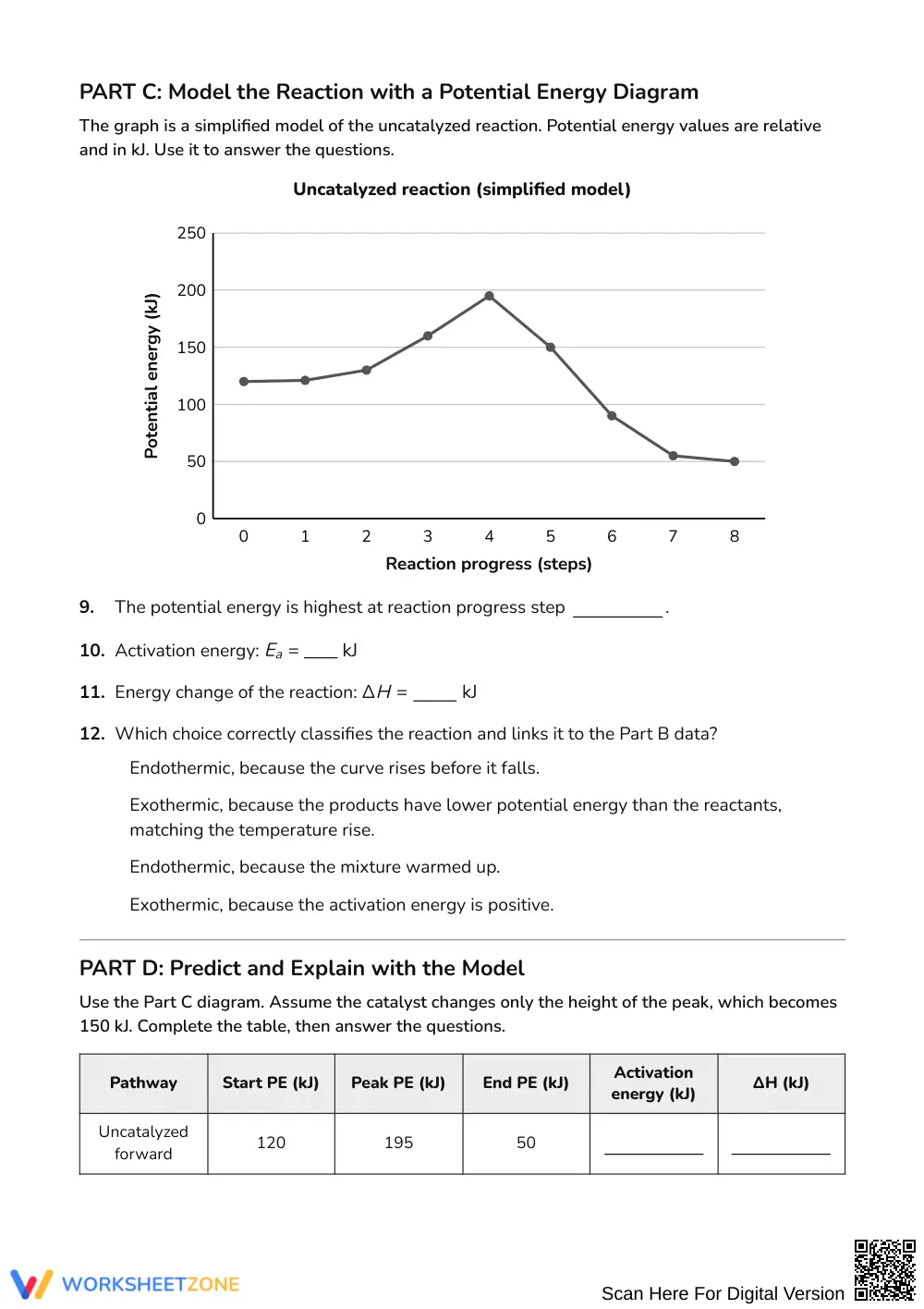
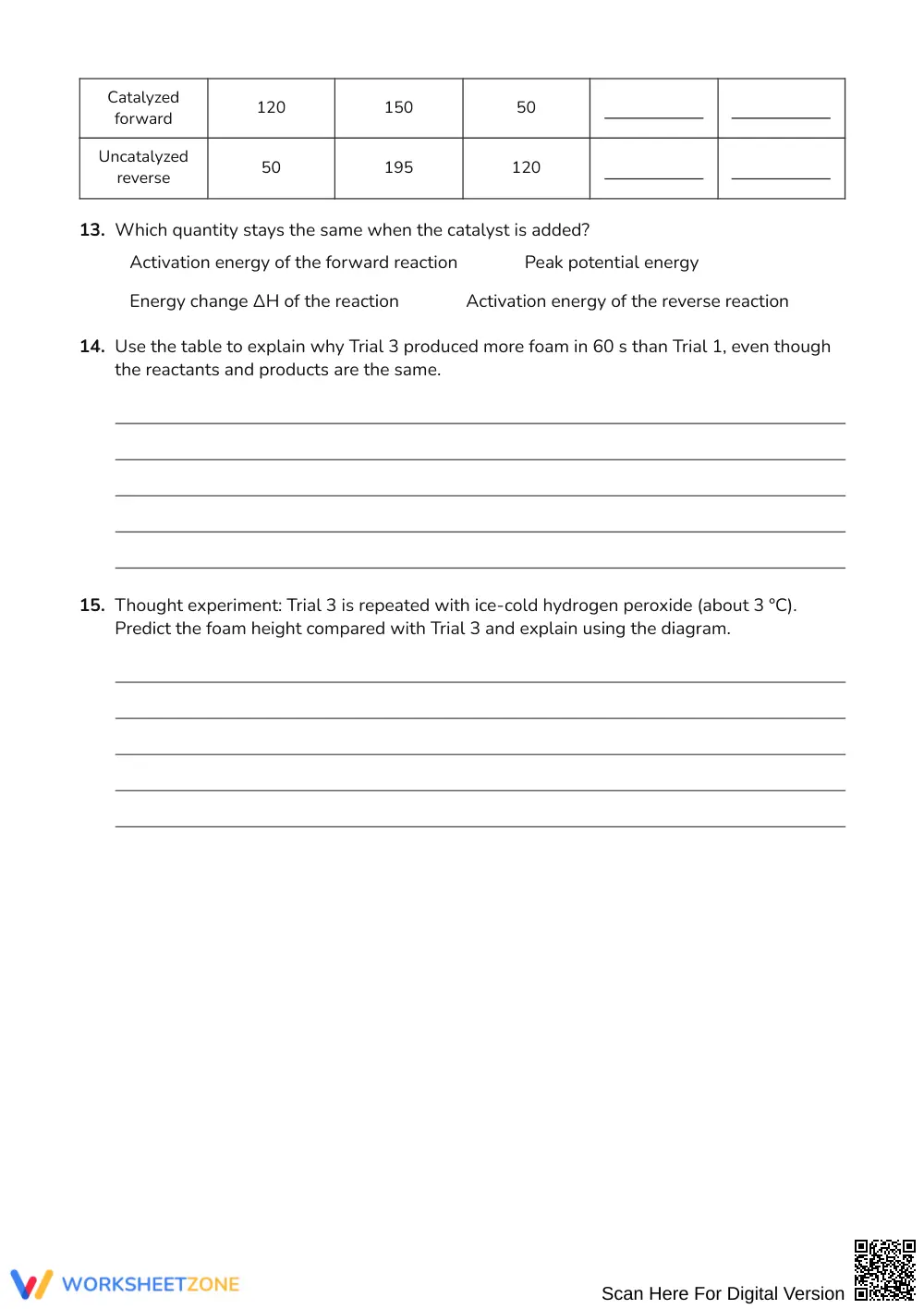
The worksheet is organized into four parts: Part A asks students to plan the investigation, Part B requires data interpretation, Part C introduces a potential energy diagram, and Part D extends the model for prediction and explanation. All four pages are printable, and a complete answer key is provided on the final page.
- Guided practice – Part A (5 questions) scaffolds students with a model answer and sentence frames for writing a testable question and identifying variables.
- Supported practice – Part B (4 items) lets students compare data, choose evidence‑based statements, and justify conclusions.
- Independent practice – Parts C & D (13 items) challenge students to read a diagram, calculate activation energy changes, and generate predictions without prompts.
This progression follows the classic I Do, We Do, You Do release, moving from teacher‑modeled examples to autonomous application.
Standard: – Students investigate a chemical reaction using a potential energy diagram, identifying variables, controls, and making predictions based on evidence. Both standard codes can be copied directly into lesson plans, IEP goals, or district curriculum mapping tools.
How to Use It
1. Before a lab, have students complete Part A as a pre‑lab assignment to focus their inquiry. 2. During the lab, use Part B as a quick data‑check worksheet; circulate and note misconceptions. 3. After the lab, assign Parts C and D for homework to reinforce diagram interpretation and extension thinking. Each segment takes roughly 3–5 minutes, fitting neatly into a 45‑minute class.
Who It's For
This resource is ideal for high‑school science students (grades 8‑12) who need structured practice with experimental design and energy‑profile analysis. It pairs well with a classroom anchor chart on variables and a teacher‑led demonstration of the yeast‑hydrogen peroxide reaction.
Research demonstrates that explicit instruction in variable identification and evidence-based prediction significantly improves students' ability to design scientific investigations (Fisher & Frey, 2014). When learners explicitly distinguish between independent, dependent, and controlled variables before interpreting experimental results, their conceptual retention and analytical accuracy increase substantially. By aligning these structured tasks directly to an accessible potential energy diagram framework, this resource actively reinforces the fundamental skill of investigating chemical reactions using visual energy models. Secondary science educators can confidently assign this printable worksheet as an introductory classroom task, targeted intervention assignment, or structured small group activity because it reflects validated cognitive apprenticeship principles. The included complete answer key allows teachers to monitor ongoing progress efficiently or facilitate peer review sessions during regular laboratory blocks. Print, distribute, and implement this resource today to strengthen inquiry skills and build enduring mastery across high school chemistry coursework.


