




























Views
Downloads

Green and Yellow Food Sorting Worksheet | Grade K Printable

Paste this activity's link or code into your existing LMS (Google Classroom, Canvas, Teams, Schoology, Moodle, etc.).
Students can open and work on the activity right away, with no student login required.
You'll still be able to track student progress and results from your teacher account.
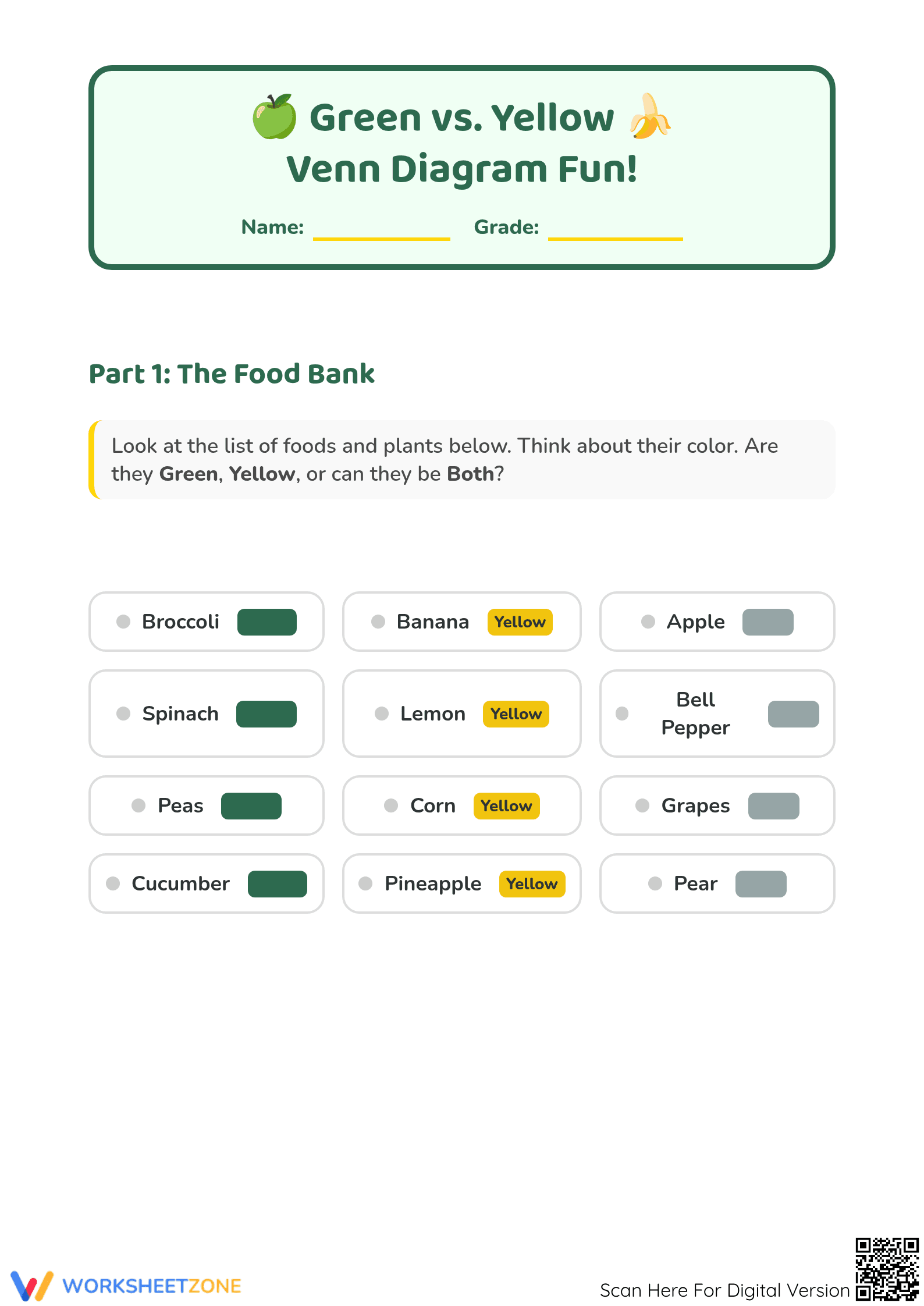
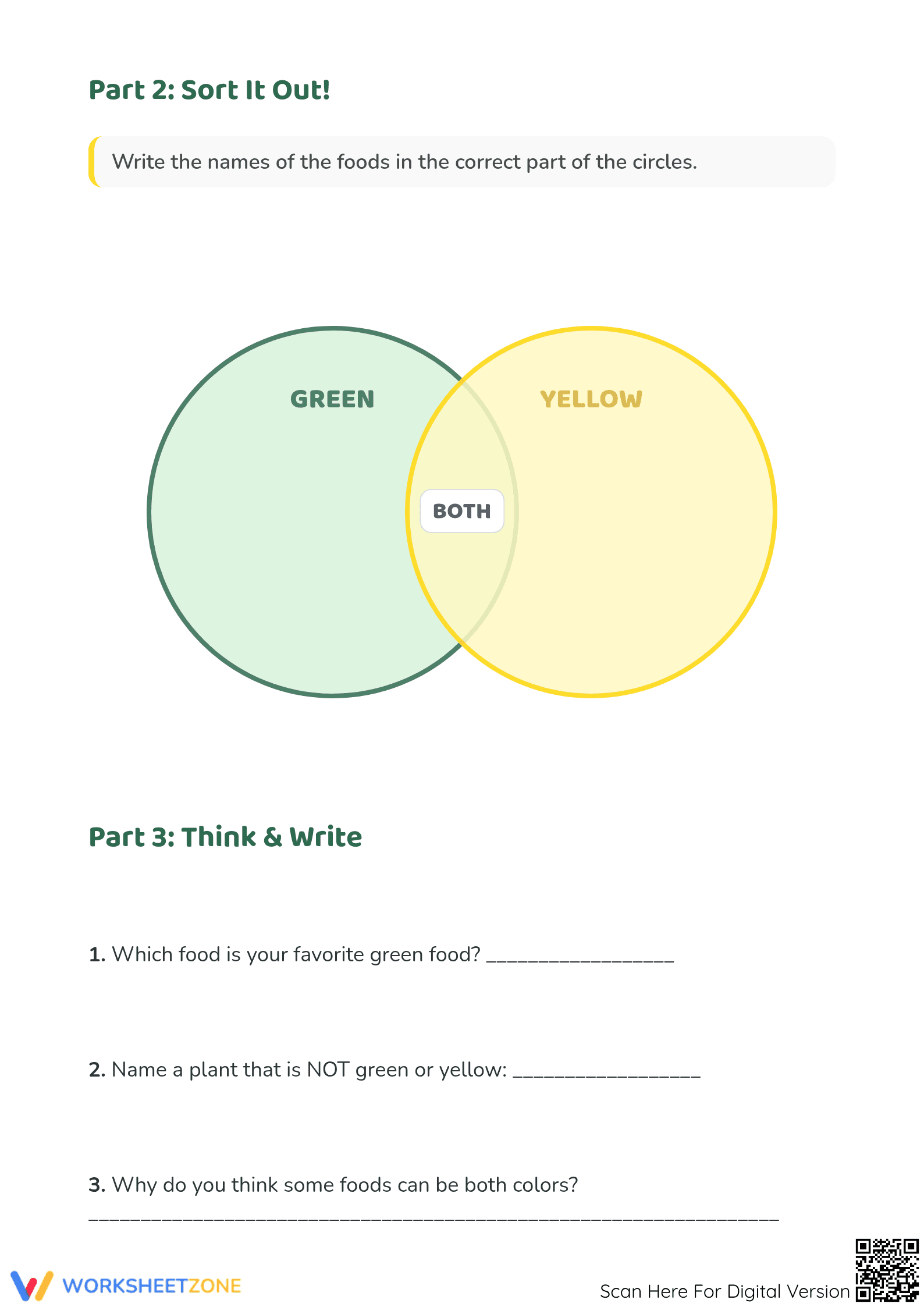
This Grade K Venn diagram worksheet helps young learners master the art of categorization through a fun, food-themed sorting activity. Students analyze 12 different items based on color attributes to determine if they belong in the green set, the yellow set, or both. This resource builds essential data organization skills and encourages logical reasoning in early mathematicians.
At a Glance
- Grade: Kindergarten · Subject: Math
- Standard:
CCSS.MATH.CONTENT.K.MD.B.3— Classify objects into given categories and count the number of objects in each- Skill Focus: Data organization and attribute sorting
- Format: 2 pages · 15 tasks · Answer key included · PDF
- Best For: Small group centers or independent practice
- Time: 15–20 minutes
What's Inside: This two-page PDF includes a comprehensive food bank with 12 labeled illustrations for students to evaluate. The second page features a large, clear Venn diagram for physical sorting and three "Think & Write" questions that prompt students to explain their reasoning. A complete answer key is provided to allow for quick teacher review or student self-correction.
Zero-Prep Workflow: Teachers can implement this resource in three simple steps. First, print the two-page document (30 seconds). Second, distribute to students with green and yellow crayons or pencils (1 minute). Third, review the completed Venn diagrams using the provided key (1 minute). Total teacher preparation time is under two minutes, making this an ideal choice for busy mornings or unexpected substitute plans.
Standards Alignment: This activity directly addresses `CCSS.MATH.CONTENT.K.MD.B.3` by requiring students to classify objects into given categories. It also supports introductory data work by asking students to represent their findings in a visual format. This standard code can be copied directly into lesson plans, IEP goals, or district curriculum mapping tools to demonstrate compliance with state and national requirements.
How to Use It: Use this worksheet during the guided practice portion of a lesson on attributes and sets. After introducing the concept of a Venn diagram, provide this sheet as a way for students to apply their knowledge to familiar objects. For a formative assessment, observe students as they decide where the "Both" category items belong, noting if they can identify that some grapes or apples can be either color.
Who It's For: This resource is designed for Kindergarten students but is also appropriate for Pre-K enrichment or Grade 1 review. It provides excellent support for English Language Learners (ELL) through the use of clear, labeled visuals for common foods. It pairs naturally with a hands-on sorting bin of plastic play food or a classroom anchor chart about primary and secondary colors.
Sorting and categorizing are foundational cognitive skills that bridge the gap between simple observation and formal mathematical reasoning. According to the RAND AIRS 2024 report on early childhood numeracy, the ability to organize data into visual representations like Venn diagrams significantly enhances a student's capacity for logical set theory later in their academic career. This worksheet targets CCSS.MATH.CONTENT.K.MD.B.3 by requiring students to analyze attributes like color and determine membership in overlapping sets. By engaging with familiar objects like fruits and vegetables, learners build semantic connections while practicing the mechanical skill of data entry. The inclusion of "Think & Write" prompts further pushes students toward meta-cognition, asking them to justify their sorting logic. This dual-layer approach—combining procedural sorting with conceptual reasoning—is a hallmark of high-quality instructional materials that support long-term retention of mathematical properties in Grade K learners.


