































Gratitude Words: Grateful, Appreciate, Thankful | Grade 3

Paste this activity's link or code into your existing LMS (Google Classroom, Canvas, Teams, Schoology, Moodle, etc.).
Students can open and work on the activity right away, with no student login required.
You'll still be able to track student progress and results from your teacher account.
Build meaningful language skills with this Grade 3 vocabulary worksheet focused on gratitude words. Students define, match, and apply six essential terms—including grateful, appreciate, and thankful—through direct matching and personal sentence construction, developing authentic word consciousness and expressive writing fluency across two structured practice pages.
At a Glance
- Grade: 3 · Subject: English Language Arts
- Standard:
L.3.6— Acquire and accurately use grade-appropriate conversational and domain-specific vocabulary- Skill Focus: Gratitude and appreciation vocabulary
- Format: 2 pages · 9 total tasks · Complete answer key included · Printable PDF
- Best For: Independent practice, morning work, and vocabulary stations
- Time: 20–30 minutes
What's Inside
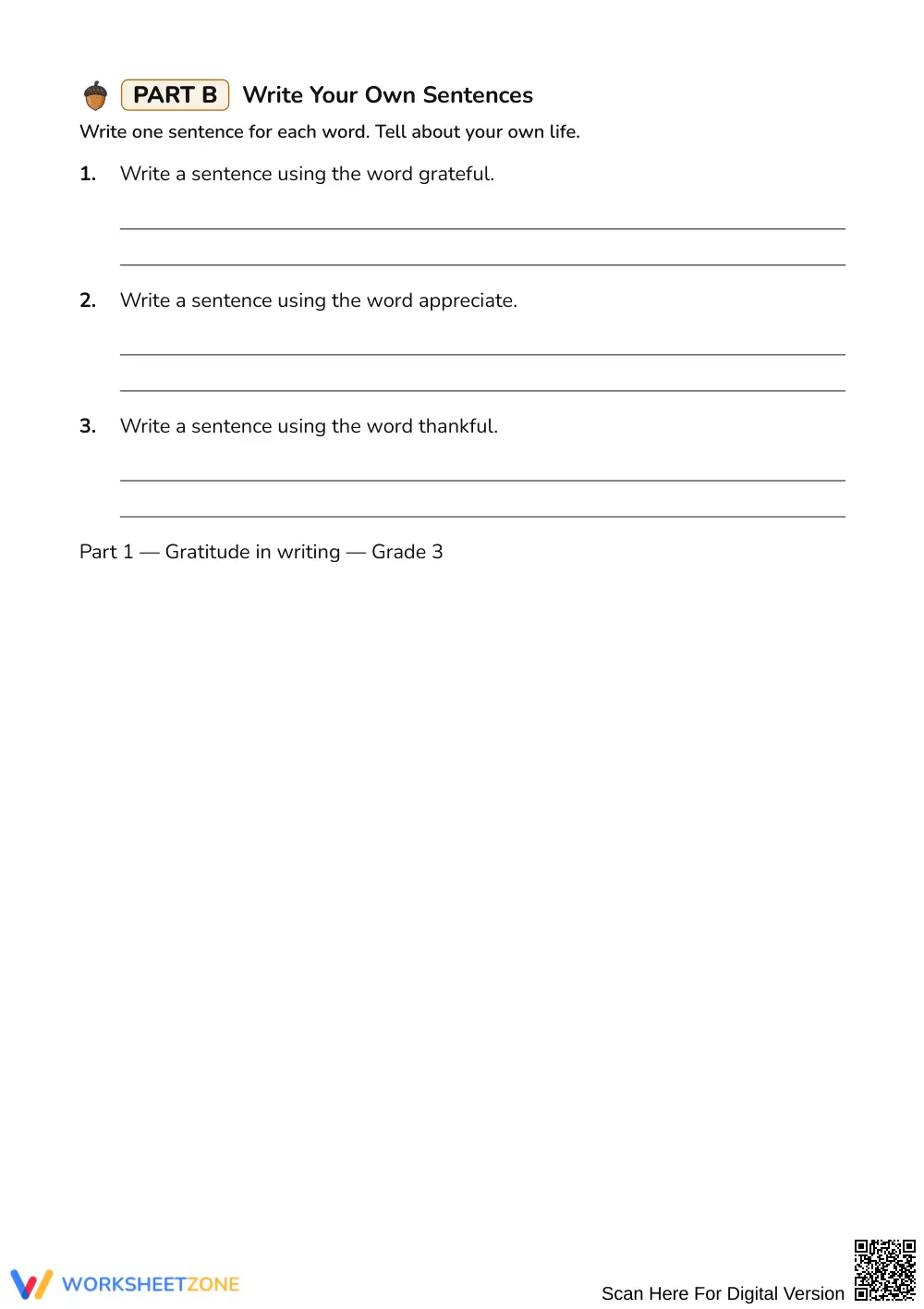
This 2-page vocabulary resource features 9 targeted tasks accompanied by a full 2-page answer key. Part A provides 6 matching items pairing key gratitude terms—grateful, appreciate, thankful, generous, kindness, and thoughtful—with clear definitions. Part B offers 3 sentence-writing prompts requiring students to apply terms to their daily lives, supported by student-friendly mentor sentences.
Skill Progression
- Guided practice (Tasks 1–3): Students match high-frequency gratitude terms to concrete definitions with teacher modeling or partner support.
- Supported practice (Tasks 4–6): Learners complete remaining matching items independently, using contextual clues to solidify receptive understanding.
- Independent practice (Tasks 7–9): Students compose 3 original sentences about their lives, utilizing provided mentor examples as syntax scaffolds.
This sequence implements the gradual release of responsibility model, transitioning students from foundational term recognition to independent written application.
Standards Alignment
The primary standard addressed is L.3.6: Acquire and use accurately grade-appropriate conversational, general academic, and domain-specific words and phrases. A supporting standard is W.3.4, which focuses on producing clear, coherent writing appropriate to task and purpose. Both standard codes can be copied directly into lesson plans, IEP goals, or district curriculum mapping tools.
How to Use It
Administer this worksheet following direct instruction on social-emotional vocabulary or seasonal themes. It functions effectively as a formative assessment station during small-group reading rotations, where teachers observe whether students accurately distinguish emotional states from actionable behaviors. Alternatively, assign it as a focused independent writing activity. Expected completion time is 20 to 30 minutes.
Who It's For
This resource serves Grade 3 general education learners, English language learners developing Tier 2 emotional vocabulary, and students in specialized intervention groups. For students needing additional scaffolding, pair this worksheet with a vocabulary anchor chart or a seasonal mentor text before beginning Part B.
Vocabulary acquisition in the intermediate elementary grades requires deliberate instructional movement from receptive recognition to active, expressive application. According to Fisher & Frey (2014), students retain target vocabulary far more effectively when structured definition matching is immediately paired with authentic, self-generated writing tasks. This Grade 3 gratitude vocabulary resource directly fulfills standard L.3.6 by guiding young learners to acquire and accurately apply social-emotional terms—such as grateful, appreciate, and thoughtful—in both literal definition contexts and original personal sentences. Rather than memorizing isolated flashcard definitions, students examine clear mentor sentences and synthesize their own personal life experiences into syntactically correct statements. By grounding emotional vocabulary in explicit scaffolded practice, educators build semantic depth, strengthen reading comprehension, and foster expressive writing fluency within an intentional, research-backed framework designed to reinforce long-term lexical retrieval across academic and everyday conversational domains.


