


























Views
Downloads

Grade 1 Onset and Rime 'ed' | Essential Phonics
Paste this activity's link or code into your existing LMS (Google Classroom, Canvas, Teams, Schoology, Moodle, etc.).
Students can open and work on the activity right away, with no student login required.
You'll still be able to track student progress and results from your teacher account.
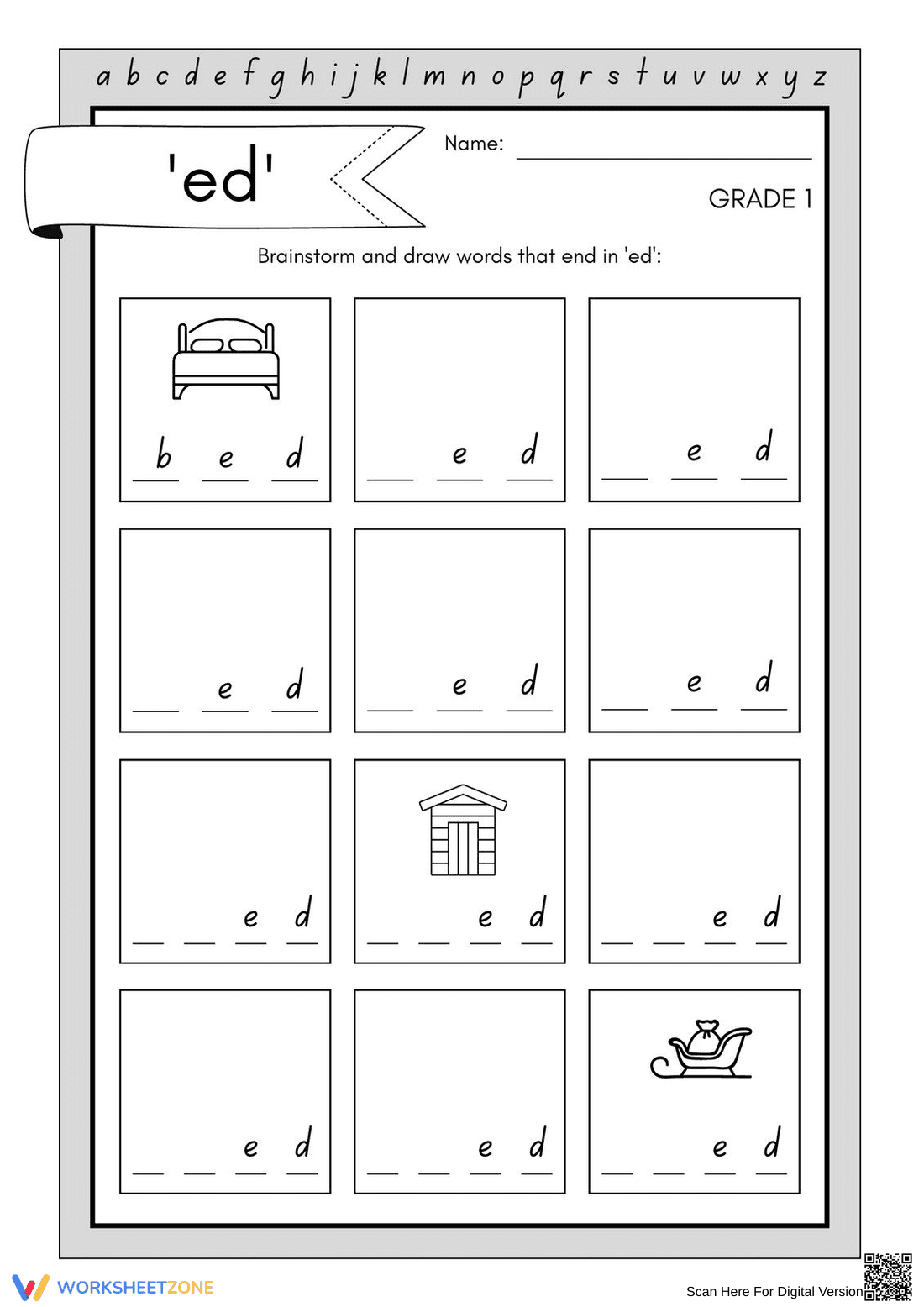
This Grade 1 phonics worksheet focuses on the 'ed' word family, helping students develop essential decoding skills through onset and rime manipulation. By brainstorming and drawing words like "bed," "red," and "fed," learners strengthen their phonological awareness and spelling accuracy in a creative, engaging format that bridges the gap between phonics and vocabulary.
At a Glance
- Grade: 1 · Subject: ELA
- Standard:
CCSS.ELA-LITERACY.RF.1.3— Decode regularly spelled one-syllable words using phonics knowledge- Skill Focus: 'ed' Word Family (Onset & Rime)
- Format: 1 page · 12 tasks · Answer key included · PDF
- Best For: Independent phonics practice or morning work
- Time: 15–20 minutes
The worksheet features a 12-box grid designed for student interaction. Each box provides a scaffolded "___ e d" structure, encouraging students to identify the initial consonant (onset) and pair it with the 'ed' rime. The layout includes space for students to illustrate their words, reinforcing the connection between written symbols and meaning while providing a visual cue for comprehension.
This resource is designed for a zero-prep classroom workflow. 1. Print: Select the single-page PDF and print enough copies for your class (30 seconds). 2. Distribute: Hand out the sheets during your phonics block or as a transition activity (1 minute). 3. Review: Use the included answer key for a quick whole-class check or individual grading (30 seconds). Total teacher prep time is under 2 minutes, making it an ideal choice for busy mornings or unexpected sub plans.
Aligned to `CCSS.ELA-LITERACY.RF.1.3`, this activity specifically targets the ability to decode regularly spelled one-syllable words. It also supports RF.1.2.C by helping students isolate and produce initial, medial vowel, and final sounds in spoken single-syllable words. Both standard codes can be copied directly into lesson plans, IEP goals, or district curriculum mapping tools.
Use this worksheet during the independent practice phase of a lesson on short 'e' word families. It serves as an excellent formative assessment tool; observe if students can generate real words versus nonsense words and if their illustrations match the phonetic output. Expected completion time is 15 to 20 minutes, making it a perfect fit for literacy centers or small group rotations.
This resource is perfect for first-grade students or kindergarteners ready for advanced phonics. It provides necessary scaffolding for English Language Learners through the drawing component, which allows them to demonstrate understanding without heavy reliance on complex sentence structures. Pair this with a short 'e' anchor chart or a decodable reader for a comprehensive literacy experience.
Research by Fisher & Frey (2014) emphasizes the importance of word study and the gradual release of responsibility in early literacy instruction. This 'ed' word family worksheet applies these principles by providing a clear structure for students to practice onset and rime independently. By focusing on CCSS.ELA-LITERACY.RF.1.3, the activity ensures that students are building the foundational decoding skills necessary for reading fluency. The inclusion of a drawing task leverages dual coding theory, where visual representation aids in the retention of phonetic patterns. According to NAEP data, early mastery of phonological awareness is a primary predictor of later reading success. This 12-task printable offers a high-utility, low-stakes environment for students to experiment with letter-sound correspondences, ensuring they meet grade-level expectations for phonics and word recognition in a structured, evidence-based manner.


