




























Views
Downloads

Essential Light Reflection Worksheet | Grade 4 Science

Paste this activity's link or code into your existing LMS (Google Classroom, Canvas, Teams, Schoology, Moodle, etc.).
Students can open and work on the activity right away, with no student login required.
You'll still be able to track student progress and results from your teacher account.
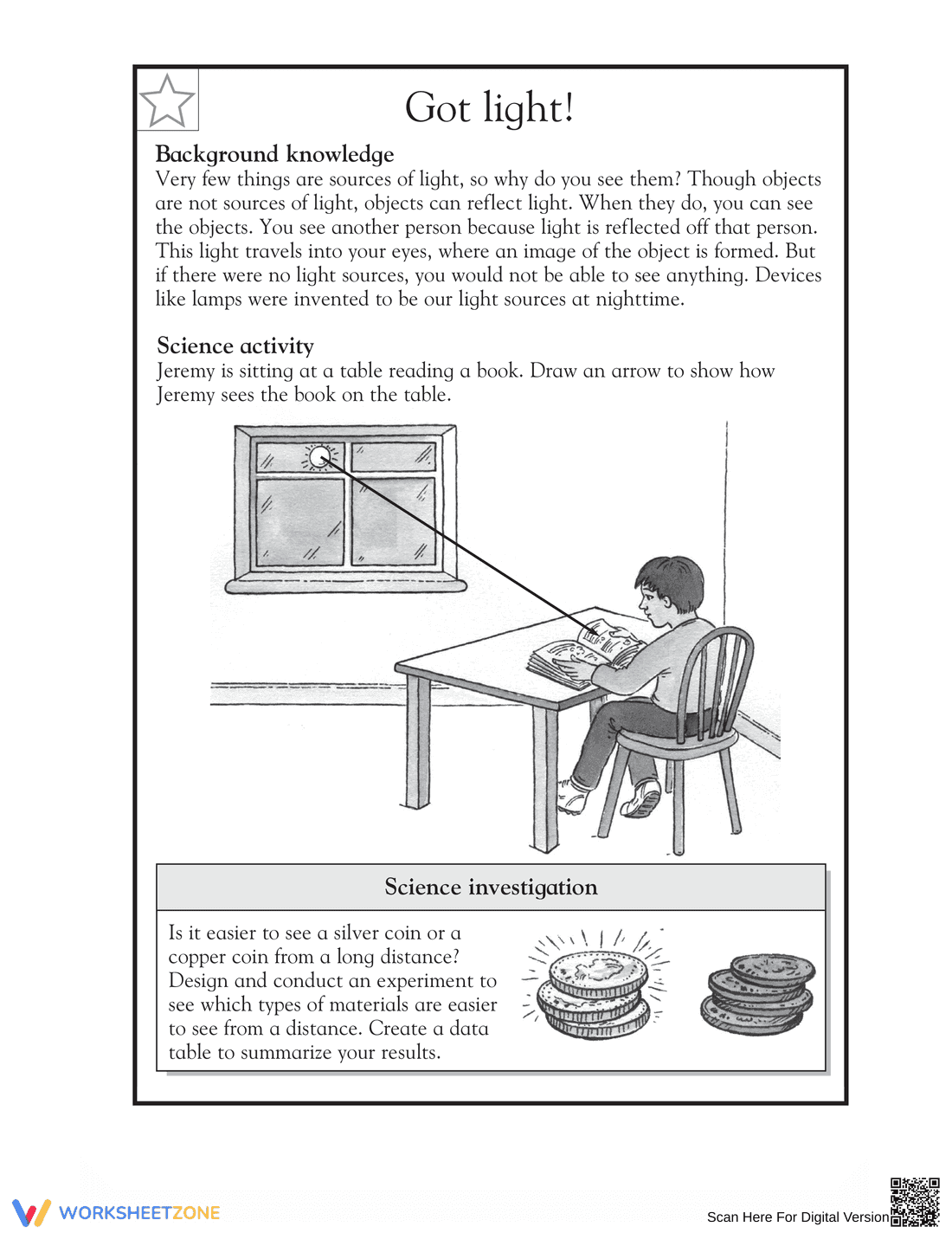
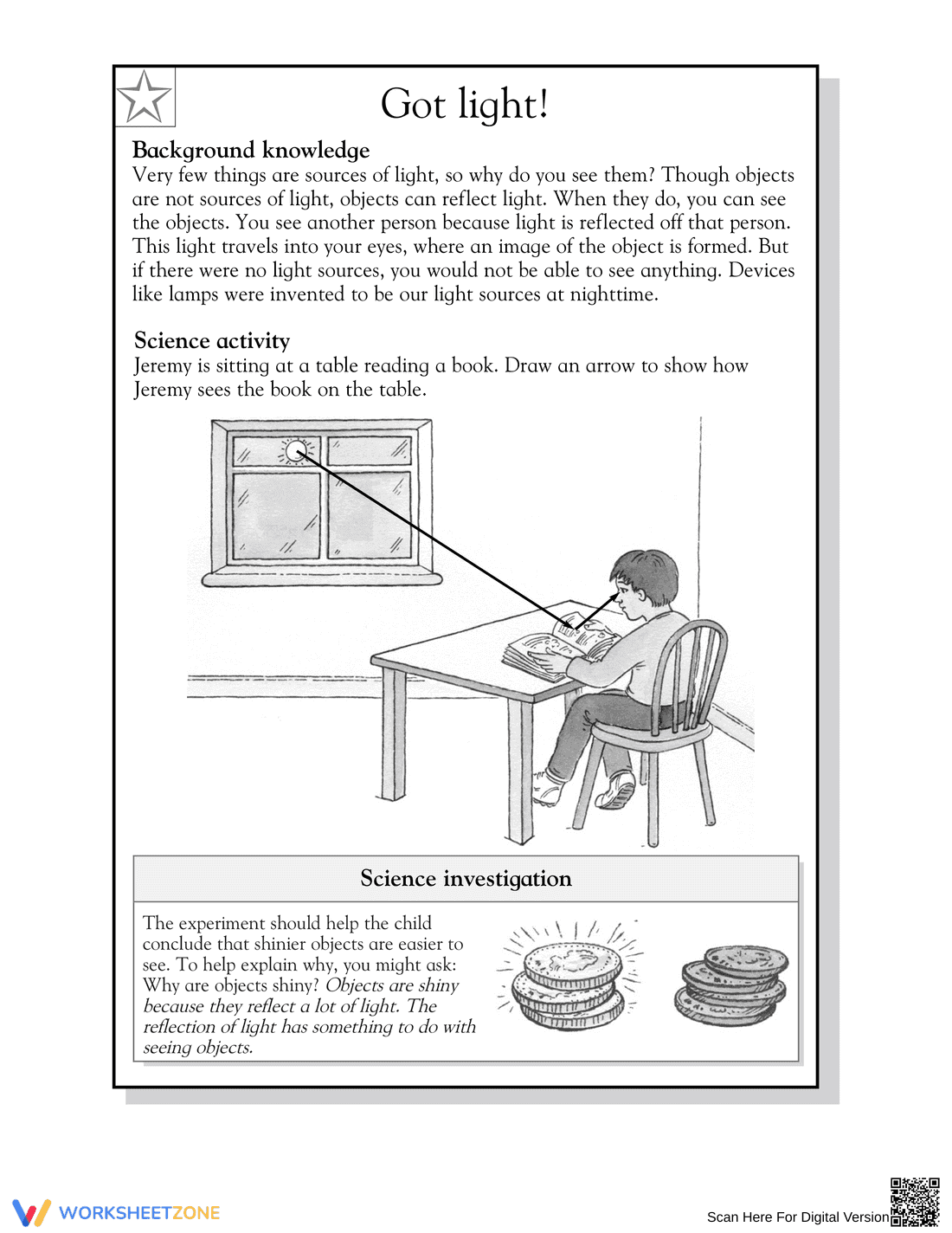
This worksheet provides targeted practice for Grade 4 students on the foundational science concept of light reflection. Through a clear explanatory text, a modeling activity, and an investigation prompt, students will build a concrete understanding of how light travels from a source, reflects off an object, and enters the eye, allowing the object to be seen.
At a Glance
- Grade: 4 · Subject: Science
- Standard:
4-PS4-2— Model how light reflecting from objects allows them to be seen.- Skill Focus: Light Reflection and Vision
- Format: 1 page · 2 problems · No answer key · PDF
- Best For: Concept introduction or formative assessment
- Time: 15–20 minutes
This single-page resource starts with a "Background knowledge" section explaining light sources versus reflection. It then presents two tasks: a "Science activity" to model the path of light, and a "Science investigation" to design an experiment on material reflectivity. The worksheet is a self-contained, print-ready PDF.
Skill Progression
The worksheet follows a structured sequence to ensure students grasp the core concept.
- Guided practice: The initial text provides foundational knowledge on how vision depends on reflected light.
- Supported practice: The "Science activity" asks students to apply the concept by drawing a model of a boy reading, scaffolding the abstract idea into a visual representation.
- Independent practice: The "Science investigation" serves as an extension, challenging students to design their own experiment and promoting higher-order thinking.
This gradual-release model ensures students understand, apply, and then explore the concept independently.
Standards Alignment
This worksheet directly aligns with NGSS 4-PS4-2, requiring students to model how reflected light allows sight. The drawing task provides direct evidence for this standard. The standard code can be easily copied into lesson plans or curriculum maps.
How to Use It
This resource is flexible. Use it as an introductory activity to solidify the concept of reflection. The "Science activity" is an excellent formative assessment tool to check for misconceptions about the direction of light. Alternatively, assign it as homework to reinforce the day's lesson. The investigation can be a quick in-class challenge or a full lab activity. Expect completion to take 15-20 minutes.
Who It's For
Designed for Grade 3 and 4 students studying physical science. The clear language makes it accessible for all learners. For students needing support, a teacher could model the activity with a real flashlight. This worksheet pairs well with a hands-on demonstration using mirrors or a read-aloud about light sources.
This resource applies NGSS standard 4-PS4-2, which focuses on modeling how reflected light enables vision. By having students draw the light's path, the worksheet addresses the core modeling practice of the standard. The inquiry task aligns with research on the importance of hands-on science activities for building understanding. According to Fisher & Frey (2014), a gradual release of responsibility—moving from guided to independent practice as this worksheet does—is a proven framework for student learning. This single-page PDF effectively combines direct instruction, guided application, and independent inquiry, making it a robust tool for teaching the physics of sight to elementary students.


