


























Views
Downloads

Essential Grade 4 Sound and Pitch — No-Prep Worksheet
Paste this activity's link or code into your existing LMS (Google Classroom, Canvas, Teams, Schoology, Moodle, etc.).
Students can open and work on the activity right away, with no student login required.
You'll still be able to track student progress and results from your teacher account.
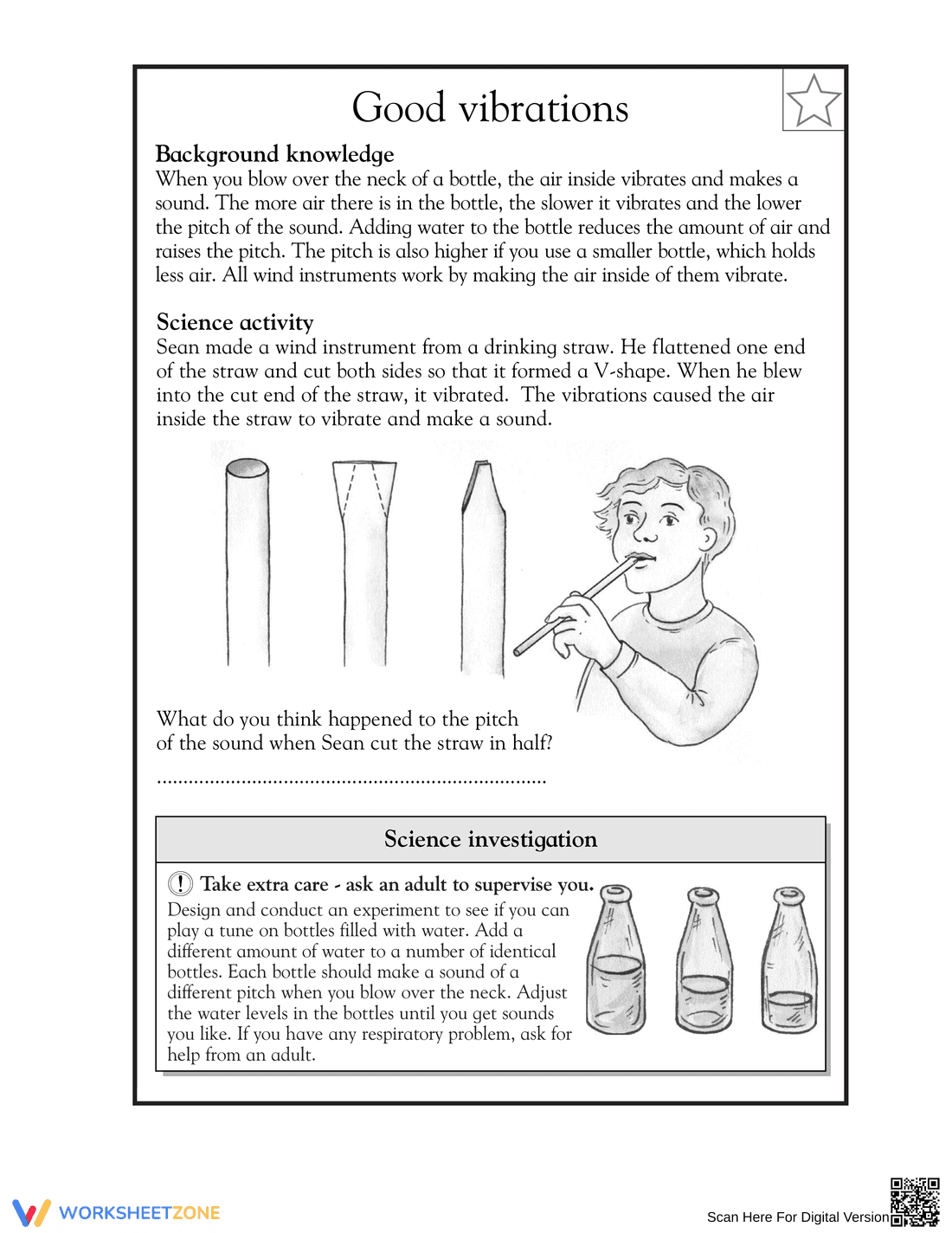
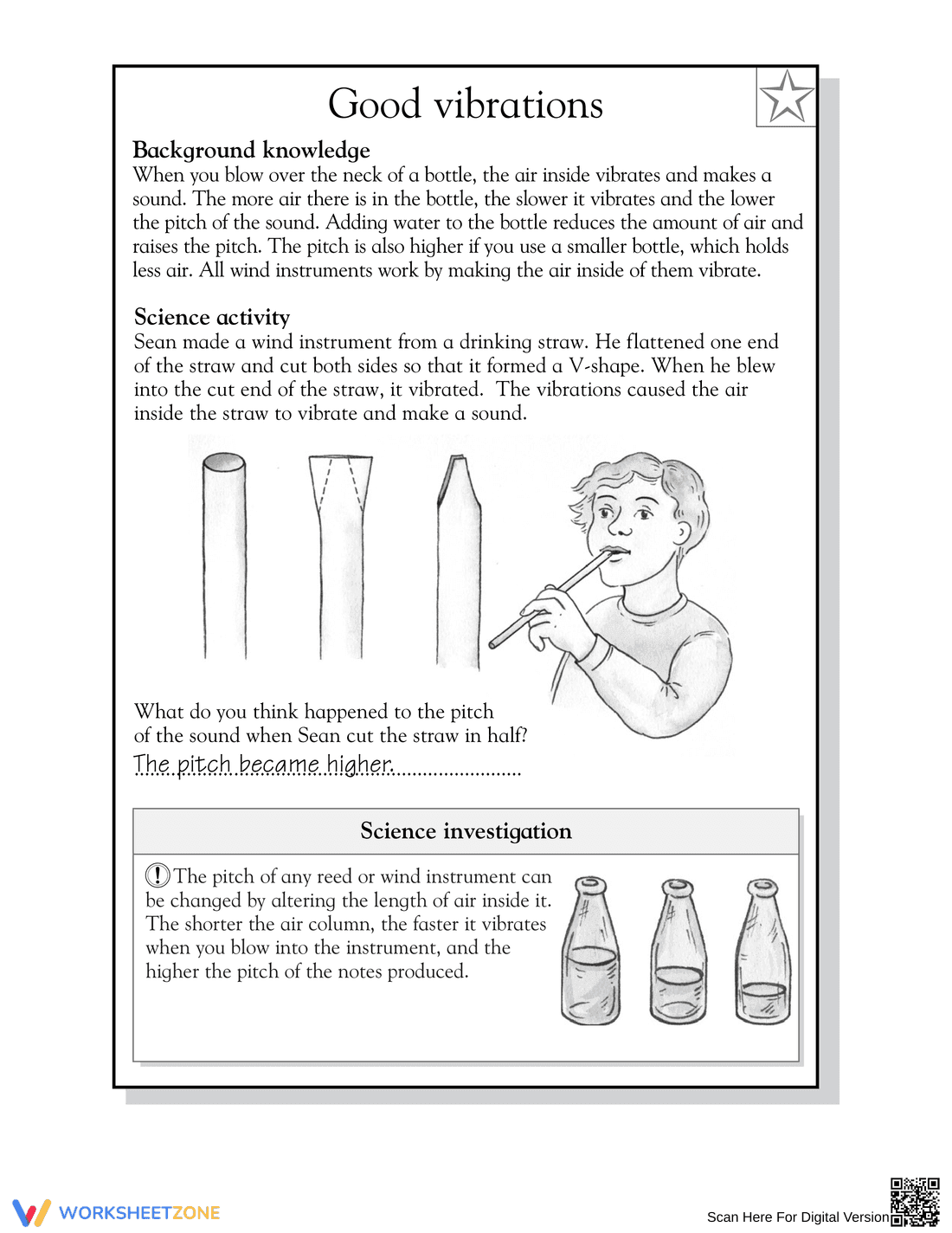
This hands-on science worksheet helps Grade 4 students investigate the physical properties of sound through direct experimentation. Learners build a simple straw instrument and conduct a bottle-tuning investigation to observe how vibrations create varying pitches. This resource bridges the gap between abstract physics concepts and tangible, classroom-ready science experiences.
At a Glance
- Grade: 4 · Subject: Science
- Standard:
4-PS4-1— Develop a model to describe wave patterns and properties- Skill Focus: Sound vibrations and pitch
- Format: 2 pages · 2 problems · Answer key included · PDF
- Best For: Interactive classroom science lab activities
- Time: 20–30 minutes
What's Inside
This two-page PDF includes a student worksheet and a comprehensive answer key. The instructional flow begins with a "Background Knowledge" section to anchor the physics of air vibration. Students then move into two distinct lab phases: a "Science Activity" focused on straw-based reed instruments and a "Science Investigation" involving water-filled bottles to explore column length and pitch.
A Zero-Prep Science Lab
Implementing this lab follows a simple three-step workflow. First, print the document and gather straws, scissors, and bottles (2 minutes). Second, distribute materials and allow students to follow the self-guided instructions to build and observe (15 minutes). Third, use the included answer key to facilitate a whole-class review of the results (5 minutes). This zero-prep approach is ideal for busy science blocks or emergency substitute plans.
Standards Alignment
Aligned to Next Generation Science Standard 4-PS4-1, this resource requires students to develop a conceptual model of wave patterns. By manipulating the length of straws and water levels in bottles, students see how changing a physical variable alters the resulting sound vibration. This standard code can be copied directly into lesson plans, IEP goals, or district curriculum mapping tools.
How to Use It
Use this worksheet as a discovery-based hook during your physical science unit on waves. It works best after a brief introduction to the concept of vibration but before formal lectures on pitch and frequency. Teachers can circulate and observe students' predictions about straw length as a formative assessment of their growing understanding of inverse relationships in acoustics.
Who It's For
This resource is designed for fourth-grade students but is highly adaptable for third-grade enrichment. The clear, visual instructions support English language learners by providing concrete representations of abstract scientific vocabulary. It pairs naturally with a classroom anchor chart displaying terms like "frequency," "vibration," and "pitch" to reinforce academic language during the hands-on portion of the lesson.
According to the RAND AIRS 2024 report, hands-on science instruction significantly improves long-term retention of physical science concepts compared to passive reading alone. This worksheet implements inquiry-based learning principles by requiring students to investigate the standard 4-PS4-1 through direct manipulation of materials. By observing how water levels and straw lengths change the pitch of a sound, students internalize the physics of vibrations rather than just memorizing definitions. This approach aligns with modern pedagogical standards that emphasize the "Doing" of science to build authentic mastery. The structured nature of the tasks provides enough scaffolding for independent work while maintaining the rigor required for grade-level competency. Integrating such practical models into the curriculum ensures that students can bridge observable phenomena with the underlying wave properties defined in national frameworks. This activity serves as a reliable instrument for demonstrating energy transfer through sound vibrations and pitch fluctuations.


