


























Views
Downloads
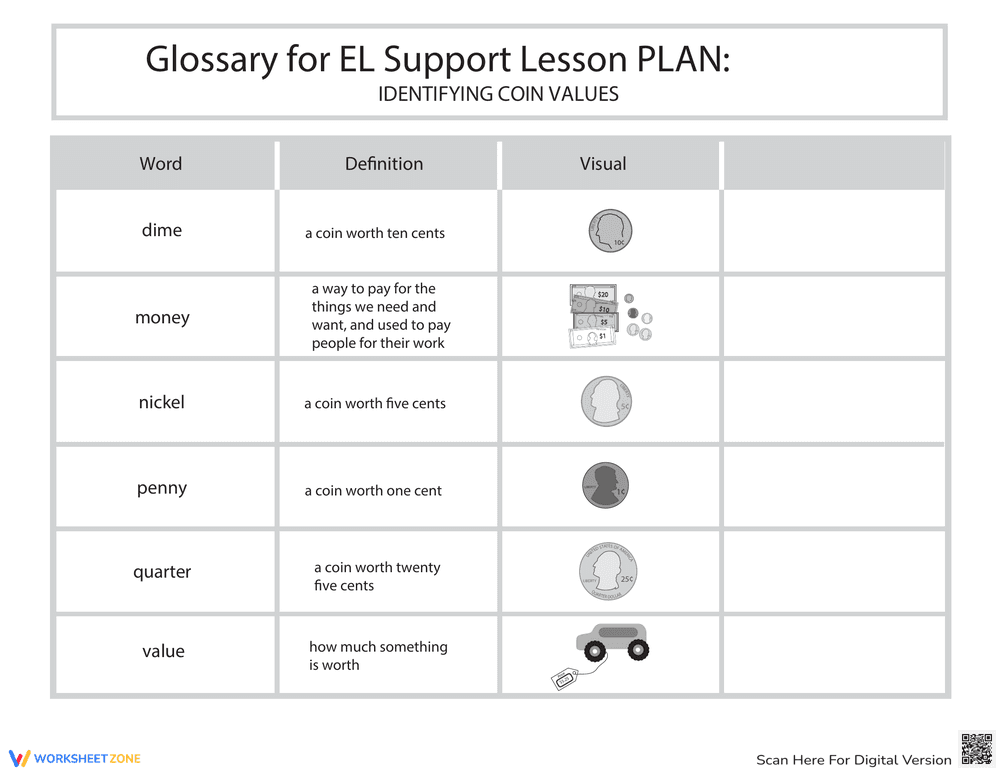

Grade 2 Coin Values — Printable Vocabulary Glossary
Paste this activity's link or code into your existing LMS (Google Classroom, Canvas, Teams, Schoology, Moodle, etc.).
Students can open and work on the activity right away, with no student login required.
You'll still be able to track student progress and results from your teacher account.
This printable glossary helps second-grade students master money vocabulary by pairing essential terms with clear definitions and visual representations. Designed to support English learners, this resource builds foundational financial literacy, preparing students to solve word problems involving coins. Students quickly connect terms like dime, nickel, and value to their real-world counterparts.
At a Glance
- Grade: Grade 2 · Subject: Money Math
- Standard:
2.MD.C.8— Solve word problems involving dollar bills, quarters, dimes, nickels, and pennies- Skill Focus: Coin identification and value vocabulary
- Format: 1 page · 6 vocabulary terms · Reference sheet · PDF
- Best For: English language learner vocabulary support
- Time: 10–15 minutes
This single-page reference sheet contains a vocabulary table featuring six essential money terms: dime, money, nickel, penny, quarter, and value. Each entry provides a student-friendly definition alongside a clear visual illustration of the coin. An empty column is included for students to write translations or draw their own representations.
Zero-Prep Classroom Workflow
This resource requires zero teacher preparation. Follow these three steps to implement it:
- Print (1 minute): Print one copy per student or project the PDF.
- Distribute (1 minute): Hand out sheets at the start of the math block.
- Review (5 minutes): Read terms together, prompting students to write translations in the blank column.
With under two minutes of setup, this sheet is perfect for emergency sub plans.
Standards Alignment
This tool supports standard `2.MD.C.8`, which requires students to solve word problems involving dollar bills, quarters, dimes, nickels, and pennies. By mastering coin vocabulary, students build the linguistic schema needed to solve complex word problems. Both standard codes can be copied directly into lesson plans, IEP goals, or district curriculum mapping tools.
How to Use It
Use this glossary to pre-teach vocabulary before direct instruction. Alternatively, place it in a math center as a desktop anchor chart. During activities, observe if students can match physical coins to the illustrations. This formative assessment helps identify students needing hands-on practice. The activity takes 10 to 15 minutes to complete.
Who It's For
This resource is ideal for second-grade students, particularly English language learners (ELLs) who benefit from visual scaffolds. It pairs naturally with a hands-on coin sorting activity. The open-ended notes column allows advanced learners to write equivalent values, such as noting that five pennies equal one nickel, ensuring easy differentiation.
This vocabulary glossary supports the acquisition of money concepts aligned with standard `2.MD.C.8`, focusing on the plain-English skill of identifying coin values. According to research by Fisher & Frey (2014) on scaffolding academic language, providing visual glossaries with structured space for student notes significantly enhances comprehension for diverse learners. By linking the written word, a student-friendly definition, and a visual graphic, this resource lowers the cognitive load during complex math tasks. The open column for student interaction aligns with best practices in dual-language instruction, allowing learners to bridge their native language with English math terminology. Educators can integrate this evidence-based tool into daily lessons to support vocabulary acquisition, ensuring all students develop the prerequisite language skills needed to solve money word problems.


