




























Views
Downloads
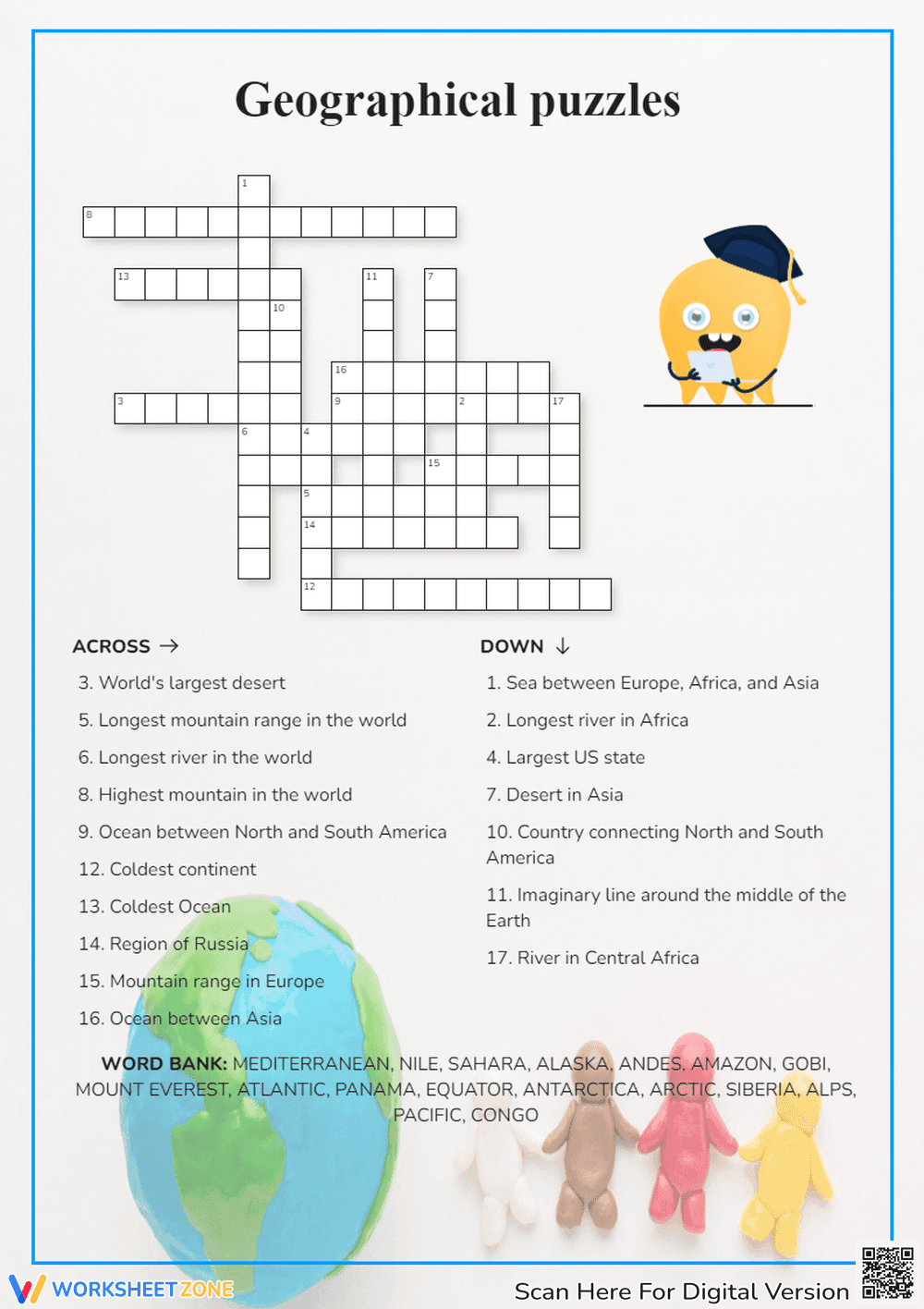

Geography Crossword Worksheet | Grade 3 Printable

Paste this activity's link or code into your existing LMS (Google Classroom, Canvas, Teams, Schoology, Moodle, etc.).
Students can open and work on the activity right away, with no student login required.
You'll still be able to track student progress and results from your teacher account.
This Grade 3 geography crossword worksheet helps students master domain-specific vocabulary by identifying major world landforms, bodies of water, and continents. By matching descriptive clues to specific geographical locations, learners reinforce their spatial awareness and foundational social studies knowledge in an engaging, puzzle-based format.
At a Glance
- Grade: 3 · Subject: Social Studies
- Standard:
CCSS.ELA-LITERACY.L.3.6— Acquire and use domain-specific words- Skill Focus: Geography vocabulary
- Format: 1 page · 17 problems · Answer key included · PDF
- Best For: Independent practice and review
- Time: 15–20 minutes
This single-page resource features a classic crossword puzzle layout with 17 distinct clues divided into "Across" and "Down" categories. Students identify significant global features, like the longest river in Africa. A comprehensive word bank is provided at the bottom, containing all necessary terms like Mediterranean, Sahara, and Equator. A complete answer key is included for quick grading.
Designed for immediate classroom implementation, this worksheet requires under two minutes of teacher preparation.
- Print (1 min): Download the PDF and print a class set.
- Distribute (1 min): Hand out during social studies blocks. The word bank lets students begin immediately.
- Review (3 mins): Use the answer key to check responses or project it for self-correction.
This self-explanatory format makes it an ideal addition to any substitute plan.
This activity aligns with CCSS.ELA-LITERACY.L.3.6: "Acquire and use accurately grade-appropriate conversational, general academic, and domain-specific words and phrases." It also supports foundational geography standards by requiring students to recall specific characteristics of global regions. Both standard codes can be copied directly into lesson plans, IEP goals, or district curriculum mapping tools.
Teachers can deploy this crossword as a formative assessment after a global geography unit. It serves perfectly as independent practice while the teacher works with small groups. Alternatively, use it as morning work to activate prior knowledge. Observe how students utilize the word bank—crossing out terms provides a quick visual indicator of their strategies. Expected completion time is 15 to 20 minutes.
This resource is primarily designed for second, third, and fourth-grade students building their foundational social studies vocabulary. The inclusion of a word bank provides built-in differentiation, making the task accessible for English Language Learners and students requiring additional scaffolding. It pairs excellently with a world map anchor chart or a direct instruction lesson on the seven continents and five oceans, allowing students to reference visual aids while solving the clues.
Integrating domain-specific vocabulary practice through structured puzzles significantly enhances retention and retrieval for elementary learners. This resource targets CCSS.ELA-LITERACY.L.3.6, requiring students to acquire and use domain-specific words accurately. According to a ScienceDirect TpT Analysis, incorporating gamified elements like crosswords into routine vocabulary instruction increases student engagement and time-on-task compared to traditional rote memorization worksheets. By contextualizing geographical terms within descriptive clues, learners actively process the defining characteristics of global landmarks rather than simply matching terms to definitions. This cognitive processing strengthens semantic networks, ensuring that foundational concepts like continents, oceans, and major mountain ranges are firmly established in long-term memory. The structured format, complete with a supportive word bank, ensures that cognitive load remains focused on content mastery rather than task navigation, making it a highly effective tool for diverse classrooms.


