


























Views
Downloads


Letter G Tracing Worksheet | Essential Phonics Practice
Paste this activity's link or code into your existing LMS (Google Classroom, Canvas, Teams, Schoology, Moodle, etc.).
Students can open and work on the activity right away, with no student login required.
You'll still be able to track student progress and results from your teacher account.
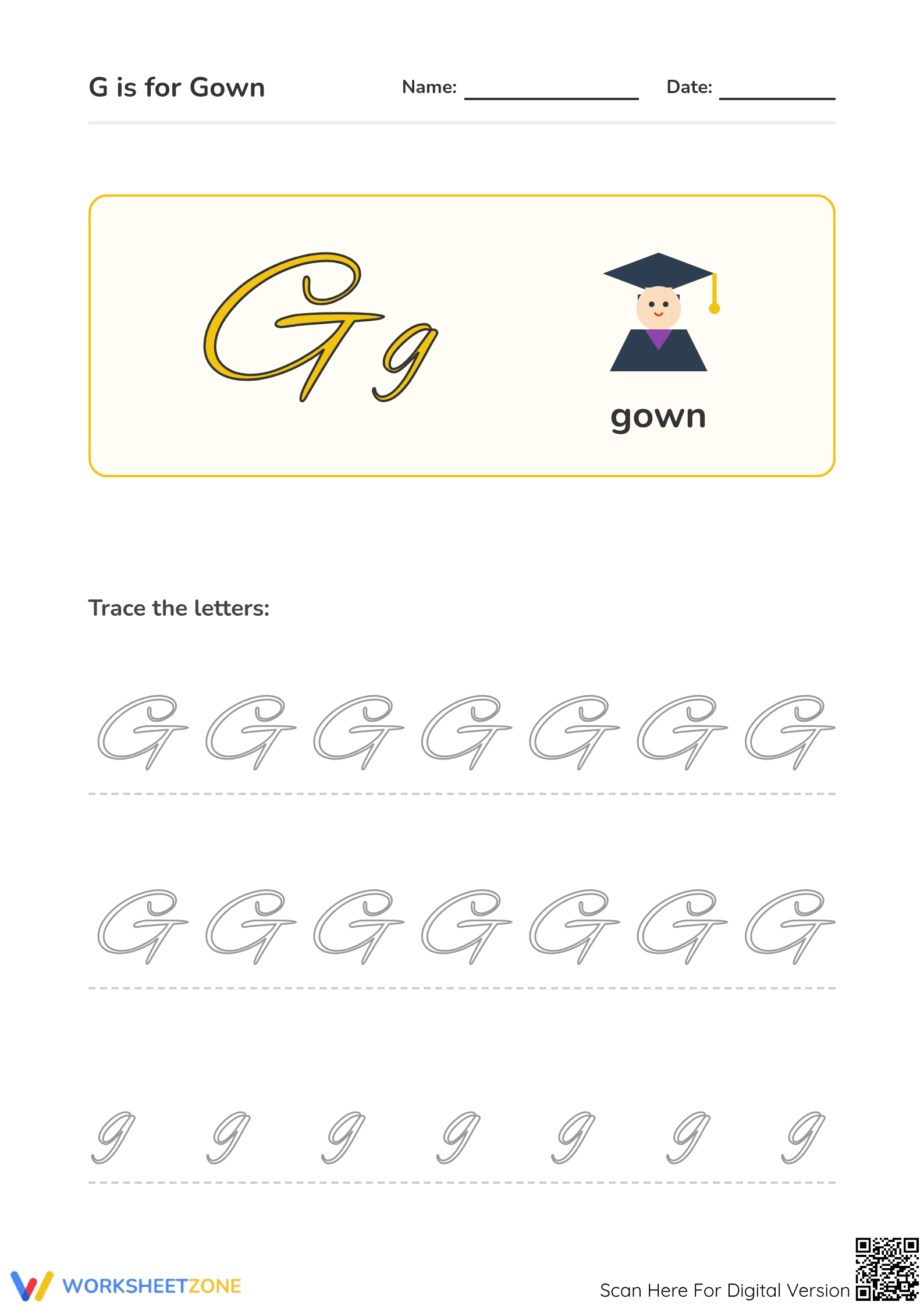
This Kindergarten Letter G worksheet provides structured handwriting practice to help students master the formation of uppercase and lowercase letters. By tracing the letter G in a stylized script, learners build the fine motor control necessary for fluent writing while reinforcing the connection between the letter and its beginning sound in the word gown.
At a Glance
- Grade: Kindergarten · Subject: ELA
- Standard:
CCSS.ELA-LITERACY.L.K.1.A— Print many upper- and lowercase letters correctly during handwriting practice- Skill Focus: Letter G formation
- Format: 2 pages · 28 problems · Answer key included · PDF
- Best For: Morning work or independent phonics centers
- Time: 10–15 minutes
This two-page PDF features a clear visual anchor with the word gown and a corresponding illustration of a graduate. The first page includes two rows of uppercase G tracing and one row of lowercase g. The second page provides additional lowercase practice. The large, clear tracing guides are designed for early learners developing pencil grip and stroke order.
Teachers can implement this resource in under 2 minutes. Simply print the two-page PDF (1 minute), distribute to students with pencils or crayons (30 seconds), and provide a quick verbal model of the letter stroke (30 seconds). This print-and-go design makes it an ideal choice for emergency sub plans or quiet-time activities that require zero teacher setup.
The primary standard addressed is `CCSS.ELA-LITERACY.L.K.1.A`, which requires students to print many upper- and lowercase letters. This worksheet specifically targets the letter G, providing repetitive practice to ensure muscle memory. Both standard codes can be copied directly into lesson plans, IEP goals, or district curriculum mapping tools.
Use this worksheet during the independent practice phase of a gradual release lesson on the letter G. It is best assigned after students have practiced the letter shape in the air or with sand trays. For a formative assessment, observe the directionality of the student's strokes to ensure they are following top-down formation patterns. Completion typically takes 12 minutes.
This resource is designed for Kindergarten students, though it serves as excellent remediation for Grade 1 learners struggling with letter recognition. It pairs naturally with an anchor chart featuring the G sound or a read-aloud book focusing on the alphabet. The simple layout ensures that students with diverse needs can focus entirely on the motor task.
According to the RAND AIRS 2024 report, repetitive tactile practice such as tracing is a foundational component of early literacy development, directly impacting a student's ability to transition from letter recognition to word composition. This worksheet aligns with evidence-based practices by isolating the letter G and providing 28 distinct opportunities for formation practice. By focusing on CCSS.ELA-LITERACY.L.K.1.A, the resource ensures that students meet the plain-English skill requirement of printing upper- and lowercase letters with accuracy. Research from Fisher & Frey (2014) emphasizes that such independent practice is most effective when preceded by direct modeling, making this worksheet a vital tool for the independent practice phase of phonics instruction. The inclusion of a visual anchor like gown further supports phonological awareness by linking the visual symbol to a concrete beginning sound.


